Get a Scoping Call
Resources

Resources

Technical deep-dives into solver architecture, validation methodology, and production simulation workflows. Written by the engineers building the platform.

Why Your Reservoir Predictions Are Wrong: Empirical vs Physics-First Simulation
blogMar 11, 2026

Why Your Reservoir Predictions Are Wrong: Empirical vs Physics-First Simulation

Viscosity errors, pressure drop failures, PVT predictions that miss by 50%. If your reservoir simulations are systematically wrong, the problem isn't your data. It's empirical correlations breaking down outside their calibration range. Here's what petroleum engineers are switching to.

newtsim engineering
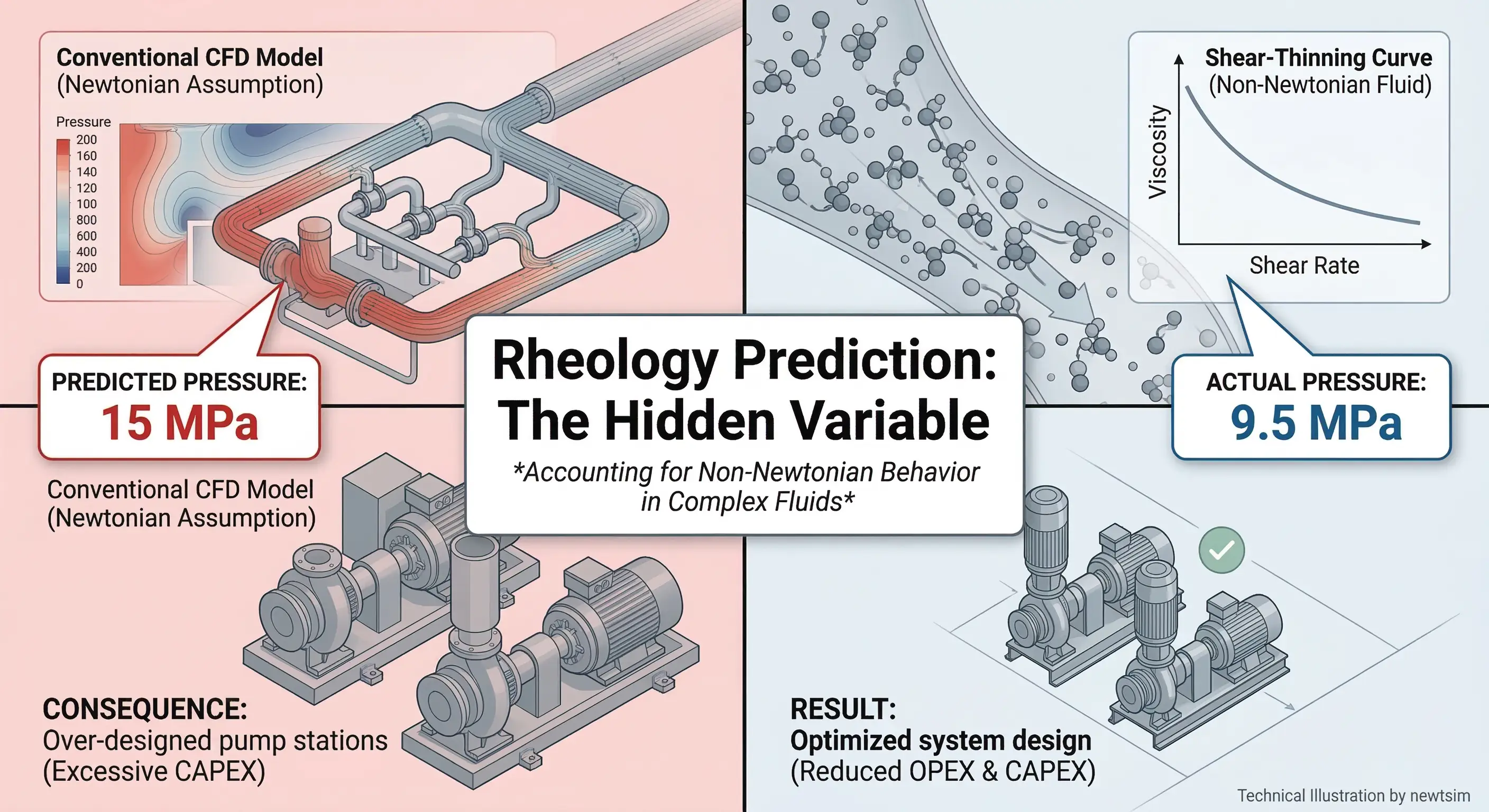
Rheology Prediction: The Hidden Variable That Makes or Breaks Process Simulations
blogMar 4, 2026

Rheology Prediction: The Hidden Variable That Makes or Breaks Process Simulations

Pipeline pressure drops, coating surface finishes, polymer extrusion rates: all fundamentally governed by rheology. Yet it's one of the most poorly characterized properties in process simulation.

newtsim engineering
Predictive Maintenance with Physics-Based Digital Twins
blogFeb 25, 2026

Predictive Maintenance with Physics-Based Digital Twins

Equipment failures cost industrial plants millions in downtime. Physics-based digital twins detect anomalies before alarms trigger, predicting failures days or weeks in advance with root cause attribution from first principles.

newtsim engineering
Why Your Drug Delivery Formulations Fail at Scale: Dissolution, Diffusion, and the Physics You're Ignoring
blogFeb 18, 2026

Why Your Drug Delivery Formulations Fail at Scale: Dissolution, Diffusion, and the Physics You're Ignoring

A pharmaceutical company spends 18 months optimizing an oral solid dosage form. Dissolution testing shows 85% release in 45 minutes. The formulation passes every in vitro specification, then fails bioequivalence in Phase 1.

newtsim engineering
Battery Electrolyte Design Is a Molecular Problem: Why Conductivity Predictions from Correlations Miss by 40%
blogFeb 11, 2026

Battery Electrolyte Design Is a Molecular Problem: Why Conductivity Predictions from Correlations Miss by 40%

Your electrochemistry team has a promising cathode material. The half-cell performance is excellent. Now you need an electrolyte that delivers high ionic conductivity, wide electrochemical stability window, and operates below -20°C.

newtsim engineering
Catalyst Screening Without a Lab: How Molecular Simulation Predicts Activity, Selectivity, and Deactivation
blogFeb 4, 2026

Catalyst Screening Without a Lab: How Molecular Simulation Predicts Activity, Selectivity, and Deactivation

A chemicals company needs a more selective catalyst for propylene oxide production. The current catalyst achieves 88% selectivity, but the 12% byproduct stream costs $15M/year in separation and waste treatment.

newtsim engineering
Chemical Reactor Mixing Problems: When CFD Alone Gets the Chemistry Wrong
blogJan 28, 2026

Chemical Reactor Mixing Problems: When CFD Alone Gets the Chemistry Wrong

Your CSTR was designed for 92% yield. After commissioning, it delivers 78%. The reaction kinetics are well-characterized: lab-scale calorimetry confirmed the rate constants, and the thermodynamics are solid. So why is the plant-scale reactor underperforming?

newtsim engineering
Multiphase Flow in Oil and Gas Separators: Why Empirical Sizing Correlations Leave 20% on the Table
blogJan 21, 2026

Multiphase Flow in Oil and Gas Separators: Why Empirical Sizing Correlations Leave 20% on the Table

A production facility in the Permian Basin processes 30,000 barrels per day through a three-phase separator. The separator was sized using API 12J guidelines with a 10-minute oil retention time and 5-minute gas retention time. Liquid carryover in the gas stream exceeds 0.1 gal/MMscf twice a week.

newtsim engineering
Heat Exchanger Fouling Prediction: Moving from Fixed Schedules to Physics-Based Condition Monitoring
blogJan 14, 2026

Heat Exchanger Fouling Prediction: Moving from Fixed Schedules to Physics-Based Condition Monitoring

A refinery operates 200+ shell-and-tube heat exchangers in its crude preheat train. Every exchanger fouls. It is thermodynamically inevitable when hot crude contacts metal surfaces. The question is how fast and when to clean.

newtsim engineering
Polymer Processing and Crystallization: Predicting Microstructure from Molecular Simulation Instead of Trial Runs
blogJan 7, 2026

Polymer Processing and Crystallization: Predicting Microstructure from Molecular Simulation Instead of Trial Runs

An injection molder receives a new lot of polypropylene from the resin supplier. Same grade number, same datasheet properties: MFI 12 g/10min, density 0.905 g/cm3, tensile strength 34 MPa. The operator runs the normal molding cycle, and the parts warp.

newtsim engineering
Supercritical Fluid Extraction: Why Solubility Predictions from Equations of State Miss by Orders of Magnitude
blogDec 31, 2025

Supercritical Fluid Extraction: Why Solubility Predictions from Equations of State Miss by Orders of Magnitude

A botanical extraction company is designing a supercritical CO2 process to extract cannabinoids from hemp biomass. The target: 90%+ extraction efficiency for CBD and CBG while minimizing co-extraction of chlorophyll and waxes. Peng-Robinson EOS predictions are off by 10-100x.

newtsim engineering
Nanoparticle Formulation Stability: Predicting Aggregation, Ostwald Ripening, and Shelf Life from Molecular Physics
blogDec 24, 2025

Nanoparticle Formulation Stability: Predicting Aggregation, Ostwald Ripening, and Shelf Life from Molecular Physics

A pharmaceutical company develops a nanoparticle suspension for injectable drug delivery. Particle size: 120 nm by DLS, polydispersity index 0.08, zeta potential -35 mV. By every standard stability metric, this formulation looks excellent. Six months later, it has aggregated into micron-scale clusters.

newtsim engineering
Membrane Separation Process Design: Why Permeability-Selectivity Tradeoffs from Solution-Diffusion Models Are Not Enough
blogDec 17, 2025

Membrane Separation Process Design: Why Permeability-Selectivity Tradeoffs from Solution-Diffusion Models Are Not Enough

A gas processing company needs to upgrade a natural gas stream from 8% CO2 to pipeline spec (< 2% CO2) at a remote wellhead where amine treating is not practical. Membrane separation is the obvious choice: lower capex, no chemicals, minimal operator attention.

newtsim engineering