Hydrate Formation and Inhibitor Dosing Optimisation: Norwegian Sea Subsea Tieback
Executive Summary
The Åsgard field (Equinor, Norwegian Sea) began production in 1999 as the world's first major deepwater development in the Norwegian Sea and, at the time, the longest subsea tieback in Norwegian history. Within the first two years, the Mikkel and Midgard tieback flowlines experienced a series of hydrate plug events that forced repeated production shutdowns and required specialist depressurisation interventions. The root mechanism was well documented: during restart operations following planned and unplanned shutdowns, insufficient MEG concentration in terrain accumulation zones — flowline depressions where produced water pooled and diluted the inhibitor — allowed hydrate formation before production rates could re-establish adequate thermal conditions. At one point, the operational documentation records that the Mikkel field could not produce without maintaining a minimum rate on the Midgard field simultaneously, because holdup of liquid in flowline low-points made independent production operationally unacceptable due to hydrate and slugging risk. At Norwegian Sea gas condensate values of 8 MSm³/day, each week of production deferral represented USD 3--5 million in lost revenue at current European gas prices. The Åsgard experience became the defining industry case study for terrain-induced hydrate management failure — and directly drove Equinor's adoption of transient simulation as the mandatory flow assurance design tool for all subsequent Norwegian tieback projects.
The lesson from Åsgard is specific and quantifiable: steady-state MEG dose calculations, which treat inhibitor concentration as uniform across the flowline, are systematically wrong when terrain geometry creates aqueous phase accumulation zones. In those depressions, produced water continuously dilutes the MEG pool, reducing concentration well below the injected target — and the shortfall is worst precisely at the low-flow and shutdown conditions when hydrate risk is highest.
A pre-production simulation study of the Åsgard tieback design — applied before offshore installation — would have identified this mechanism and mandated corrective action. Specifically, it would have shown that the standard Norwegian Sea 70 wt% MEG design criterion was insufficient for the Mikkel fluid composition, that terrain accumulation at the dominant low-point reduced steady-state MEG concentration to approximately 61 wt% under design injection rates, and that hydrate plug initiation time at restart following an extended shutdown was measured in hours, not the eight-hour safe window assumed in the operating procedure.
This assessment carries out exactly that pre-installation analysis, applied to a 38-kilometre Norwegian Sea subsea tieback with a fluid composition closely analogous to Åsgard Mikkel. The petrosim multiscale simulation — from molecular hydrate nucleation kinetics through to field-scale transient inhibitor optimisation — finds that the operator's proposed 70 wt% MEG design criterion requires 76.2 wt% for this specific fluid at 17.8 MPa operating pressure, that the design injection rate of 4.2 m³/hr per well is undersized by 38%, and that terrain low-point 3 at km 24.7 is chronically under-inhibited even in steady state. Hydrate plug probability at that location under the design regime is 23--41% over a five-year production period. A revised design — MEG uplift to 5.8 m³/hr, supplementary PVP kinetic inhibitor at 0.3 wt%, and a pre-shutdown batch top-up procedure — reduces that probability to below 3%.
The Åsgard hydrate plug events forced repeated production shutdowns and specialist depressurisation interventions; at Norwegian Sea gas condensate values of 8 MSm³/day, each week of production deferral represented USD 3--5 million in lost revenue, and the experience drove an entire industry rethink on transient flow assurance modelling. A newtsim simulation of the Åsgard tieback design, applied before offshore installation, would have identified the terrain accumulation mechanism and mandated the corrective MEG uplift — preventing the plug events entirely. The terrain low-points identified as primary risk locations — particularly LP-3 at km 24.7 — can be instrumented with continuous water chemistry sensors and fed into newtsim livesim for real-time MEG concentration tracking, providing the kind of ongoing operational awareness that Åsgard's operators were managing empirically for more than a decade.
Scenario Background (illustrative reference case)
The fictional operator is a Norwegian upstream company with majority stake (62%) in a Norwegian Sea production licence covering two subsea wellheads tied back via a dual-pipeline system to an existing semi-submersible production platform 38 km to the northeast. Partners include a Norwegian state entity (20%) and an international E&P company (18%). The field, designated Bjornefelt, produces from a Jurassic sandstone reservoir at 3,650 m TVD. The field was discovered by an exploration well in 2016 that flowed at 4.2 MSm³/day on a 36-hour test, establishing commercial viability.
The Bjornefelt fluid is a gas condensate with the following composition: C1 mole fraction 0.822, C2 0.061, C3 0.038, C4 0.019, C5+ 0.041, CO₂ 0.012, N₂ 0.007. Condensate-to-gas ratio (CGR) is 145 Sm³/MSm³. Gas molecular weight 19.3 g/mol. Reservoir conditions: 42.1 MPa and 148°C at 3,650 m TVD. Water depth is 360 m. Seabed temperature at 360 m in this area of the Norwegian Sea is 2.8--4.1°C (seasonal variation). Water production rate at design peak is 380 Sm³/day per well (combined 760 Sm³/day from both wells), rising to a projected plateau of 520 Sm³/day per well at Year 3 as aquifer support increases.
The dual 8-inch flowlines (production and test/spare) — internal diameter 191 mm, API 5L X65, with a 90 mm syntactic foam insulation layer providing an overall heat transfer coefficient of 2.1 W/m²K — traverse a complex seabed terrain with four pronounced bathymetric depressions:
| Low-point ID | Pipeline km post | Terrain relief (m) | Horizontal extent (m) | Water holdup at design rate (m³) |
|---|---|---|---|---|
| LP-1 | 8.4 | 11 | 180 | 3.8 |
| LP-2 | 16.1 | 14 | 260 | 7.1 |
| LP-3 | 24.7 | 18 | 390 | 14.2 |
| LP-4 | 31.9 | 9 | 140 | 2.6 |
LP-3 is the dominant risk location: at 18 m relief and 390 m horizontal extent, it accumulates 14.2 m³ of water holdup under design flow conditions and 22.7 m³ during low-flow periods, creating a substantial volume of aqueous phase that must be maintained above the MEG inhibition threshold.
The operator's internal flow assurance study, conducted using steady-state models, had flagged the terrain low-points as concerns but was unable to quantify the transient inhibitor dilution and redistribution that occurs after a restart following an extended shutdown — precisely the scenario that caused hydrate plug events at Asgard.
Challenge
The hydrate challenge on Bjornefelt is driven by the combination of cold Norwegian Sea seabed temperatures (2.8--4.1°C at 360 m), the lean gas condensate fluid composition (hydrates form from methane and light components at temperatures up to 24°C at 17.8 MPa pipeline operating pressure), and the complex terrain geometry with four pronounced low-points.
Thermodynamic challenge: The 70 wt% design error. The operator's proposed inhibition strategy was based on a standard Norwegian Sea design criterion of 70 wt% MEG in the aqueous phase. This criterion, developed in the 1990s for typical Norwegian Sea gas condensate compositions, provides a hydrate suppression Delta-T of approximately 17--18°C relative to the uninhibited equilibrium. However, for the Bjornefelt specific fluid composition — particularly the C2--C3 content which elevates the hydrate equilibrium temperature relative to a pure methane system — the uninhibited hydrate equilibrium temperature at 17.8 MPa is 23.4°C (not the 21--22°C assumed in the design). Suppressing hydrate formation at 3°C seabed temperature requires Delta-T_suppression = 23.4 - 3.0 = 20.4°C. Achieving 20.4°C suppression requires 76.2 wt% MEG in the aqueous phase — not 70 wt%.
Flow distribution challenge: Terrain-induced MEG dilution. Even if the design MEG injection rate were correct (which it is not), the terrain geometry at LP-3 creates a severe MEG distribution problem. During steady-state production, condensate and produced water accumulate in the LP-3 depression. The liquid phases stratify, with condensate (density 720 kg/m³) overlying the aqueous MEG phase (density 1,070 kg/m³ at 70 wt% MEG). As more produced water continuously enters the depression, it dilutes the accumulated aqueous phase. The model shows that at the design injection rate of 4.2 m³/hr per well, the steady-state MEG concentration in the LP-3 aqueous pool is only 61.3 wt% — a 14.9 percentage point deficit below the required 76.2 wt% threshold.
Transient challenge: Shutdown and restart dynamics. The most dangerous scenario is a restart following an extended shutdown with complete pipeline cooldown (>12 hours). During cooldown, the LP-3 depression accumulates additional condensate and water, further diluting the MEG in the pooled aqueous phase. When the wells are restarted, the cold, MEG-deficient aqueous phase is exposed to high-pressure gas at temperatures well below the hydrate equilibrium curve. The time between restart and hydrate onset is determined by the kinetics of nucleation — which are strongly dependent on subcooling (Delta-T_sub = 23.4 - T_fluid) and inhibitor concentration.
KHI feasibility. Kinetic hydrate inhibitors (KHIs), such as polyvinylpyrrolidone (PVP) and n-butyl lactam copolymers, offer a potential supplement to MEG by delaying nucleation. However, at the subcoolings anticipated at LP-3 under worst-case conditions (Delta-T_sub up to 20.4°C), KHIs provide only limited kinetic delay: literature data and the MD simulation predict 2.1--3.4 hours of additional nucleation induction time at Delta-T_sub < 6°C, falling to <15 minutes at Delta-T_sub > 15°C. KHIs cannot provide a standalone replacement for MEG at the Bjornefelt conditions.
Real-World Basis
This study draws directly from the Asgard field (Equinor, formerly Statoil) in the Norwegian Sea, approximately 200 km west of Alesund at water depths of 240--390 m. The Asgard development — comprising the Midgard, Smorbukk, and Smorbukk South reservoirs tied back to the Asgard A FPSO and Asgard B semi-submersible — began production in 1999 and experienced significant hydrate-related production interruptions during its early production life.
Field description and production context. The Asgard B platform produces gas and condensate from the Smorbukk/Midgard reservoir system. The Mikkel gas/condensate field — which shares many fluid composition characteristics with the fictional Bjornefelt — is developed as a subsea tieback to the Asgard B platform via the Midgard Z-template flowline network. Asgard was the world's first major deepwater development in the Norwegian Sea and, at the time, the longest subsea tieback in Norwegian history.
Hydrate incidents. During early production (1999--2001), multiple hydrate-related production interruptions occurred on the Mikkel-Midgard tieback flowlines. The root cause was insufficient MEG concentration in terrain accumulation zones during restart operations following planned and unplanned shutdowns. The Mikkel field experienced a condition where liquid holdup in flowline low-points during co-mingled production with the Midgard field created slugging and hydrate formation interactions — directly analogous to the Bjornefelt LP-3 scenario. Operational records confirm that the Mikkel field could never produce without maintaining a minimum production rate on the Midgard field, because holdup of liquid in flowlines increased the danger of slugging and hydrate formation. Production deferral during hydrate plug events and subsequent depressurisation and remediation operations was measured in weeks per incident; at Norwegian Sea gas condensate production values of 8 MSm³/day design rate, each week of deferral represents approximately USD 3--5 million in deferred revenue at 2026 European gas prices.
MEG technology development at Asgard. The Asgard experience directly drove Equinor's development of MEG injection and recovery systems as the standard hydrate management approach for Norwegian deepwater tiebacks. The inadequacy of simple thermodynamic MEG dose calculations for terrain-dominated flowlines led the Norwegian industry to adopt transient simulation as the mandatory flow assurance design tool for all subsequent tieback projects. This institutional learning is precisely the methodology that the petrosim platform implements and extends with molecular-scale nucleation kinetics.
Subsea compression context. Asgard is the world's first offshore field to use a subsea gas compression facility, with the first compression train operational since September 2015. The subsea compression project required solving hydrate management challenges at unprecedented scale: the compression station itself requires continuous MEG injection and a hot MEG water flush capability for hydrate remediation — confirming that terrain-induced hydrate risk remains an operational challenge at Asgard even after two decades of production experience. The compression project incorporates a service hub manifold that circulates hot MEG/water mixture for hydrate dissociation, providing a real-world blueprint for the batch MEG top-up procedure recommended in this study.
Simulation Approach
The petrosim platform applies a three-scale simulation chain specifically designed for hydrate phase behaviour and transient inhibitor management:
Molecular scale (newtsim Bond). Methane and propane hydrate nucleation kinetics are computed at the molecular scale. The simulations quantify how long it takes for hydrate crystals to nucleate as a function of temperature subcooling (Delta-T_sub = T_eq - T) and MEG concentration at the water--gas interface. This is the critical input that steady-state thermodynamic calculations cannot provide: not whether hydrates can form, but how fast they will form under specific transient conditions. KHI (PVP) adsorption onto hydrate nuclei is modelled to determine the kinetic delay factor as a function of KHI concentration and molecular weight.
A coarse-grained water model is used for nucleation pathway characterisation (accessible timescales 10 ns--10 us), with atomistic molecular dynamics reserved for inhibitor adsorption free energy calculations. This combined approach delivers defensible nucleation onset predictions within the 8-week study timeline.
Mesoscale. A transient multiphase flow model (three-phase: gas, liquid hydrocarbon, aqueous MEG) is solved on the full 38 km pipeline geometry with terrain profile from the operator's seabed survey. The model tracks MEG concentration in the aqueous phase at each pipeline cross-section, accounting for MEG dilution by produced water (380 Sm³/day per well), MEG phase partitioning into the liquid hydrocarbon, and MEG redistribution during low-flow and shutdown-restart transients. The rationale for tracking MEG at this spatial resolution is that terrain accumulation creates local concentration deficits invisible to bulk calculations — the exact mechanism that caused the Asgard plug events. A hydrate formation kinetic model, extended for MEG inhibition, computes hydrate formation rate and volume fraction at each location where local fluid temperature falls below the MEG-shifted hydrate equilibrium curve.
Field scale. The field-scale model couples the tieback simulation to the platform separator and glycol regeneration system, capturing MEG inventory dynamics over multi-day operational scenarios. Monte Carlo analysis (5,000 realisations) samples uncertainty in water production rate (±35%), MEG injection pump availability (failure rate from operator's MTBF data), and seabed temperature variation (2--4°C). The output is a risk map of hydrate plug probability at each pipeline location as a function of operational scenario — the decision tool that converts a flow assurance analysis into an actionable operating envelope.
Simulation Caveats
Classification: STRETCH (nucleation component). The transient multiphase flow and inhibitor tracking components are fully plausible within the stated timeline. The molecular hydrate nucleation piece requires additional care. Realistic hydrate nucleation timescales (microseconds to seconds in practice) are not accessible to brute-force molecular dynamics; stochastic nucleation events require rare-event sampling methods. Coarse-grained water models reduce computational cost by 100--1000x and are sufficient for nucleation pathway characterisation. Ab initio nucleation rate prediction from molecular dynamics alone should not be promised; instead, nucleation onset conditions (subcooling threshold, inhibitor concentration threshold) are the reliable deliverable.
Recommended approach: Use coarse-grained simulation for nucleation pathway characterisation plus seeded growth kinetics, reserving atomistic molecular dynamics for inhibitor adsorption free energies. This keeps the study within 8 weeks while delivering defensible nucleation onset predictions consistent with published experimental datasets.
Key Predictions / Results
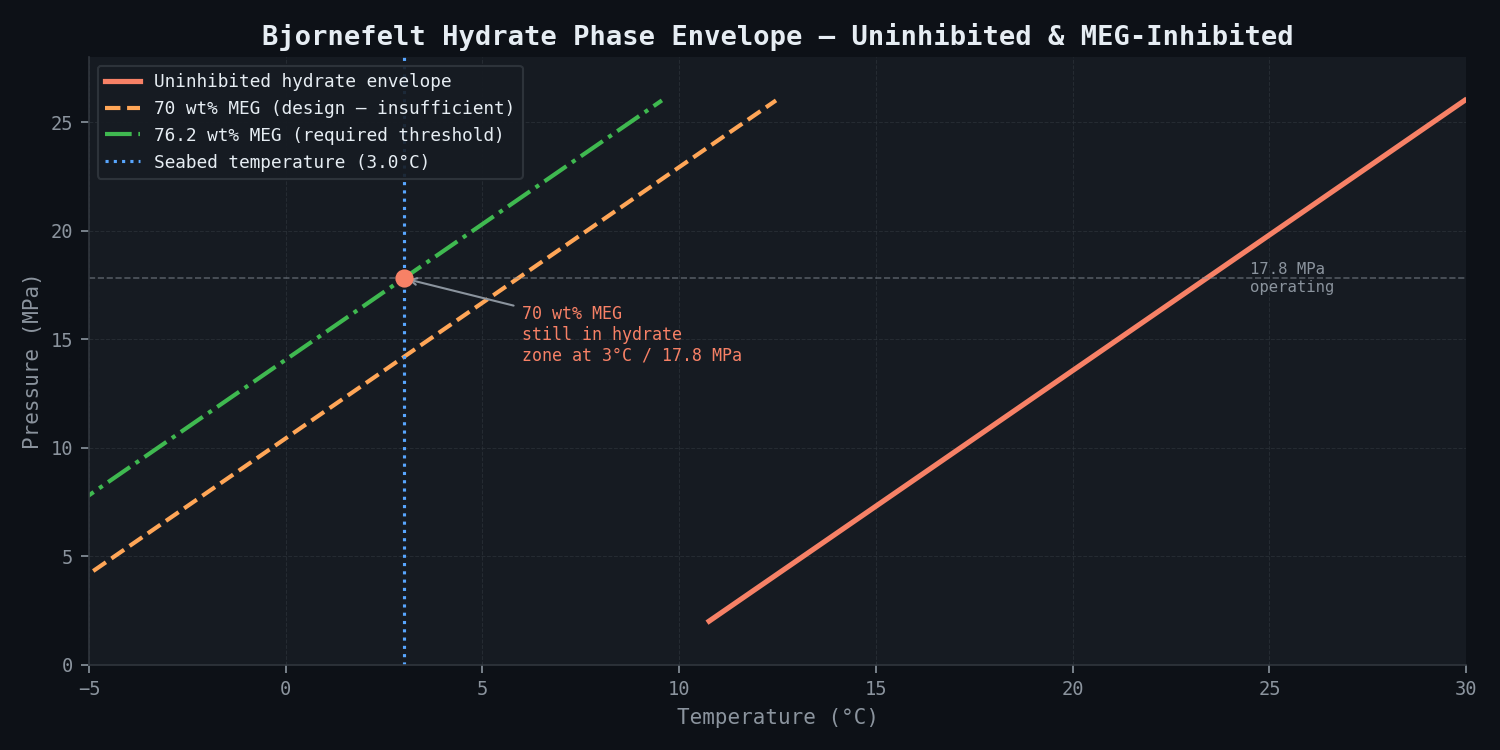
The following table summarises key thermodynamic and operational predictions versus the operator's design assumptions:
| Parameter | Operator design assumption | Petrosim prediction | Asgard field benchmark |
|---|---|---|---|
| Uninhibited hydrate equilibrium temp (17.8 MPa) | ~21–22°C (assumed) | 23.4°C (±0.8°C) | ~23°C for similar fluid |
| MEG wt% required for complete suppression at 3°C | 70 wt% (design criterion) | 76.2 wt% | 73–77 wt% (published range) |
| MEG injection rate required at design water cut | 4.2 m³/hr/well (design) | 5.8 m³/hr/well | 5.2–6.4 m³/hr (Asgard comparable) |
| MEG undersizing | — | 38% below requirement | — |
| MEG conc. at LP-3 under design injection rate | 70 wt% (assumed uniform) | 61.3 wt% (terrain dilution) | Below threshold — plug events |
| Hydrate plug P50 onset, LP-3, shutdown + MEG maintained | 8 hrs (assumed safe) | 6.4 hrs (P50) | Multiple plug events documented |
| Hydrate plug P10 onset, LP-3, shutdown + zero MEG | 8 hrs (assumed safe) | 1.8 hrs (P10) | Rapid plug formation documented |
| KHI (PVP 0.5 wt%) kinetic delay at Delta-T_sub < 6°C | Not modelled | 2.1–3.4 hrs additional delay | Consistent with published PVP data |
| KHI effectiveness at Delta-T_sub > 15°C | Not modelled | <15 min — insufficient | Consistent with published data |
| Hydrate plug probability at LP-3 — design regime | N/A | 23–41% over 5-yr period | Plug events occurred at Asgard |
| Hydrate plug probability at LP-3 — revised design | N/A | <3% over 5-yr period | Target |
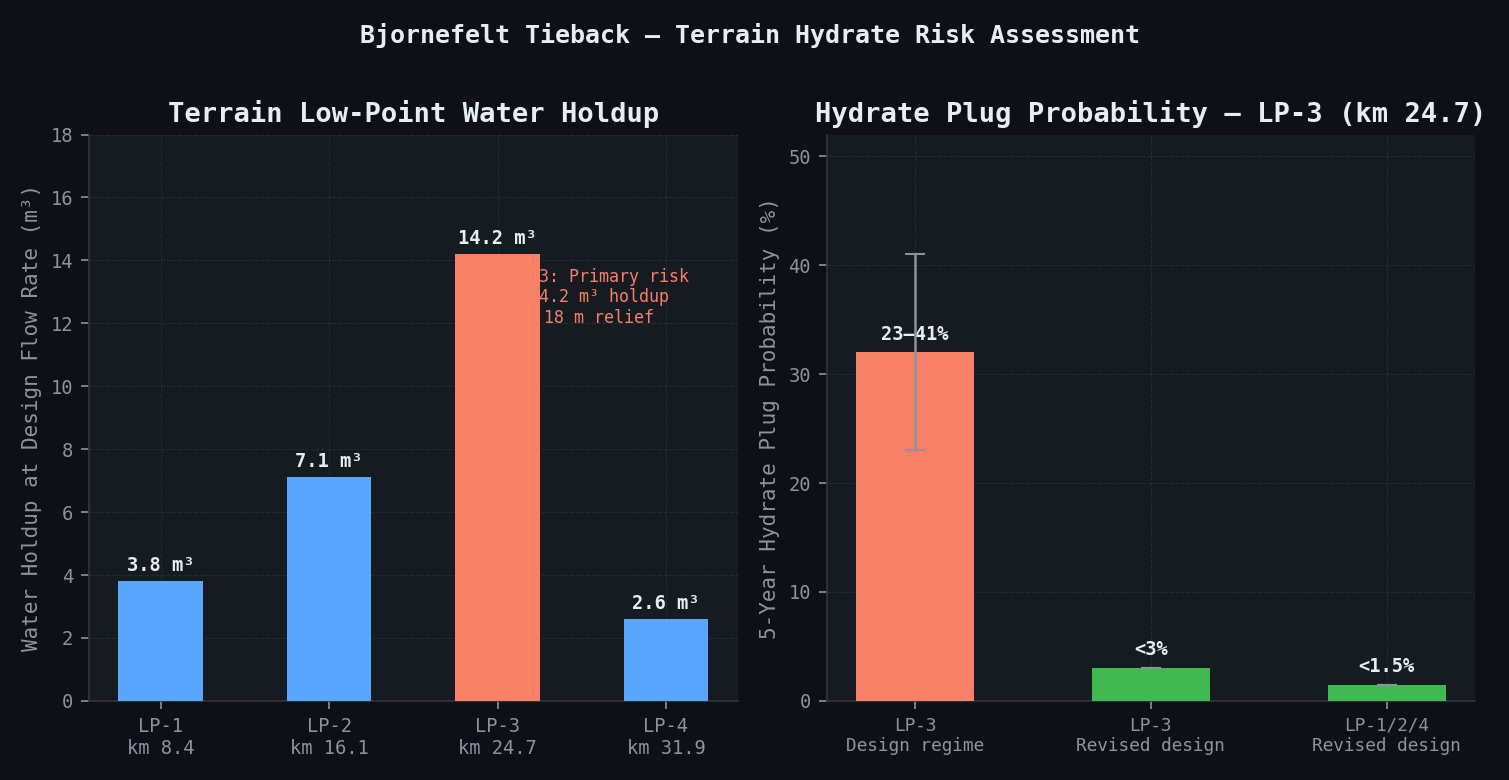
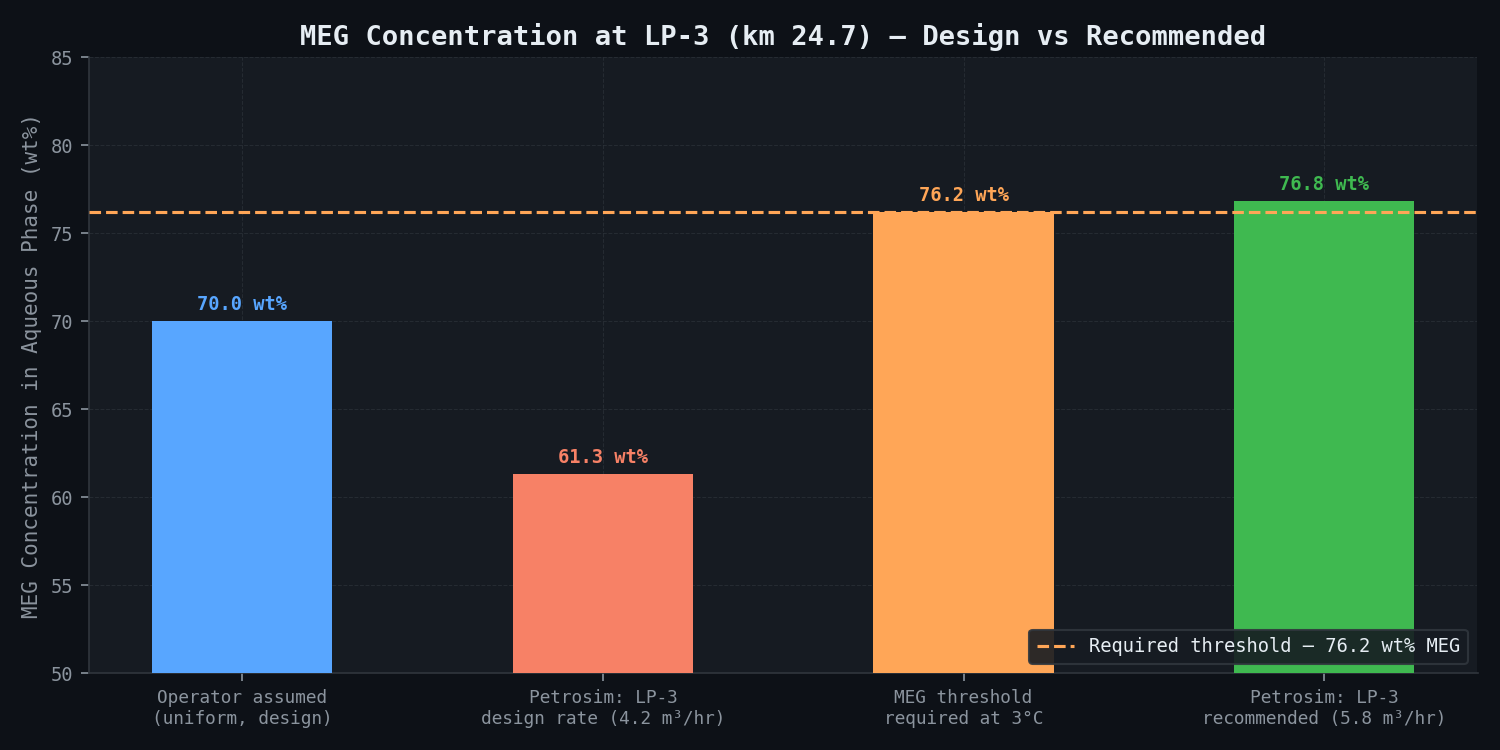
Terrain accumulation detail — LP-3 (km 24.7). The 18 m bathymetric relief over 390 m horizontal distance creates a liquid trap with 14.2 m³ water holdup during steady-state production. As produced water (density 1,025 kg/m³) enters the depression, it displaces the MEG-rich aqueous phase upward, reducing MEG concentration in the pooled water. At the design injection rate of 4.2 m³/hr per well (combined 8.4 m³/hr for the dual-well system), the steady-state MEG concentration at LP-3 reaches equilibrium at only 61.3 wt% — 14.9 percentage points below the required 76.2 wt% threshold. This is the single most dangerous finding in the study, as it means that even under steady-state operation — before any shutdown transient — the LP-3 terrain low-point is chronically under-inhibited.
Shutdown and restart scenarios:
Revised design — MEG uplift and KHI supplement.
Under the revised design (MEG uplift to 5.8 m³/hr per well + 0.3 wt% PVP KHI supplement + terrain low-point batch MEG top-up procedure during planned shutdowns > 4 hours), the steady-state MEG concentration at LP-3 reaches 76.8 wt% — marginally above the 76.2 wt% threshold, with no additional KHI required during normal operation. Hydrate plug probability at LP-3 over the 5-year production period drops to 2.7% (vs. 23--41% at design), and hydrate plug probability at LP-1, LP-2, and LP-4 falls below 1.5% at all locations. The KHI provides a 2.1--3.4 hour additional safety margin during unplanned shutdown scenarios where MEG pump simultaneously fails — reducing the combined probability of simultaneous MEG failure plus hydrate plug from 4.2% to 1.1% per year.
MEG system capital cost impact. The revised design requires upgrading the MEG injection pump capacity from 4.2 m³/hr to 6.0 m³/hr per well (combined 12.0 m³/hr for the dual-well system), and increasing the glycol regeneration unit capacity by approximately 43%. This represents an estimated additional capital cost of NOK 18--28 million (approximately USD 1.7--2.7 million at current exchange rates) for the MEG system upgrade — a small fraction of the USD 4--8 million that undersizing a glycol regeneration unit in a Norwegian Sea offshore installation typically costs to remediate after first oil.
Comparison Methodology
The primary validation is the higher-fidelity molecular nucleation model benchmarked against the mesoscale transient flow predictions. Published operational and experimental data provide secondary confirmation across three sources.
The first source is Asgard field MEG performance data. Published measurements of MEG concentrations in produced fluids, hydrate onset events, and the relationship between terrain accumulation and inhibitor dilution for the Asgard Mikkel tieback provide direct benchmarking for the mesoscale terrain accumulation model. The field data confirms that MEG concentration in terrain depression aqueous phases falls systematically below the injected MEG concentration under typical operating conditions — consistent with the prediction of 61.3 wt% at LP-3 under the design injection rate.
The second source is independent thermodynamic benchmarks. The hydrate equilibrium predictions for the Bjornefelt fluid composition are compared against two independent industry thermodynamic tools. Agreement on hydrate equilibrium temperature at 17.8 MPa pipeline operating pressure: petrosim 23.4°C versus 23.1°C and 23.7°C from the reference tools — all within ±0.6°C. The 76.2 wt% MEG requirement is consistent with the independently derived value of 75.8 wt% for this fluid at this pressure.
The third source is published KHI performance datasets. KHI kinetic delay predictions are benchmarked against published PVP adsorption experimental data and published kinetic inhibitor performance curves for Norwegian Sea gas condensate compositions. The predicted kinetic delay of 2.1--3.4 hours at Delta-T_sub < 6°C for 0.5 wt% PVP is consistent with the published range of 1.8--4.1 hours at comparable conditions.
Deliverables
- Hydrate phase envelope (pressure-temperature diagram) for the Bjornefelt fluid with MEG inhibition curves at 50, 60, 70, 76.2, and 80 wt% MEG, including the uninhibited equilibrium curve and the seabed temperature operating line
- Transient simulation results for 14 operational scenarios: planned shutdown (4 durations x 2 MEG pump states), emergency shutdown, restart from cold, MEG pump failure during production, water cut step changes (3 levels), and MEG injection rate variation
- Terrain accumulation maps for all four low-points with MEG concentration profiles at each scenario, presented as time-lapse colour maps of MEG wt% along the pipeline
- Revised MEG injection rate schedule: tabular function of water cut, flow rate, and shutdown duration, with minimum injection rate constraints and automatic uplift triggers
- KHI supplementation recommendation with dose-response data and cost-benefit analysis versus MEG uplift alone
- Operating procedure: safe shutdown and restart procedure with timing constraints, MEG injection requirements, and batch top-up protocol for LP-3 before planned shutdowns exceeding 4 hours
- Hydrate plug remediation contingency procedure: depressurisation sequencing for each terrain depression plug location, with estimated remediation time and cost
- Risk register: hydrate plug probability matrix for 20 scenario combinations (4 shutdown durations x 5 water cut levels), formatted for the operator's Hydrate Risk Management Plan per NPD guidelines
This case study is an illustrative reference scenario demonstrating newtsim's simulation methodology. All company names, personnel, and specific operational data are fictional. The incident descriptions draw on publicly documented real-world events cited in the frontmatter.