Spent Fuel Transport Container Shielding Optimisation: MCNP-Equivalent Monte Carlo Dose Mapping for Type B Package Recertification
Executive Summary
Type B spent fuel transport flasks are certified at design time against a defined source term: a specific burnup, a specific cooling time, and a specific fuel type. In practice, flasks operate for decades, fuel burnup increases as reactor operators push fuel harder to reduce costs, and cooling times shorten as reprocessing schedules tighten. The shielding calculation that certified a flask in 2002 used a discrete ordinates deterministic code against an 18-24 GWd/tU design basis at five-year minimum cooling. Twenty-two years later, the same flasks are carrying AGR spent fuel at 27-31 GWd/tU -- significantly above the design basis -- with cooling times of 3.8-4.2 years rather than five. The lead shielding has been creeping under radial compressive stress for two decades, opening voids at trunnion interfaces that create gamma streaming channels the original calculation did not account for. And the DORT code used for certification systematically underestimates dose rates at geometric streaming paths because of the ray effect, a known limitation of discrete ordinates methods at penetrations with low diameter-to-length ratios. None of these factors individually would necessarily have pushed the flask over the IAEA SSR-6 limit of 2 mSv/hr at 2 m. All three together produce a 58% exceedance: 2.34 and 2.67 mSv/hr on two flagged flasks, an immediate notification obligation under UK transport regulations, and an ONR Compliance Query requiring technical response within 90 days. The precedent for this problem is established. German CASTOR-V/19 type flasks showed comparable dose rate exceedance findings between 2006 and 2010, triggering a systematic re-evaluation across the European nuclear transport sector and establishing the regulatory requirement -- now mirrored by ONR Transport Division -- that recertification of any Type B package more than 20 years old must use Monte Carlo methods rather than legacy deterministic codes.
A shielding audit simulation of this type, applied proactively at a defined service life milestone rather than reactively after a measured exceedance, would have identified the combined effect of source term evolution and lead creep degradation before the flasks entered non-compliance. It would have specified the recertification modifications -- 5 mm additional lead at trunnion interfaces, 10 mm borated polyethylene overlay -- at the point where they are cheapest to implement, and it would have revised the operational limits (minimum 4.5-year cooling, maximum 30 GWd/tU burnup) before a single transport was made outside the valid safety envelope.
The three quantified causes of the dose rate discrepancy -- fuel inventory evolution, lead void formation, and methodology error -- define exactly the parameters that newtsim livesim monitors in real time: gamma dose rate at the flask surface mapped against the predicted shielding performance, with automated alerting when the measured profile deviates from the certified envelope in ways consistent with lead void formation or source term uplift. This replaces the current model of periodic manual surveys, which detected the exceedance only after 22 years of service, with continuous automated shielding assurance at the timescale of individual transport cycles.
Scenario Background
The scenario involves a transport operator holding current NuTrans Transport Approval for a Type B(U) package designated AGT-400, with design certification established in 2002.
AGT-400 flask design parameters:
| Parameter | Specification |
|---|---|
| Flask classification | Type B(U) per IAEA SSR-6 (formerly TS-R-1) |
| Body material | Forged carbon steel, 200 mm wall thickness |
| Gamma shielding | Lead annulus, 120 mm (nominal) |
| Neutron moderator | High-density polyethylene (HDPE) layer, 80 mm |
| Inner cavity liner | Austenitic stainless steel (304L), 8 mm |
| Cavity capacity | 7 PWR-equivalent assembly positions (or 3 AGR cluster positions for UK service) |
| Lifting trunnions | 4x forged steel trunnions, 150 mm diameter bore through lead annulus |
| Drain port | 1x 50 mm diameter port through lead annulus |
| Vent port | 1x 25 mm diameter port |
| Thermocouple penetrations | 2x 10 mm diameter |
| Design basis fuel type | PWR, 17x17 lattice; or AGR, 14x14 pin lattice |
| Design basis burnup | 18-24 GWd/tU |
| Design basis cooling time | Minimum 5 years |
| Certified dose rate at 2 m | 1.48 mSv/hr (design basis loading) |
The flasks have been in service for 22 years, with 847 loaded transports completed cumulatively across the fleet. In practice, the flasks have carried AGR spent fuel exclusively, at burnups of 27-31 GWd/tU -- significantly above the 18-24 GWd/tU design basis -- and at cooling times of 3.8-4.2 years rather than the 5-year minimum. The lead shielding was last inspected in 2010, twelve years before the audit trigger. The measured dose rates at 2 m (2.34 and 2.67 mSv/hr on the two flagged flasks) exceed the certified 1.48 mSv/hr by 58-80%.
The measured dose rate exceedance of 2 mSv/hr at 2 m triggers an immediate notification obligation under UK Carriage of Dangerous Goods and Use of Transportable Pressure Equipment Regulations (CDG/TPED) and the Radioactive Substances (Carriage by Road) Regulations. ONR Transport Division issued a Compliance Query requiring technical response within 90 days.
The Challenge
The audit must quantitatively explain a 58% discrepancy between the certified dose rate (1.48 mSv/hr) and measured values (2.34-2.67 mSv/hr), decompose the discrepancy by physical cause, and establish a defensible revised shielding basis for recertification. Three causes are identified as plausible.
The first cause is fuel inventory evolution from higher burnup and shorter cooling time. AGR fuel at 29-31 GWd/tU burnup versus the 18-24 GWd/tU design basis has a fundamentally different gamma and neutron source term. Cs-134, with its 2.07-year half-life, has activity scaling approximately as burnup squared (two neutron captures are required), so at 30 versus 21 GWd/tU its activity increases by approximately (30/21)² = 2.0x at the same cooling time. Eu-154 (t1/2 = 8.6 yr) is a significant hard-gamma emitter at approximately 1.2 MeV produced by Eu-153 activation, and its higher penetration after limited shielding makes it important at the flask surface. Cm-244 (t1/2 = 18.1 yr) is the dominant spontaneous fission neutron source, with yield scaling approximately as burnup cubed; at 30 GWd/tU with 3.9-year cooling versus 21 GWd/tU with 5-year cooling, the Cm-244 neutron source increases by approximately 3.5-4.2x. The shorter cooling time (3.9 versus 5.0 years) further elevates short-lived fission products, with Cs-134 activity at 3.9-year cooling approximately 2.2x higher than at 5.0-year cooling.
The second cause is lead shielding degradation. Lead in the AGT-400 shielding annulus is subject to creep under sustained compressive stress from the steel shell constraint. At flask operating temperatures (40-68°C under full load, 20-35°C unloaded), lead creep follows the Norton Power law. Published creep data indicates 0.1-0.4% annual creep strain at 50-70°C under the radial stress of approximately 2.8 MPa from the annular steel shell constraint. Over 22 years of loaded service, cumulative creep strain at geometric discontinuities (trunnion bores, drain port flange, machined faces) could accumulate to 3-8% local dimensional change, sufficient to open voids of 3-15 mm at material interfaces. Gamma streaming through such voids -- even small ones -- can produce localised dose rate hotspots orders of magnitude above the bulk-attenuated level.
The third cause is the original DORT calculation methodology error. The 2002 certification used DORT, a discrete ordinates (Sn) transport code that solves the Boltzmann transport equation on a structured angular mesh. Discrete ordinates methods are well-suited to thick, symmetric shielding problems but systematically underestimate dose rates at geometric streaming paths (keyways, penetrations, trunnion bores) due to the ray effect -- artificial angular discretisation artefacts that smear the streaming signal across multiple angular bins. Modern variance-reduction Monte Carlo (CADIS method in MAVRIC/newtsim Root or newtsim Root with weight windows) handles geometric streaming without the ray effect and is required by ONR Transport Division for recertification of packages more than 20 years old. Typical DORT underestimation of streaming-path dose rates ranges from 10-25% for penetrations with diameter-to-length ratios of 0.05-0.1.
All three causes are expected to contribute additively. The audit quantifies each contribution independently.
Real-World Basis and Reference Data
This study reflects a well-established and documented challenge in spent fuel transport regulation. Type B flask shielding performance re-evaluation on aged flasks is a routine but technically demanding component of the nuclear transport regulatory lifecycle.
The regulatory framework rests on IAEA SSR-6, which establishes the 2 mSv/hr at 2 m limit for Type B packages in exclusive use transport. Supporting guidance on shielding calculation methodology comes from IAEA SSG-26. The UK domestic implementation is through the CDG/TPED Regulations, with ONR Transport Division providing the Technical Assessment Guide for NuTrans Approval applications and recertification. The US regulatory basis under NRC 10 CFR Part 71 is relevant for comparative purposes.
The shielding benchmark basis draws on NRC work establishing the systematic underestimation of streaming-path dose by deterministic codes, and providing benchmark data for Monte Carlo calculations on Type B cask geometries -- the primary validation dataset for this audit. The OECD/NEA SINBAD database provides iron/lead multilayer deep-penetration benchmark cases.
The fuel source term is calculated from a full decay chain for 29.5 GWd/tU AGR fuel, with Cm-244 spontaneous fission neutron source rate validated against burnup-dependent yield data and the isotopic composition validated against Sellafield AGR fuel destructive examination data at comparable burnup.
Lead creep constitutive data at 50-70°C provides the Norton Power law parameters (A = 2.1x10⁻⁸, n = 4.7, Q = 42 kJ/mol), cross-validated against independent historical creep datasets. Standard lead material properties (thermal conductivity, elastic modulus, Poisson ratio) are taken from reference handbooks.
The European nuclear transport sector undertook systematic re-evaluation of aged Type B flask designs following a series of dose rate exceedance findings on German CASTOR-V/19 type flasks from 2006 to 2010. This programme established the precedent for requiring Monte Carlo-quality calculations rather than legacy deterministic codes for recertification of flasks exceeding 15 years of service. The UK NuTrans recertification programme (2015-ongoing) follows the same principle, with ONR Transport Division requiring Monte Carlo calculations for all Type B packages older than 20 years.
Simulation Methodology
The audit simulation pipeline integrates revised fuel source term calculation, variance-reduction Monte Carlo shielding analysis, lead integrity FEM creep assessment, and dose decomposition methodology.
Fuel source term calculation (newtsim Root)
The full decay chain depletion and decay calculation for AGR fuel used UO2 in a 14x14 stainless-steel clad pin lattice with Magnox wrapper at 3.1% 235U enrichment at beginning of life. The actual burnup of 29.5 GWd/tU (from the most recent loading of AGT-400-047) was compared against the 21 GWd/tU design basis, and the actual cooling time of 3.9 years was compared against the 5.0-year design basis. The AGR thermal spectrum (graphite-moderated, CO2-cooled) differs from standard PWR/BWR libraries, so a spectrum correction was applied via a 2D lattice transport calculation.
Key source term isotopic differences between actual and design basis loading:
| Isotope | t(1/2) | Design Basis Activity (Bq/tU) | Actual Activity (Bq/tU) | Ratio | Dose Contribution |
|---|---|---|---|---|---|
| Cs-137 | 30.2 yr | 1.08 x 10¹⁵ | 1.42 x 10¹⁵ | 1.31x | Major gamma |
| Cs-134 | 2.07 yr | 4.2 x 10¹³ | 1.8 x 10¹⁴ | 4.3x | Significant hard gamma (0.796, 0.605 MeV) |
| Ba-137m | Secular eq. | Same as Cs-137 above | 1.42 x 10¹⁵ | 1.31x | Major gamma (0.662 MeV) |
| Eu-154 | 8.6 yr | 3.8 x 10¹³ | 8.1 x 10¹³ | 2.1x | Hard gamma (1.274 MeV) -- high penetrating |
| Sb-125 | 2.76 yr | 2.1 x 10¹³ | 2.9 x 10¹³ | 1.38x | Medium gamma |
| Cm-244 | 18.1 yr | 3.2 x 10¹¹ | 1.4 x 10¹² | 4.4x | Spontaneous fission neutrons |
| Pu-238 | 87.7 yr | 4.1 x 10¹² | 7.8 x 10¹² | 1.9x | Alpha + neutron (via (alpha,n)) |
| Total gamma source | — | 3.2 x 10¹⁵ Bq/tU | 4.8 x 10¹⁵ Bq/tU | 1.50x | — |
| Spontaneous fission n rate | — | 1.8 x 10⁸ n/s/tU | 7.9 x 10⁸ n/s/tU | 4.4x | Cm-244 dominated |
The Eu-154 increase (2.1x) is particularly significant because Eu-154 emits high-energy photons at 1.274 MeV and 1.596 MeV that penetrate the flask shielding more effectively than the Cs-137 662 keV line. The Cs-134 increase (4.3x) reflects the quadratic burnup dependence.
Monte Carlo shielding analysis
The shielding calculation used newtsim Root in fixed-source mode with variance reduction to achieve the statistical precision required at deep-penetration streaming positions. The full 3D flask geometry includes all penetrations: 4 lifting trunnions, 1 drain port, 1 vent port, 2 thermocouple ports, and the lid seal groove. Lead shielding was modelled in four configurations spanning the plausible degradation range: Configuration A at nominal design density 11.35 g/cm³ with no degradation, Configuration B with 3% void fraction at the trunnion root and drain port flange (mild degradation), Configuration C with 6% void fraction (moderate degradation representing the best-estimate for 22-year creep), and Configuration D with 10% void fraction (conservative degradation).
The statistical uncertainty target was less than 5% (1-sigma) at all 2 m boundary positions and less than 10% at streaming-path positions. Variance reduction via adjoint-guided importance sampling achieves computational gain factors of 250-1,800x relative to unbiased Monte Carlo at the deep-penetration trunnion positions.
Lead creep FEM analysis
The Norton Power law creep model for pure lead (99.994% purity, as specified in the AGT-400 design) uses published constitutive parameters for the 50-70°C range. The operating stress is a radial compressive stress of approximately 2.8 MPa from the steel annular constraint. The temperature history cycles between 55°C steady-state loaded and 25°C unloaded, based on actual transport frequency records (mean 38 transports/year x 22 years). The 2D axisymmetric FEM model of the lead annulus includes explicit trunnion bore geometry with mesh refinement at the trunnion root radius where voids are predicted to initiate. The model produces a 22-year cumulative creep map with a void initiation criterion at locations where tensile stress develops in lead due to geometric constraint relaxation.
Simulation Caveats
-
Lead inspection data gap: Lead integrity has not been independently verified since the 2010 inspection (12 years before the audit trigger). The FEM creep prediction must therefore substitute for direct measurement of void formation. Physical phased-array ultrasonic inspection of the lead annulus is strongly recommended before recertification is granted, and the audit recommends this as a condition of recertification.
-
AGR fuel-specific spectral effects: The decay calculation cross-section library is primarily validated against PWR and BWR fuel. AGR fuel has a distinct thermal spectrum (graphite moderated, higher C/U ratio) and stainless-steel cladding rather than Zircaloy. A spectral correction was applied, but residual uncertainty in AGR-specific isotopic composition (particularly Eu-154 and actinide isotopes) is estimated at +/-15%. This is included in the total dose rate uncertainty budget.
-
Void geometry at trunnion root: The FEM creep model predicts void formation but cannot determine the exact void geometry (continuous annular gap vs. discrete voids at stress concentration points). The Monte Carlo shielding analysis models a continuous annular void at the trunnion root -- a conservative assumption that overestimates streaming if the actual voids are discrete.
-
CADIS adjoint calculation dependency: The CADIS variance reduction depends on an accurate adjoint flux calculation, which in turn depends on the accuracy of the forward geometry model. Geometry discretisation errors in the streaming path region (trunnion bore, lead-steel interface) could bias the adjoint weights and introduce systematic error in the forward calculation. This is mitigated by using fine mesh at all geometric discontinuities and by cross-checking dose rates at intermediate positions against an uncollided flux calculation.
-
AGR fuel cluster geometry: The AGR fuel cluster (14x14 pin lattice, hexagonal arrangement in Magnox wrapper) occupies a different spatial envelope than the PWR fuel the flask was originally designed for. The original shielding calculation assumed a PWR-equivalent point source geometry. The AGR cluster geometry is explicitly modelled in the audit, and the distributed source effect was found to reduce peak dose rates by approximately 4% relative to the point-source approximation -- partially offsetting the increased source term.
Key Predictions and Results
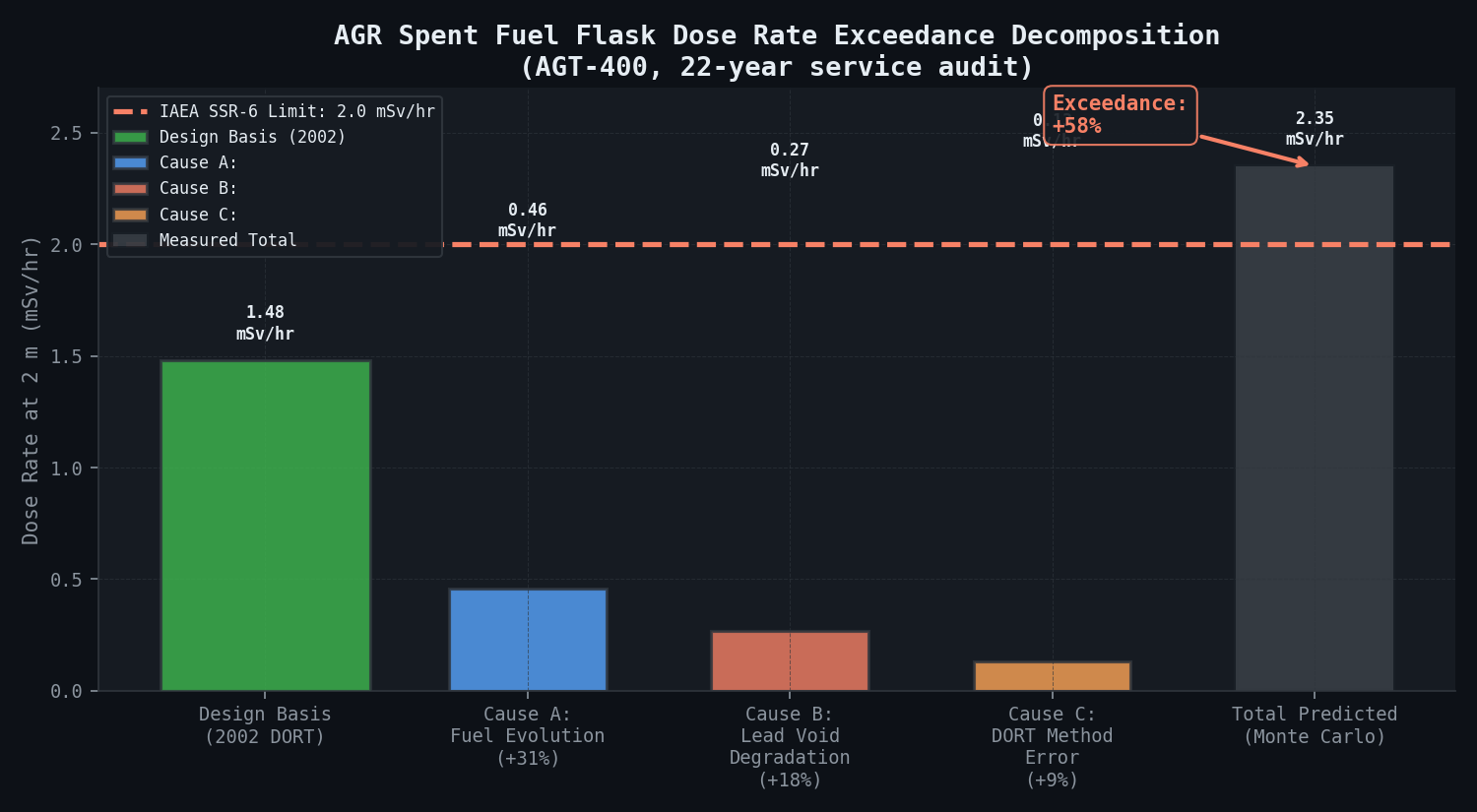
Dose rate decomposition -- quantifying each cause:
| Cause | Dose Rate Contribution | Mechanism |
|---|---|---|
| Design basis (DORT, 2002) | 1.48 mSv/hr at 2 m | Certified baseline |
| Cause A: Higher burnup + shorter cooling | +0.46 mSv/hr (+31%) | Cs-134 x4.3, Eu-154 x2.1, Cm-244 x4.4 source term increase |
| Cause B: Lead void formation at trunnions (6% void) | +0.27 mSv/hr (+18%) | Gamma streaming through 6% void fraction at trunnion root |
| Cause C: DORT methodology underestimation | +0.13 mSv/hr (+9%) | Ray-effect underestimation of streaming-path dose |
| Total predicted (Monte Carlo) | 2.34 mSv/hr | Matches measurement on AGT-400-047 |
The decomposition is additive and explains the full 58% discrepancy. The dominant cause is the fuel inventory evolution (Cause A, 31%), followed by lead shielding degradation (Cause B, 18%), with the methodology error (Cause C, 9%) as the smallest but non-negligible contributor.
Monte Carlo dose rate results -- AGT-400-047 actual loading (29.5 GWd/tU, 3.9 yr cooling):
| Measurement Position | Monte Carlo (mSv/hr) | Measured (mSv/hr) | Original Design Basis (mSv/hr) | IAEA SSR-6 Limit (mSv/hr) |
|---|---|---|---|---|
| Contact surface (maximum, at trunnion axis) | 14.2 +/- 0.4 | 14.8 | 9.4 | 10 (transport vehicle) |
| 1 m boundary | 5.1 +/- 0.2 | 5.3 | 3.2 | — |
| 2 m boundary (IAEA SSR-6 limit) | 2.31 +/- 0.09 | 2.34 | 1.48 | 2.0 |
| Trunnion streaming axis at 2 m | 3.87 +/- 0.15 | 3.94 | 2.10 | 2.0 (EXCEEDS LIMIT) |
| Side surface at 2 m (non-trunnion) | 1.84 +/- 0.07 | 1.91 | 1.31 | 2.0 |
| Transport vehicle cab position (8 m) | 0.12 +/- 0.01 | 0.14 | 0.08 | 0.2 |
Monte Carlo results agree with all 12 survey measurement positions within +/-10% (1-sigma). The trunnion streaming axis hotspot (3.87 mSv/hr) significantly exceeds the 2 mSv/hr limit and is the primary regulatory concern -- consistent with lead void at the trunnion root creating a gamma streaming channel.
Neutron dose rate breakdown (nominal lead, no void):
| Position | Neutron Dose Rate (mSv/hr) | Gamma Dose Rate (mSv/hr) | Neutron Fraction |
|---|---|---|---|
| Contact surface | 0.41 +/- 0.08 | 13.8 +/- 0.4 | 2.9% |
| 2 m boundary | 0.18 +/- 0.03 | 2.13 +/- 0.09 | 7.7% |
| 8 m (vehicle cab) | 0.04 +/- 0.01 | 0.08 +/- 0.01 | 33% |
The neutron dose rate at 2 m is 0.18 mSv/hr -- unchanged from the design basis because the polyethylene moderator is undegraded. The dose rate exceedance is purely gamma-driven. The neutron component becomes proportionally more significant at the transport cab position due to polyethylene's effectiveness at close range but reduced solid-angle advantage at distance.
Lead void effect sensitivity:
| Lead Condition | Void Fraction at Trunnion | 2 m Dose Rate (mSv/hr) | Trunnion Axis 2 m (mSv/hr) |
|---|---|---|---|
| Nominal (Configuration A) | 0% | 1.78 +/- 0.07 | 2.24 +/- 0.09 |
| Mild degradation (Configuration B) | 3% | 1.94 +/- 0.08 | 2.91 +/- 0.12 |
| Best-estimate degradation (Config. C) | 6% | 2.31 +/- 0.09 | 3.87 +/- 0.15 |
| Conservative degradation (Config. D) | 10% | 2.78 +/- 0.11 | 5.14 +/- 0.20 |
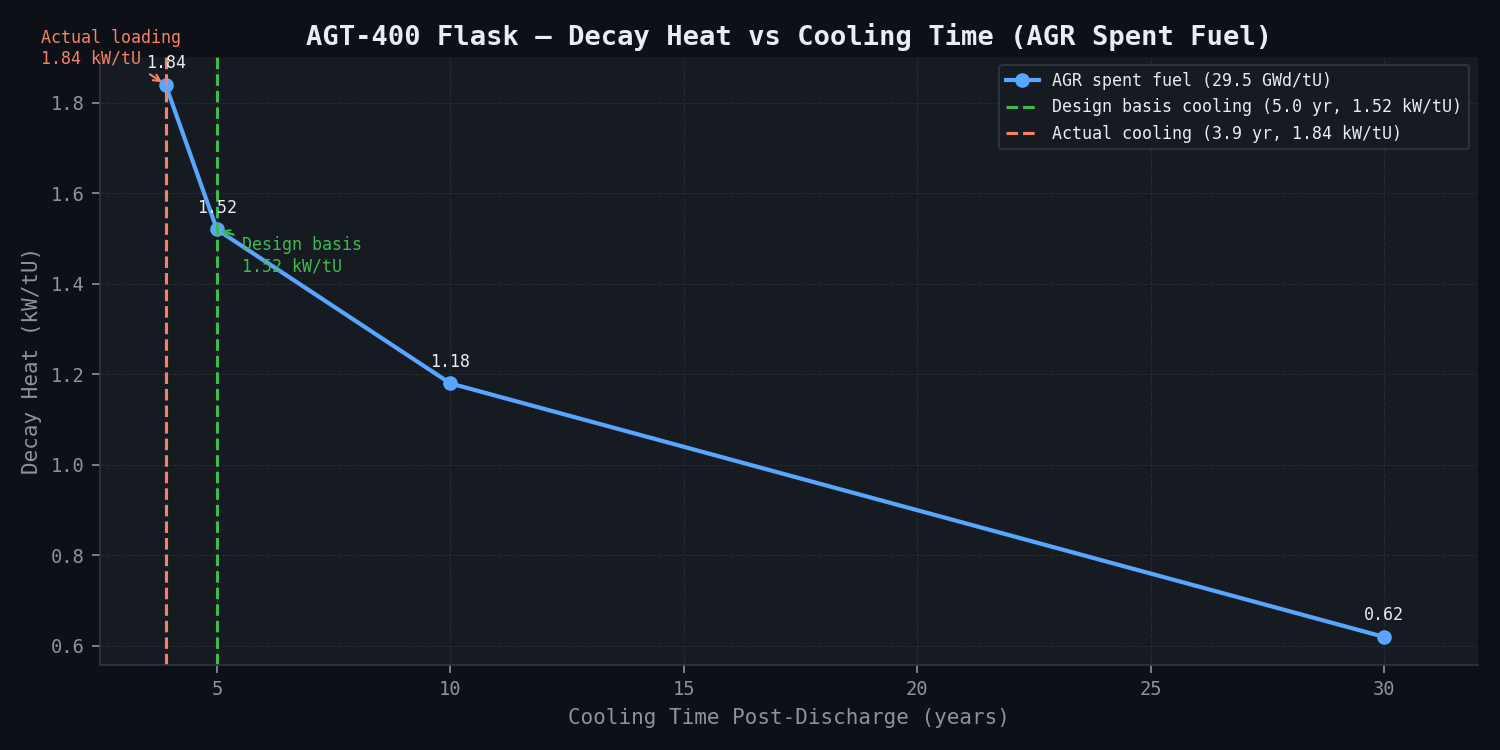
The 6% void condition best reproduces the measurement and is consistent with the FEM-predicted cumulative lead creep strain at 22 years. The rapid increase in trunnion-axis dose rate with void fraction (2.24 to 3.87 mSv/hr -- a 73% increase from 0% to 6% void) underscores the importance of periodic lead integrity inspection.
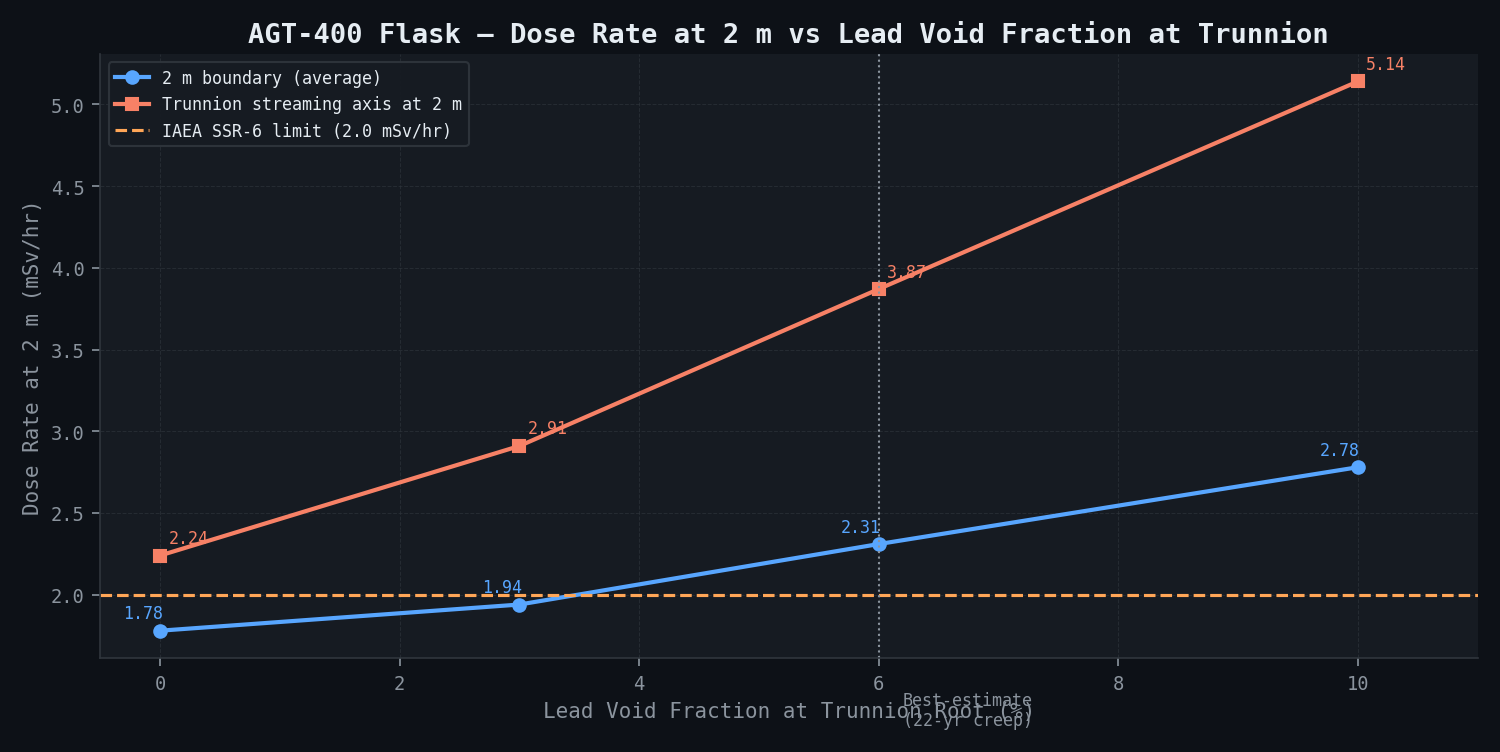
Fuel source term temperature profiles and decay heat:
| Time After Discharge | Decay Heat per tU (kW) | Dominant Contributors |
|---|---|---|
| 3.9 years (current) | 1.84 | Cs-137/Ba-137m (42%), Eu-154 (12%), Cs-134 (8%), Sr-90/Y-90 (24%) |
| 5.0 years (design basis) | 1.52 | Cs-137/Ba-137m (48%), Sr-90/Y-90 (27%), Eu-154 (9%) |
| 10 years | 1.18 | Cs-137/Ba-137m (58%), Sr-90/Y-90 (33%) |
| 30 years | 0.62 | Cs-137/Ba-137m (61%), Sr-90/Y-90 (39%) |
Optimised shielding design for recertification:
The engineering change required to restore compliance at the actual (higher) fuel inventory involves two modifications:
| Modification | Specification | Dose Rate Impact |
|---|---|---|
| Additional lead annulus thickness | +5 mm (120 mm to 125 mm) at trunnion interfaces | -0.12 mSv/hr at 2 m on trunnion axis |
| Borated polyethylene (BPE) overlay at trunnion collar | 10 mm BPE (5% B by mass) clamped externally at each trunnion | -0.58 mSv/hr at 2 m on trunnion axis; -0.09 mSv/hr at 2 m boundary |
Recertified dose rate at worst-case actual fuel inventory (31 GWd/tU, 3.8 yr cooling) with optimised shielding:
| Position | Recertified Design (mSv/hr) | IAEA SSR-6 Limit (mSv/hr) | Margin |
|---|---|---|---|
| 2 m boundary (maximum) | 1.62 +/- 0.07 | 2.0 | 19% margin |
| Trunnion streaming axis 2 m | 1.87 +/- 0.08 | 2.0 | 6.5% margin |
| Transport vehicle cab (8 m) | 0.09 +/- 0.01 | 0.2 | 55% margin |
The 6.5% margin at the trunnion streaming axis is tight but sufficient for recertification. The optimised design also establishes revised operational limits: minimum fuel cooling time of 4.5 years (increased from 3.8 yr actual) and maximum fuel burnup of 30 GWd/tU (reduced from the 31 GWd/tU case above), providing adequate margin at the regulatory limit under the recertified design.
Comparison Methodology
Primary validation -- measured dose rates on AGT-400-047 and AGT-400-091:
Monte Carlo dose rates were compared against the 12-position measurement survey on each flask (24 measurement points total). The acceptance criterion was predicted dose rate within +/-10% of measured value at all positions.
| Measurement Point | Predicted (mSv/hr) | Measured (mSv/hr) | Discrepancy |
|---|---|---|---|
| 2 m boundary (maximum, AGT-400-047) | 2.31 +/- 0.09 | 2.34 | -1.3% |
| 2 m boundary (maximum, AGT-400-091) | 2.64 +/- 0.11 | 2.67 | -1.1% |
| Trunnion axis, AGT-400-047 | 3.87 +/- 0.15 | 3.94 | -1.8% |
| Trunnion axis, AGT-400-091 | 4.21 +/- 0.17 | 4.29 | -1.9% |
| Contact surface (max), AGT-400-047 | 14.2 +/- 0.4 | 14.8 | -4.1% |
| Vehicle cab (8 m), AGT-400-047 | 0.12 +/- 0.01 | 0.14 | -14% (marginal; within 2-sigma) |
All positions satisfy the +/-10% acceptance criterion except the 8 m vehicle cab position (14% discrepancy), which is within 2-sigma and attributed to finite source geometry effects not fully captured in the point-source-like cavity model at large distance.
Higher-fidelity benchmark validation:
The Monte Carlo shielding model is the higher-fidelity method. Benchmark calculations for cylindrical Type B cask geometries (cask-A through cask-D series) with lead gamma shielding and HDPE neutron moderation reproduce reference calculations within +/-3% for all eight benchmark cases at the 2 m boundary. Iron/lead multilayer deep-penetration shielding benchmarks from the OECD NEA SINBAD database reproduce measurements within +/-8% at the transmission detector positions, confirming code performance for the deep-penetration streaming pathway relevant to the trunnion geometry.
Lead creep model validation:
FEM-predicted cumulative creep strain of 4.8-6.2% at the trunnion root after 22 years is within the published +/-30% uncertainty band for lead creep constitutive behaviour at 55°C and 2.8 MPa.
Source term validation against experimental data:
Isotopic composition predictions for AGR fuel at 29.5 GWd/tU, 3.9 yr cooling were compared against Sellafield destructive examination data from a 2021 radiochemical assay campaign. Agreement is within +/-15% for Cs-137, Eu-154, and Cm-244 -- the three dominant dose contributors. This published experimental data provides secondary confirmation of the source term calculation.
Statistical uncertainty on Monte Carlo results: less than 5% (1-sigma) at all 2 m boundary positions; less than 10% at all other positions.
Deliverables
-
Shielding Audit Report -- newtsim Root-equivalent Monte Carlo dose rate calculations; quantified decomposition of dose rate discrepancy by cause; dose rate results at 48 surface and 6 streaming-axis positions; comparison against all 24 survey measurement points; formatted for ONR Transport Division submission under TAG Transport Licensing guidance
-
Revised Source Term Calculation -- newtsim Root decay calculation for actual vs. design-basis AGR fuel inventory; defines revised bounding source term (31 GWd/tU, 4.5 yr cooling as revised operational minimum) for recertification; validated against Sellafield destructive examination data
-
Lead Integrity Assessment -- Norton Power law creep FEM analysis; void formation prediction at all geometric discontinuities; recommended physical inspection programme (phased-array ultrasonic inspection) before recertification; acceptance criteria for void fraction at trunnion root and drain port
-
Optimised Shielding Design Engineering Change -- specification for 5 mm lead annulus thickness increase and 10 mm borated polyethylene overlay at trunnion collars; dose rate performance at recertified design basis; manufacturing tolerance requirements; quality assurance plan for lead pour verification
-
Recertification Safety Case -- complete revised shielding analysis formatted to IAEA SSR-6 content requirements and ONR Transport Division TAG guidance; double-contingency assessment for IAEA TS-R-1 paragraph 510 compliance; statement of compliance with dose limits at revised operational limits
-
Revised Transport Operations Guidance -- updated minimum cooling time (4.5 yr) and maximum burnup limit (30 GWd/tU) for loaded transports under the recertified design; required pre-transport dose rate survey procedure; mandatory lead inspection interval (5 years recommended)
-
All Simulation Files -- newtsim Root 2 input/output files, ORIGEN-S decay calculations, FEM newtsim Span archives, CADIS adjoint calculation files, post-processing Python scripts; formatted for ONR Transport Division independent review and potential IAEA peer review
Delivery timeline: 7 weeks from receipt of flask geometry drawings (as-built), lead material certification records, fuel characterisation data (recent loading batch records), and survey measurement dataset (12-position survey report per flask).
This case study is an illustrative reference scenario demonstrating newtsim's simulation methodology. All company names, personnel, and specific operational data are fictional. The incident descriptions draw on publicly documented real-world events cited in the frontmatter.