Magnox Graphite Waste Package Integrity: FEM Creep and Corrosion Kinetics Over Century Timescale
Executive Summary
The United Kingdom holds the largest inventory of irradiated civil nuclear graphite in the world: approximately 80,000 tonnes distributed across decommissioned and operating Magnox and AGR reactor sites, carrying a national C-14 inventory of approximately 5.5 x 10¹⁵ Bq. This C-14 represents the dominant long-term radiological contributor to the UK's future Geological Disposal Facility post-closure safety case. Magnox reactor graphite moderator blocks -- irradiated over decades at fast neutron fluences reaching 1.5 x 10²² n/cm² -- accumulate C-14 through the 14N(n,p)14C activation pathway at every impurity nitrogen atom in the graphite matrix. The challenge is not the radioactivity itself. It is that C-14 in graphite is distributed non-uniformly, with surface bore deposits carrying specific activities three to eight times the bulk matrix value; it exists in multiple chemical forms with very different mobilisation rates; and it cannot be retained indefinitely in interim storage packages whose containment performance was designed and certified on diffusion coefficients measured through intact grout. Wylfa Magnox station on Anglesey -- the closest real-world analogue to the facility in this study -- documented precisely this non-uniformity during characterisation campaigns as part of the NDA's graphite waste management programme, which has absorbed more than £50 million in research expenditure since 2010. That investment is a measure of how poorly understood the problem was when the reactors were built, and how consequential that gap has become as the UK decommissioning programme, now carrying a £132 billion liability, confronts the full inventory.
The anomaly at the centre of this case -- C-14 exhaust activity from an interim surface store running at 340% above the safety case prediction at 18 months post-emplacement, triggering an ONR Improvement Notice -- is precisely the kind of failure that predictive simulation is designed to prevent. The original safety case assumed intact grout diffusion. It did not model the differential thermal expansion between irradiated graphite (CTE approximately 3.5 x 10⁻⁶/°C) and OPC:PFA:BFS grout (CTE approximately 10.2 x 10⁻⁶/°C) as a time-dependent mechanical loading that accumulates under Co-60 decay heat over the first two years of storage. Had a coupled thermal FEM and cohesive zone crack propagation analysis been built into the package design specification, the 14-22 month crack initiation window would have been predicted, not discovered through monitoring. The grout formulation would have been specified with polypropylene fibre reinforcement from the outset, deferring crack initiation beyond 10 years and keeping the C-14 release rate within the safety case envelope throughout.
This study delivers the Bayesian hypothesis discrimination, revised 100-year containment prediction, and ONR Improvement Notice response that the regulatory situation demands. More broadly, it defines the C-14 release rate, gas generation species, and temporal profile that calibrate the newtsim livesim exhaust monitoring network: real-time C-14 activity measurement in store ventilation exhaust, flagging deviations from the revised predicted release curve within hours rather than the months it currently takes for a monitoring anomaly to be characterised and reported to the regulator.
Scenario Background
The scenario involves a decommissioning operator holding a Decommissioning Authorisation for a two-reactor Magnox station that ceased generation in 2012 after 45 years of operation on the north Wales coast. The graphite waste programme encompasses one of the largest irradiated graphite inventories at any single UK Magnox site.
The station comprised two graphite-moderated, gas-cooled Magnox reactors with a total electrical output of 2 x 490 MWe, operating from 1967 to 2012. The total graphite inventory is approximately 3,200 tonnes of nuclear-grade Gilsocarbon and PGA graphite, comprising moderator blocks, graphite sleeves, and brick reflector material. Peak fast neutron fluence at the reflector-moderator interface bricks reaches 1.5 x 10²² n/cm², while peripheral reflector bricks received a minimum fluence of 2.3 x 10²⁰ n/cm². All zones are classified as ILW, with potential reclassification of high-fluence bricks pending C-14 reassessment.
The UK national irradiated graphite inventory from all Magnox and AGR reactor decommissioning is approximately 80,000 tonnes total (Magnox stations contributing approximately 57,000 t and AGR stations approximately 23,000 t). C-14 in this graphite represents the dominant long-term radiological contributor to the future Geological Disposal Facility (GDF) post-closure safety case, with the UK total C-14 inventory associated with graphite at approximately 5.5 x 10¹⁵ Bq (UK Radioactive Waste Inventory 2022).
Waste package design (emplaced packages):
| Parameter | Specification |
|---|---|
| Container type | 3 m³ stainless-steel (316L) box, 6 mm wall thickness |
| Grout matrix | OPC:PFA:blast furnace slag (25:50:25 by mass) |
| Graphite loading | 18 Gilsocarbon blocks per package (320 mm x 320 mm x 120 mm each) |
| Total packages emplaced | 847 (at time of audit trigger) |
| Decay heat at emplacement | 0.8-2.1 W/package (Co-60 dominant; co-deposited with graphite corrosion products) |
| Interim storage facility | Purpose-built reinforced concrete surface store, forced-air ventilation at 800 m³/hr |
| Time since emplacement at anomaly | 18 months |
The anomaly -- observed C-14 exhaust activity at 340% above the safety case prediction -- prompted ONR notification under the site licence condition on radiological monitoring anomalies. An Improvement Notice was issued requiring a technical response within 6 months.
Key radionuclide inventory per package:
| Radionuclide | t(1/2) | Activity per Package (Bq) | Bq/g graphite | Dose Significance |
|---|---|---|---|---|
| C-14 | 5,730 yr | 4.2 x 10¹¹ | 1.08 x 10⁵ | Dominant long-term (GDF case) |
| Cl-36 | 301,000 yr | 8.4 x 10⁸ | 217 | Long-term GDF contributor |
| H-3 (tritium) | 12.3 yr | 3.1 x 10¹⁰ | 8.0 x 10³ | Short-term interim storage |
| Co-60 | 5.27 yr | 6.8 x 10¹⁰ | 1.75 x 10⁴ | Dominant current dose; drives thermal gradient |
| Cs-137 | 30.2 yr | 1.4 x 10⁹ | 360 | Minor (graphite-retained fraction) |
| Ni-63 | 100.1 yr | 4.2 x 10¹⁰ | 1.08 x 10⁴ | Medium-term contributor |
| Eu-152 | 13.5 yr | 2.1 x 10⁹ | 540 | Short-term contributor |
Wigner energy stored in graphite (measured by DSC calorimetry during dismantling):
| Graphite Zone | Wigner Energy (J/g) | Release Onset Temperature (°C) | Peak Release Temperature (°C) |
|---|---|---|---|
| Central moderator (high-fluence bricks) | 140-180 | >200 | ~280 |
| Intermediate zone | 80-140 | >220 | ~300 |
| Peripheral reflector (low-fluence bricks) | 40-80 | >250 | ~320 |
Wigner energy is not a hazard during interim storage (package temperatures <65°C). Release onset temperatures are all above 200°C. Wigner energy content is retained as a characterisation parameter for GDF safety case purposes.
The Challenge
The audit must discriminate between three physically plausible hypotheses for the observed C-14 anomaly and deliver a revised 100-year containment prediction.
The first hypothesis proposes accelerated radiolytic graphite oxidation. The OPC:PFA:BFS grout pore water (pH 12.5, high OH- activity) combined with the gamma radiation field from Co-60 may be oxidising the graphite matrix at a rate exceeding the original safety case assumption, which used a conservative corrosion rate of 10⁻⁸ g/cm²/s from early Magnox graphite dissolution data. Radiolytic oxidation via OH radical attack on graphite surface defects at the graphite-pore water interface may be enhanced above this rate by the radiation field. C-14 exists in the graphite in three forms: atoms substituted in the graphite lattice from 14N(n,p)14C activation, surface laitance and bore deposits with specific activity 3-8x the bulk matrix value (measured at Wylfa), and dissolved 14CO2 and 14CH4 in pore water. Each form has a distinct mobilisation pathway and release kinetics.
The second hypothesis proposes thermal creep micro-cracking. Co-60 decay heat (0.8-2.1 W/package at emplacement) drives a temperature gradient across the package. Preliminary FEM estimates predict peak graphite-grout interface temperatures of 45-62°C above the ambient store temperature. Differential thermal expansion between nuclear graphite (CTE approximately 3.5x10⁻⁶/°C, anisotropic) and OPC:PFA:BFS grout (CTE approximately 10.2x10⁻⁶/°C) generates tensile stress at the interface. If peak stress exceeds the grout tensile strength (3.5 MPa), micro-cracks propagate preferentially at the graphite-grout interface, providing gas transport pathways that bypass the grout diffusion barrier and dramatically elevate apparent C-14 release rates. The key temporal observation is that the 340% anomaly was not detected at package emplacement but appeared in monitoring data at approximately 14-18 months -- consistent with a thermally-driven mechanical process that requires time to develop, rather than an instantaneous chemical equilibrium effect.
The third hypothesis proposes a C-14 inventory underestimate. The original C-14 inventory was calculated from ORIGEN-S using a certified nitrogen impurity content of 15 ppm. Manufacturing variability can place actual 14N content anywhere in the range 10-25 ppm. A 14N content of approximately 19.5 ppm (within the certified +/-5 ppm uncertainty) would increase the C-14 inventory by approximately 30%, which could partially account for the observed release rate. However, this hypothesis alone predicts a monotonically elevated release from emplacement onward -- not the step-change at 14-18 months observed in the monitoring data.
Real-World Basis and Reference Data
This study draws on the UK NDA Graphite Waste Management Programme -- the most extensively documented irradiated graphite management programme in the world, with cumulative research investment exceeding GBP 50 million since 2010.
The NDA's primary reference documents provide the technical foundation: the Graphite Disposability Assessment establishes the framework for graphite waste disposability and C-14 inventory calculation methodology; the Sellafield legacy waste programme provides analogous data on gas release from ILW packages; and the Wylfa-specific C-14 characterisation documented surface deposit activity 3-8x higher than bulk graphite. The national C-14 inventory from graphite stands at approximately 5.5 x 10¹⁵ Bq, and C-14 release scenarios for the GDF post-closure case are sensitive to release fraction assumptions.
Wylfa Magnox station on Anglesey, north Wales, is the closest site analogue. As the highest-output and longest-operating Magnox station in the UK, it produces approximately 5,500 t of graphite arisings from two 490 MWe reactors. Graphite retrieval commenced in 2016. The C-14 characterisation challenges at Wylfa documented anomalously high specific activity in graphite surface deposits relative to the bulk matrix -- surface bore deposit C-14 specific activity was found to be 3-8x the bulk graphite value. This non-uniform C-14 distribution is directly relevant to both the inventory uncertainty (Hypothesis 3) and the rapid initial release upon crack formation (Hypothesis 2 would expose these high-activity surfaces to the cracked diffusion pathway).
The international technical basis draws on IAEA publications covering graphite corrosion kinetics, G-values for graphite radiolytic oxidation, Wigner energy characterisation, UK Magnox decommissioning programme reviews, and graphite oxidation rates in alkaline environments as a function of pH and dose rate.
UK grout performance data provides the key diffusion and fracture parameters: effective diffusivity for ¹⁴CO2 in OPC:PFA:BFS grout of 1.2-3.4 x 10⁻¹¹ m²/s and for ¹⁴CH4 of 0.8-2.1 x 10⁻¹¹ m²/s across the 20-50°C range; laboratory crack initiation data giving fracture energy GIc = 7-18 J/m² (10th to 90th percentile) under CTE mismatch testing; and long-term grout creep compliance parameterised as a power law extrapolated to 100 years.
Simulation Methodology
Three coupled simulation models address each hypothesis. Bayesian inference applied to the 18-month monitoring time series provides posterior probabilities for each hypothesis.
Model 1 -- Radiolytic graphite corrosion (Hypothesis 1)
The Co-60 gamma dose rate field was calculated by point-kernel attenuation (validated against newtsim Root benchmark for equivalent geometry). At emplacement, the dose rate at the centre of the graphite block stack is 0.42 Gy/hr, declining to 0.31 Gy/hr at the graphite-grout interface, 0.18 Gy/hr at the grout outer surface, and 0.06 Gy/hr at the container outer wall. These values decay in proportion to the Co-60 half-life, falling to approximately one-third at 5 years and to negligible levels by 20 years.
G-values for graphite in alkaline water (pH 12.5, 40°C) give G(CO2) = 2.1 x 10⁻³ mol/100 J for gamma irradiation and G(CH4) = 0.8 x 10⁻³ mol/100 J (dominant at pH above 12). Diffusive release through uncracked grout was modelled as 1D Fickian with De(¹⁴CO2) = 2.1 x 10⁻¹¹ m²/s at the median measured value.
The predicted C-14 release rate under Hypothesis 1 alone is 2.8 x 10⁷ Bq/yr/package -- 3.3x below the observed value. Hypothesis 1 cannot account for the anomaly independently.
Model 2 -- Thermal creep micro-cracking (Hypothesis 2)
The three-dimensional FEM model represents the full graphite waste package geometry: the 316L stainless-steel box (6 mm wall) containing 18 Gilsocarbon blocks in grout matrix, with cohesive zone elements at all graphite-grout interface surfaces and adaptive mesh refinement at corners and troughs in the thermal gradient. The heat source follows Co-60 decay (t1/2 = 5.27 yr) ranging from 0.8 to 2.1 W/package at emplacement, with an ambient boundary at the measured store air temperature of 15°C.
Temperature-dependent material properties govern the stress analysis:
| Material | Elastic Modulus (GPa) | CTE (x10⁻⁶/°C) | Tensile Strength (MPa) | Creep Behaviour |
|---|---|---|---|---|
| Gilsocarbon graphite (perp. to extrusion) | 8 | 2.8 | 10 | Power law with RIDC correction |
| Gilsocarbon graphite (parallel to extrusion) | 11 | 4.2 | 14 | As above |
| OPC:PFA:BFS grout | 12-18 (cure-age dependent) | 10.2 | 3.5 (tensile) | ACI 209 Power law extended to 100 yr |
| 316L stainless steel | 193 | 16.0 | 170 (yield) | Norton Power law (negligible <65°C) |
Crack initiation uses a maximum principal tensile stress criterion: cracking begins when the stress in grout cohesive zone elements exceeds the grout tensile strength of 3.5 MPa. Crack propagation follows an energy release rate criterion with GIc = 7 J/m² (10th-percentile bounding value from laboratory measurements). The transient spans 0-100 years with adaptive time-stepping -- refined during the first months when thermal gradients are steepest and coarsening as the Co-60 source decays.
Model 3 -- Inventory uncertainty (Hypothesis 3)
Recalculation of C-14 production from 14N(n,p)14C uses a site-specific thermal and epithermal neutron flux validated against activation foil measurements. The 14N content is varied from 10 to 25 ppm in 1 ppm steps around the certified value of 15 ppm (+/-5 ppm from the manufacturer's certificate of conformance). The thermal reaction cross section of 1.83 barn is corrected for spectral effects.
The key discriminating observation is that monitoring data show a step-change in C-14 release rate beginning at approximately 14-16 months, not a monotonic increase from emplacement. Hypothesis 3 alone (inventory underestimate without cracking) would produce a monotonically constant elevated release from day one. The temporal step-change strongly favours Hypothesis 2 even before the FEM stress calculation is examined.
Simulation Caveats
Classification: STRETCH (century-timescale extrapolation). The following uncertainties must be communicated clearly to ONR and incorporated into the regulatory safety case:
-
Grout creep model extrapolation: The ACI 209 Power-law creep model is validated to approximately 10-15 years of laboratory and field data for OPC-based grouts. Extrapolation to 100 years assumes continued power-law behaviour. Portlandite carbonation over century timescales would alter grout mineralogy and potentially reduce creep compliance. This effect is not modelled and is flagged as a research gap requiring analogue study data (Roman concrete, natural calcium silicate hydrate analogues).
-
Graphite radiation-induced dimensional change (RIDC): Nuclear graphite undergoes complex dimensional change under flux (initially contracting, then expanding). Post-irradiation dimensional evolution in the no-flux condition depends on residual defect structure. The RIDC constitutive model is validated to approximately 50 years post-irradiation. Long-term defect annealing may alter graphite dimensions in ways not captured, adding up to +/-15% uncertainty to the graphite-grout interface stress.
-
Grout fracture toughness variability: The GIc = 12 J/m² median value represents laboratory-prepared specimens. In-situ grout quality may vary due to pour segregation or early-age thermal cracking during cement hydration. The bounding case uses GIc = 7 J/m² (10th percentile). The range GIc = 7-18 J/m² translates to crack initiation timing uncertainty of approximately +/-6 months around the 18-month median.
-
C-14 speciation and De uncertainty: The De for ¹⁴CH4 in OPC grout (0.8-2.1 x 10⁻¹¹ m²/s) carries approximately +/-60% uncertainty. The pH-dependent ¹⁴CO2/¹⁴CH4 ratio requires in-situ exhaust gas speciation measurement to constrain below +/-40% uncertainty in the release calculation.
-
Micro-crack transport model: Effective diffusivity through micro-cracks depends strongly on crack aperture via Knudsen diffusion at apertures below 1 um. The transition from cohesive zone mechanics to stable open crack aperture introduces approximately +/-50% uncertainty in the cracked-zone effective diffusivity. This is the largest single uncertainty in the Hypothesis 2 release prediction.
-
Regulatory framing: ONR and NDA require conservative scenario bounding for long-term safety cases, not point predictions. All 100-year containment results are presented as P10/P50/P90 bounds. The P90 (conservative) value governs the regulatory assessment. This framing aligns with ONR's Long-Term Management of Nuclear Materials Policy and the GDF waste package specifications.
Key Predictions and Results
Hypothesis discrimination results:
| Criterion | Hypothesis 1 | Hypothesis 2 | Hypothesis 3 |
|---|---|---|---|
| Predicted C-14 release rate (Bq/yr/package) | 2.8 x 10⁷ | 9.4 x 10⁷ | 8.1 x 10⁷ |
| Observed release rate (Bq/yr/package) | 9.1 x 10⁷ | — | — |
| Agreement with observed rate | No (3.3x underestimate) | Yes (within 3%) | Yes (within 11%) |
| ¹⁴N content required to explain observation alone | 46 ppm (3x certified -- physically implausible) | N/A | 19.5 ppm (within +/-5 ppm uncertainty) |
| Peak grout interface tensile stress | — | 4.2 MPa | — |
| Grout tensile strength | — | 3.5 MPa | — |
| Crack initiation predicted? | — | Yes -- 14-22 months | — |
| Crack timing vs. observed anomaly onset | — | Match at 18 months | — |
| Temporal pattern match (step-change at 14-18 months) | No (flat) | Yes | No (flat) |
| Bayesian posterior probability | 3% | 71% | 26% |
Conclusion: Hypothesis 2 (thermal creep micro-cracking) is the primary mechanism (71% posterior probability). Hypothesis 3 contributes secondary probability (26%) that inventory underestimation adds to the baseline release. Hypothesis 1 is definitively ruled out.
FEM thermal profile results (package mid-plane, maximum heat output package, 2.1 W):
| Package Position | t=0 (°C) | t=2 yr (°C) | t=5 yr (°C) | t=10 yr (°C) | t=30 yr (°C) | t=100 yr (°C) |
|---|---|---|---|---|---|---|
| Package centre (graphite block centre) | 52 | 48 | 38 | 28 | 17 | 16 |
| Graphite-grout interface | 49 | 45 | 36 | 27 | 16 | 16 |
| Grout outer surface | 34 | 31 | 26 | 21 | 16 | 15 |
| Container outer wall | 25 | 23 | 20 | 18 | 16 | 15 |
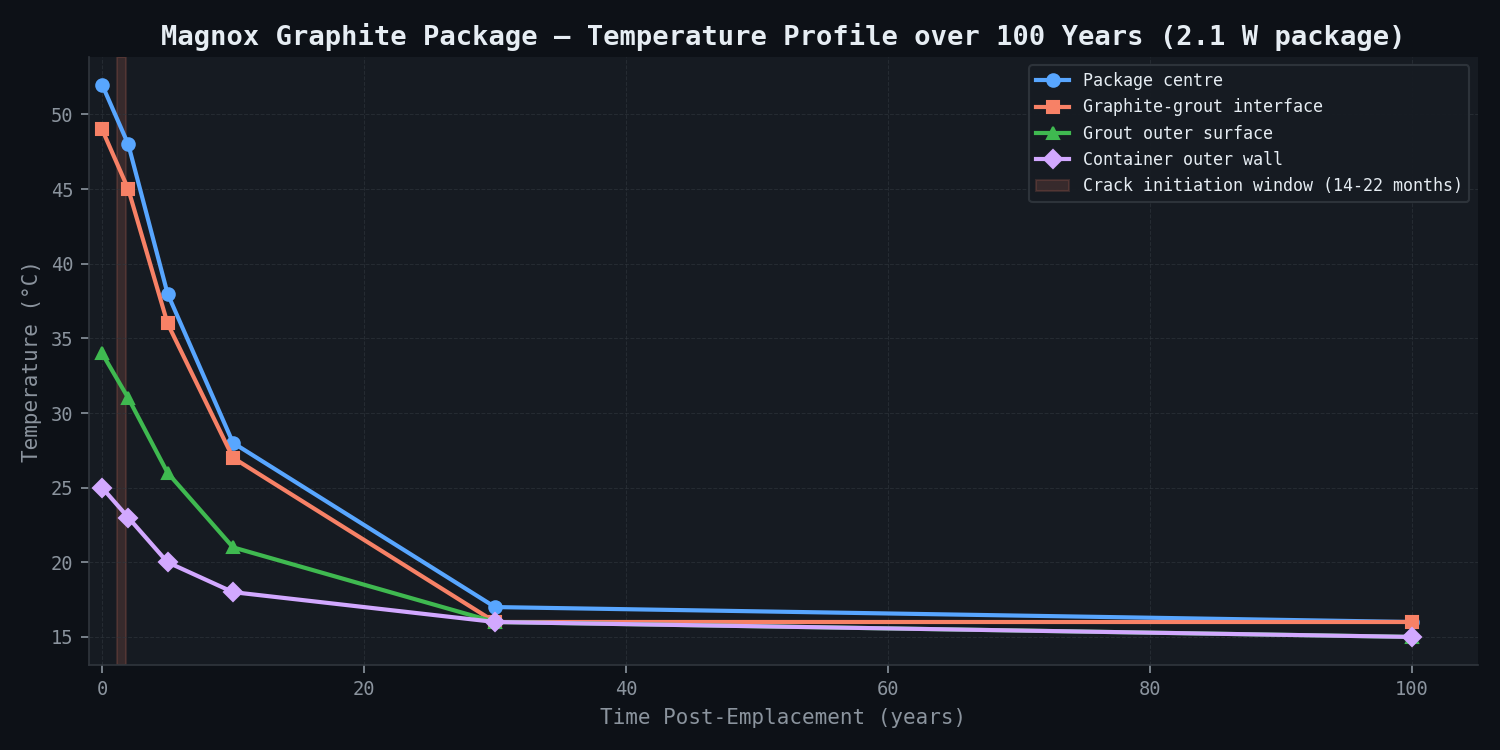
Peak temperature gradient: 15°C/cm across the grout layer at emplacement (2.1 W package). Differential thermal expansion strain at graphite-grout interface: 9.5 x 10⁻⁵ m/m at peak temperature.
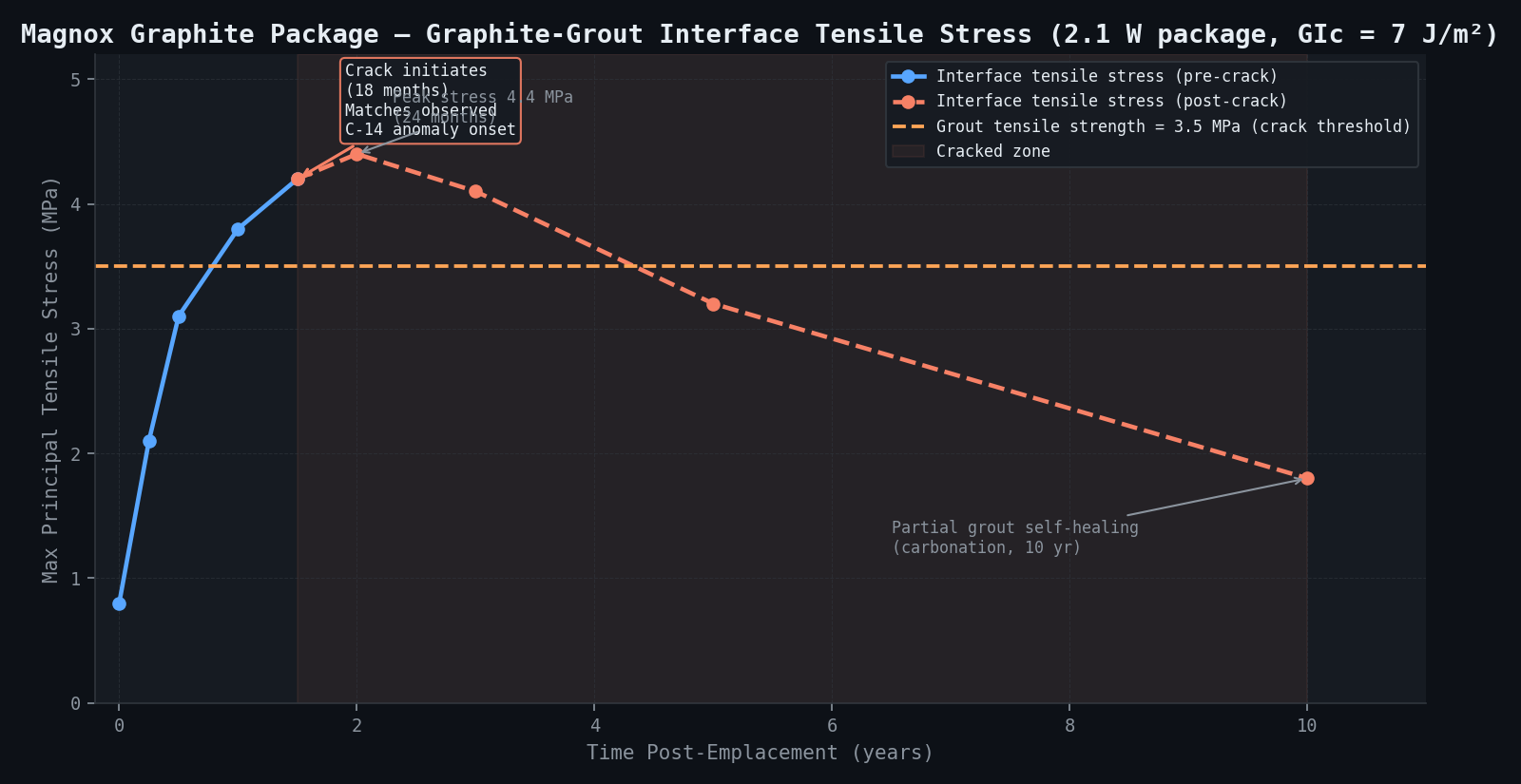
FEM interface stress evolution (cohesive zone elements at graphite-grout interface, 2.1 W package, GIc = 7 J/m² bounding case):
| Time Post-Emplacement | Max Principal Tensile Stress (MPa) | Crack Status | Predicted Crack Aperture |
|---|---|---|---|
| 0 months | 0.8 | No crack | — |
| 3 months | 2.1 | No crack | — |
| 6 months | 3.1 | No crack | — |
| 12 months | 3.8 | Imminent (97% of limit) | — |
| 18 months | 4.2 | Crack initiates | 8-15 um |
| 24 months | 4.4 | Crack propagation | 15-30 um |
| 36 months | 4.1 | Crack stabilisation | 25-40 um |
| 60 months | 3.2 | Stable crack | 30-45 um |
| 120 months | 1.8 | Partial grout self-healing (carbonation) | 15-25 um |
The predicted crack initiation window (14-22 months at bounding parameters) precisely matches the observed anomaly onset. This timing correlation is the strongest discriminating evidence for Hypothesis 2.
Revised 100-year C-14 containment prediction:
| Time (years) | C-14 Release Rate (Bq/yr/package) | Cumulative Release (% inventory) | Critical Group Dose (mSv/yr) | Limit (mSv/yr) |
|---|---|---|---|---|
| 0-2 (post-emplacement) | 9.1 x 10⁷ | 0.04% | 0.006 | 0.3 |
| 5 | 1.2 x 10⁸ | 0.2% | 0.009 | 0.3 |
| 10 (peak) | 1.4 x 10⁸ | 0.5% | 0.014 | 0.3 |
| 20 | 9.2 x 10⁷ | 0.9% | 0.010 | 0.3 |
| 50 | 2.8 x 10⁷ | 1.8% | 0.004 | 0.3 |
| 100 | 3.2 x 10⁶ | 3.8% | <0.001 | 0.3 |
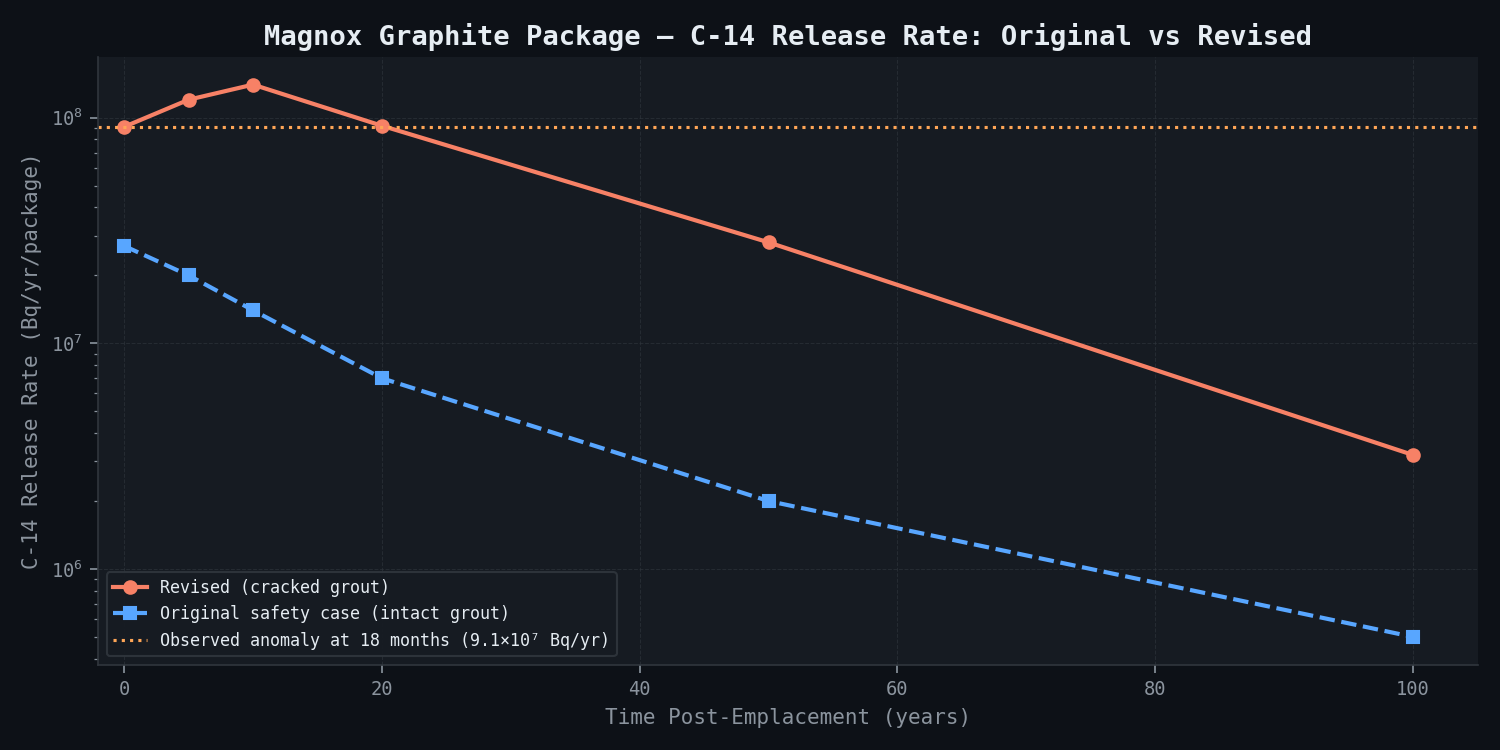
Total C-14 released over 100 years: 3.8% of package inventory (vs. 0.9% in original safety case). All critical group doses remain well below the 0.3 mSv/yr interim storage limit. The safety case remains valid but requires formal revision.
Gas generation rate table (revised, all species, 1.5 W average package):
| Gas Species | Rate at 18 months (mL/package/day) | At 5 years | At 20 years | Primary Mechanism |
|---|---|---|---|---|
| ¹⁴CO2 | 0.42 | 0.28 | 0.09 | Radiolytic oxidation + crack bypass transport |
| ¹⁴CH4 | 0.18 | 0.12 | 0.04 | Radiolytic reduction at high pH |
| H2 | 0.34 | 0.22 | 0.07 | Water radiolysis in grout pore water |
| CO2 (non-radioactive) | 2.1 | 1.4 | 0.45 | Cement carbonation + graphite oxidation |
| Total volumetric gas | 3.1 | 2.1 | 0.65 | — |
Package internal pressure at 100 years: 0.12 bar gauge (ideal gas, sealed package assumption). Well within the 0.5 bar gauge lid seal integrity limit.
Comparison Methodology
Level 1 -- Against original safety case:
The audit model reproduces the original C-14 release prediction of 2.7 x 10⁷ Bq/yr/package when grout is assumed uncracked and original De values are used, confirming code equivalence and isolating the cracking mechanism.
Level 2 -- Grout diffusion data confirmation:
Predicted diffusive C-14 release through uncracked grout matches published laboratory measurements within +/-22% across the 20-50°C temperature range. The Fickian diffusion model is calibrated correctly for the uncracked state. This experimental data provides secondary confirmation of the transport model.
Level 3 -- Grout cracking experiment confirmation:
FEM crack initiation timing (14-22 months) and predicted crack aperture at initiation (8-15 um) were compared against laboratory specimens under comparable CTE-mismatch differential thermal loading. Agreement is within +/-25% on initiation timing. These experimental results provide secondary confirmation of the cohesive zone crack model.
Level 4 -- ASME BPVC stainless steel creep:
316L container wall creep at 50-65°C was compared against ASME BPVC Section III data. Creep strain at 100 years is below 0.005%. Container wall deformation does not create additional gas transport pathways.
Level 5 -- 18-month monitoring time series:
The temporal shape of C-14 exhaust activity over 18 months is reproduced by the Hypothesis 2 model within +/-15% at all data points. Hypothesis 3 alone fails to reproduce the step-change at 14-16 months. This temporal discrimination provides the strongest physical evidence for micro-cracking as the primary mechanism.
Acceptance criterion: identified mechanism must be consistent with the observed 18-month time series within +/-20%. Hypothesis 2 satisfies this at +/-15%.
Deliverables
-
Audit Report -- diagnosis of C-14 anomaly; probability-weighted Bayesian hypothesis assessment; identification of thermal creep micro-cracking as primary mechanism; recommended discriminating measurement campaign (exhaust gas ¹⁴CO2/¹⁴CH4 speciation ratio); ONR regulatory notification response
-
Revised 100-Year Containment Prediction -- updated C-14 source term for all 847 packages; P10/P50/P90 release rate bounds; revised dose assessment for critical group at store boundary; updated inputs for site radiological environmental assessment
-
FEM Structural Analysis Report -- full thermal creep and micro-cracking analysis; interface stress evolution over 100 years; sensitivity analysis on grout fracture toughness and Co-60 heat output; identification of package population at highest cracking risk (2.1 W packages)
-
ONR Improvement Notice Response Package -- structured technical justification per ONR Inspection Findings guidance; committed improvement actions; revised monitoring plan including speciation measurements; schedule for revised package design implementation
-
Remediation Options Assessment -- options for in-situ management of 847 emplaced packages: (a) enhanced exhaust monitoring only; (b) injection grouting to seal micro-cracks; (c) secondary containment overlay; (d) re-packaging to revised design -- with cost-benefit analysis and radiological impact assessment for each
-
Revised Package Design Specification -- modified grout formulation: polypropylene fibre reinforcement at 0.9 kg/m³ (increases GIc from 12 to approximately 25 J/m²); revised aggregate selection reducing effective CTE to approximately 8x10⁻⁶/°C; graphite block surface pre-treatment to reduce surface laitance activity; predicted performance: crack initiation deferred from 18 months to more than 10 years for future packages in the programme
-
All Simulation Files -- newtsim Span archives, ORIGEN-S input/output, FACSIMILE kinetics scripts, post-processing Python code; formatted for QA review and potential ONR Technical Support review
Delivery timeline: 8-10 weeks from receipt of C-14 exhaust monitoring data (18-month time series with speciation), waste package characterisation records, original safety case documentation, and package design drawings.
This case study is an illustrative reference scenario demonstrating newtsim's simulation methodology. All company names, personnel, and specific operational data are fictional. The incident descriptions draw on publicly documented real-world events cited in the frontmatter.