Fukushima Daiichi Fuel Debris Criticality Safety: Monte Carlo Neutron Transport for Heterogeneous Corium Geometry
Executive Summary
On 11 March 2011, the Tohoku earthquake and subsequent tsunami disabled the emergency core cooling systems at Fukushima Daiichi Nuclear Power Station. Units 1, 2, and 3 underwent core meltdown over the following four days. Unit 2 experienced SCRAM at the onset of the earthquake; the Reactor Core Isolation Cooling system maintained some cooling until approximately 18:00 on 14 March, when cooling was lost and core uncovering began. By the early hours of 15 March, TEPCO's MELCOR analysis concludes that approximately 57% of the Unit 2 core had been damaged -- less severe than Units 1 and 3, but sufficient to slump several hundred tonnes of fuel and structural material into the reactor pressure vessel lower head and primary containment vessel pedestal. That solidified melt -- corium, a mixture of UO2, ZrO2, Zircaloy cladding, B4C control rod material, structural steel, and ablated concrete -- remains in the containment today. As of 2024, only 0.7 grams have been physically removed. The full decommissioning timeline extends to the 2050s at the earliest, and the total estimated cost exceeds ¥22 trillion. The primary technical barrier to commencing large-scale fuel debris retrieval is the absence of a criticality safety basis acceptable to NRA Japan: the geometry of the debris is unknown in fine-scale detail, its composition varies across the pedestal footprint on the centimetre scale, and boron from partially dissolved control rods is distributed heterogeneously -- creating local zones where the neutron absorber cannot be assumed present. Fourteen years after the accident, the safety case required to move tonnes of fissile material through an unprecedented retrieval sequence has not yet been closed.
A systematic Monte Carlo criticality assessment of this type, developed now in advance of the scaled retrieval programme planned for the 2030s, is the technical foundation that NRA Japan requires before any further retrieval operations can be authorised at scale. The 4,800 geometric-compositional case combinations in this study bound every credible configuration that could arise during debris fragmentation and container loading -- intact melt pool slabs, fragmented beds, granular heaps, retrieval arm fragment clouds, and progressively loaded containers -- across the full range of moderation ratios, boron concentrations, and reflection geometries. The result is not merely a keff table: it is the Criticality Safety Operating Limits governing arm lift mass, container loading, and minimum boron concentration in the PCV flooding water, and it is the IAEA safeguards technical note demonstrating continuous sub-criticality throughout the retrieval sequence. Without this work, the programme cannot proceed.
Its outputs define three of the most consequential parameters in the retrieval programme: the 15 kg maximum mass per retrieval arm lift, the 300 ppm minimum boron concentration in flooding water, and the neutron detector alarm setpoint at 1.2x background. These are simultaneously the Criticality Safety Operating Limits and the calibration parameters for newtsim livesim sub-criticality monitoring -- a real-time neutron flux measurement system at PCV boundary detectors that replaces the current reliance on periodic manual surveys with continuous automated criticality warning operating at the timescales of actual retrieval operations.
Scenario Background
The scenario involves the principal subcontractor for Unit 2 fuel debris retrieval operating under a tripartite governance structure involving TEPCO, the Nuclear Damage Compensation and Decommissioning Facilitation Corporation (NDF), and NRA Japan. The legal and regulatory basis for decommissioning is established under the Act on the Regulation of Nuclear Source Material, Nuclear Fuel Material and Reactors (Japan), with NRA Japan serving as the primary nuclear safety regulator.
Reactor parameters for Fukushima Daiichi Unit 2:
| Parameter | Value |
|---|---|
| Reactor type | Boiling Water Reactor (BWR), General Electric Mark I containment |
| Electrical output | 784 MWe (2,381 MWth) |
| Original fuel inventory | 548 fuel assemblies, 9x9 pin lattice |
| Fuel material | UO2 in Zircaloy-2 cladding |
| 235U enrichment at BOL | 3.7-4.5 wt% (zone-averaged) |
| Burnup at accident | Weighted average ~30 GWd/tU; maximum ~45 GWd/tU |
| Reactor operating period | 1974-2011 (37 years) |
| Accident date | 15 March 2011 (SCRAM 11 March 2011; loss of cooling commenced ~14 March) |
Post-accident characterisation of Unit 2 debris inventory:
Following the accident, TEPCO and JAEA conducted muon tomography surveys (2015, 2017) and robotic investigations from 2017 onward. Unit 2 experienced the least severe of the three core damage sequences; the core is partially intact with debris concentrated primarily in the lower RPV head and PCV pedestal rather than having fully breached the RPV. Current debris inventory estimates (as of 2025):
| Parameter | Value | Source |
|---|---|---|
| Total debris mass (all forms) | 237-320 t | TEPCO characterisation report 2021 |
| Fuel-bearing debris (UO2 content >10 wt%) | ~90 t | JAEA neutron activation analysis 2023 |
| UO2 fraction of debris matrix | 30-45 wt% | TEPCO/JAEA joint characterisation 2023 |
| Effective 235U enrichment in debris | 1.2-2.1 wt% (reduced by burnup) | JAEA ORIGEN depletion calculation |
| ZrO2/Zircaloy fraction | 15-25 wt% | Zircaloy-2 cladding, partially oxidised |
| Fe/Cr/Ni structural fraction | 20-35 wt% | RPV internals and shroud material |
| Concrete/SiO2/CaO admixture | 5-15 wt% | Pedestal floor concrete ablation products |
| B4C (control rod material) | 1-5 wt% (heterogeneous) | Partially dissolved; spatially variable |
Trial retrieval operations timeline:
In November 2024, the first physical contact with Unit 2 debris yielded approximately 0.7 g removed from the PCV pedestal using a retractable apparatus. XRF analysis confirmed an Fe, U, Zr, Cr, Ni matrix consistent with the fuel debris model. In April 2025, a second trial retrieval recovered approximately 3-5 g of additional sample, characterised as heterogeneous, brown-bronze coloured, and porous -- consistent with partially oxidised UO2/ZrO2 matrix with metallic inclusions. TEPCO plans to deploy a larger robotic arm system with wider articulation range for expanded pilot-scale retrieval during 2026-2027, with large-scale multi-tonne retrieval targeted for the first half of the 2030s per the NDF decommissioning roadmap. The criticality safety basis produced in this study is required for NRA approval before scaled retrieval operations can commence.
Compositional analysis of trial samples (non-destructive XRF/XRD, 2024-2025):
| Element / Compound | Mass Fraction (approx.) | Physical Interpretation |
|---|---|---|
| Fe (as metallic and oxide) | 35-42 wt% | RPV lower head structural steel, partially oxidised |
| U (as UO2) | 18-26 wt% | Nuclear fuel material |
| Zr (as ZrO2 and metallic) | 12-18 wt% | Zircaloy-2 cladding, partially oxidised |
| Cr (as Cr2O3 and metallic) | 4-8 wt% | Stainless steel component |
| Ni | 2-4 wt% | Stainless steel nickel content |
| Si/Ca/Al (concrete-derived) | 5-12 wt% | Pedestal floor concrete ablation |
| B (as B4C or borate) | <0.5 wt% (near detection limit) | Partially depleted control rod material |
The low boron content in the trial samples is operationally significant: it indicates that B4C dissolution and dilution through the melt has produced locally boron-poor regions. The safety case conservatively models all uncontrolled scenarios with zero boron in the debris matrix.
The Challenge
Criticality safety assessment for heterogeneous, geometrically uncertain corium is qualitatively more difficult than standard criticality safety cases for processed fuel or well-characterised waste packages. Seven distinct factors combine to make this problem uniquely demanding.
The first factor is geometric non-determinism. The debris geometry cannot be fully characterised without physical access that itself requires a pre-existing safety basis. Internal structure -- melt pool layering, fracture patterns, void distributions, water ingress channels -- is inferred from muon tomography (spatial resolution approximately 20-30 cm) and robotic camera surveys, neither of which resolves fine-scale geometry relevant to criticality. Any credible configuration across the approximately 6 m pedestal footprint must be bounded.
The second factor is compositional variability across spatial scales. Corium composition varies on the centimetre-to-metre scale depending on local melt temperature history, solidification rate, and interaction with non-fuel structural materials. UO2 content ranges from near-zero in metallic steel-dominated zones to more than 70 wt% in consolidated oxide melt zones. The effective 235U enrichment is a spatially variable function of burnup history, and B4C from cruciform control rods contributes variable boron locally, so the safety case must bound the locally boron-depleted scenario.
The third factor is the wide moderation range. The criticality hazard is maximised at an optimal hydrogen-to-uranium (H/U) atom ratio, typically 100-300 for low-enrichment UO2 in water. The corium environment spans from completely dry (H/U approximately 0) to fully submerged in water (H/U up to 500), and during retrieval operations water ingress may be non-uniform, potentially passing through the critical H/U range in localised debris regions.
The fourth factor is retrieval-induced transient geometries. The retrieval arm physically fragments the debris, and each fragmentation event creates a transient configuration -- multiple debris pieces in close proximity -- potentially with more favourable moderation geometry than the undisturbed bulk. These transients occur over timescales of seconds to minutes and must be bounded conservatively.
The fifth factor is container accumulation criticality. Debris loaded into 200 L stainless-steel retrieval containers represents a progressively changing geometry with accumulating fissile mass, and the maximum safe loading mass must be defined for all credible inter-fragment void fractions (0-50%) and water content scenarios.
The sixth factor is the IAEA safeguards dimension. The fuel debris contains declared fissile material under IAEA Comprehensive Safeguards obligations, and a criticality excursion -- even a prompt transient -- would produce a neutron flux signal detectable at PCV boundary monitors that must be explainable within the safeguards declaration. Sub-criticality monitoring provides an independent operational safety layer.
The seventh factor is regulatory novelty. NRA Japan has no pre-existing regulatory framework specifically addressing corium criticality in the decommissioning context. The safety case must adapt established frameworks (ANSI/ANS-8.1, IAEA Nuclear Security Series No. 31-G) to an unprecedented scenario, with explicit justification of each adaptation accepted by the regulator.
Real-World Basis and Reference Data
This study is grounded in the most extensively documented reactor severe accident in history. The international scientific programme catalysed by the Fukushima accident has produced an unparalleled body of primary data on corium composition, distribution, and radiological conditions.
Unit 2 experienced SCRAM on 11 March 2011 following the Tohoku earthquake and tsunami. Loss of all AC power disabled the emergency core cooling systems. The Reactor Core Isolation Cooling (RCIC) system maintained cooling until approximately 18:00 on 14 March 2011. Core uncovering commenced approximately 20:00 on 14 March, with estimated core slumping beginning around 02:00-04:00 on 15 March. The core damage fraction for Unit 2 is estimated at approximately 57% by TEPCO MELCOR severe accident analysis -- significantly less than Units 1 (approximately 75%) and 3 (approximately 65%).
The reference data for this study draws on the IAEA's comprehensive technical report on the Fukushima Daiichi accident, TEPCO's initial core damage estimates and structural condition assessments, and JAEA's Monte Carlo criticality calculations for both homogeneous and heterogeneous Fukushima corium compositions. Three-dimensional mass density mapping from muon tomography surveys in 2015 and 2017 confirms that Unit 2 debris is primarily concentrated in the RPV lower head. Robotic arm surveys from 2019 and 2021 provide in-situ video imagery and dose rate mapping at the PCV pedestal level. The OECD/NEA TCOFF project contributed thermodynamic characterisation of fuel debris compositions from severe accident modelling. Recent work on debris characterisation methodology integrating muon tomography with robotic survey data, and on subcritical neutron multiplication monitoring for PCV-interior debris, further informed the approach.
The Chernobyl "Elephant's Foot" RBMK corium (Unit 4 sub-reactor room) provides the closest historical analogy to solidified corium in a PCV environment, despite compositional differences from the graphite-moderated system. That geometry yields keff well below 0.1 -- consistent with the dominant role of geometric dilution in sub-criticality assurance for solidified melt pools, and directly supporting the conservative bounding approach used for Fukushima Unit 2. The Rocky Flats criticality experience provides the foundational methodology for heterogeneous fissile material in irregular matrices with partial reflection -- directly analogous to the debris-in-concrete-pedestal geometry. The ICSBEP Handbook LEU-COMP-THERM benchmark series provides the primary validation dataset for Monte Carlo code performance on comparable low-enrichment moderated systems.
Simulation Methodology
The simulation integrates geometric uncertainty parameterisation, automated Monte Carlo criticality sweeps, dynamic retrieval phase transient assessment, container loading analysis, and dose rate mapping -- all outputs feeding the NRA operational safety case.
Geometric uncertainty parameterisation -- five configuration classes:
| Class | Description | Physical Basis | Case Variants |
|---|---|---|---|
| G1: Intact melt pool slab | Consolidated oxide melt pool, 1-3 m diameter, 0.2-0.8 m thickness | Dominant morphology from muon tomography | 480 |
| G2: Fragmented debris bed | Irregular fragments (1-20 cm equivalent sphere), random packing, void fraction 20-50% | Debris after seismic or thermal fracturing | 1,080 |
| G3: Granular heap | <5 mm particles, random packing, partially or fully submerged | Fine-grained debris at melt zone periphery | 720 |
| G4: Retrieval arm fragment cloud | 2-8 fragments (1-10 cm) within 0.5 m radius, transient state | Active retrieval arm fragmentation event | 1,200 |
| G5: Container accumulation | Debris progressively loaded into 200 L container, 0-200 kg range | Container loading operations | 1,320 |
For all geometric classes, the parameter sweep covered UO2 fraction from 25 to 45 wt%, 235U enrichment from 1.0 to 2.5 wt%, B4C fraction from 0 to 5 wt%, and concrete admixture from 0 to 15 wt%. The moderation ratio (H/U atom) ranged from 0 (dry) to 400 (fully submerged), with dissolved boron at 0, 100, 300, 500, and 1,000 ppm. Reflection geometries included the concrete pedestal floor (30 cm, 2.35 g/cm³), water reflection, combined concrete and water, and air-only (unreflected).
Monte Carlo criticality calculation parameters:
The calculations used newtsim Root with continuous-energy cross sections. Statistical precision targets keff 1-sigma uncertainty below 0.002 per configuration, sufficient to resolve all safety-significant differences. Cross-code validation against independent Monte Carlo codes on 24 benchmark cases showed agreement within +/-0.003 Δk.
Sensitivity and uncertainty analysis identified the dominant nuclear data sensitivities: the 235U fission cross section (dominant below 1 eV) contributes +/-0.8% keff per +/-1% cross-section change, Zr-90 elastic scattering contributes +/-0.3% per +/-1%, and B-10 absorption contributes +/-1.4% per +/-1% at 300 ppm B.
Retrieval arm dynamic assessment:
The parent fragment geometry is sampled from the G2 fragmented debris bed distribution. Fragmentation is modelled as an instantaneous split into N daughter fragments (N uniformly distributed from 2 to 8), with daughter positions randomised within a 0.5 m sphere and orientations randomised. The fragments are partially submerged at the ambient PCV flooding level. Fifty independent arm-cycle sequences were evaluated, with keff calculated for each post-fragmentation state. Individual arm operation cycles are estimated at 15-40 seconds, with transient configurations persisting for less than 60 seconds.
Container loading analysis:
The analysis models a 200 L stainless-steel container (internal 0.58 m diameter, 0.75 m height) with debris mass accumulating from 0 to 200 kg in 10 kg steps. Inter-fragment void fraction is evaluated at 10% (dense), 30% (typical), and 50% (open packing), with water content in void space at 0% (dry), 50%, and 100% (fully water-filled voids).
Simulation Caveats
The results carry uncertainties more fundamental than those typical in standard criticality safety cases, arising from the unprecedented nature of corium geometry and composition:
-
Muon tomography resolution limits: Spatial resolution of approximately 20-30 cm is insufficient to resolve fine-scale geometry relevant to criticality assessment. The geometric uncertainty parameterisation is therefore based on physically motivated models constrained by tomography, not direct measurement of actual debris geometry. This is the dominant uncertainty source and is addressed by conservative worst-case geometry selection.
-
Burnup credit limitations: The reduced 235U enrichment from burnup credit is a key safety advantage, but ORIGEN depletion calculations carry +/-10% uncertainty in isotopic composition at 30 GWd/tU burnup. Conservative calculations use the upper-bound 235U inventory (2.1 wt% effective enrichment) throughout.
-
B4C heterogeneity: Trial sample boron content (<0.5 wt%) does not represent the bulk debris inventory; it reflects a single sampling location. The conservative approach of assuming zero boron for all bounding cases may significantly overestimate worst-case keff. The safety case acknowledges this conservatism explicitly and demonstrates that even under zero-boron conditions, sub-criticality is maintained.
-
Cross-section library applicability: ENDF/B-VIII.0 cross sections are validated for pure materials. Application to the complex mixed-oxide, mixed-metal corium matrix involves material self-shielding corrections carrying +/-2% uncertainty -- small relative to geometric uncertainty but included in the total keff uncertainty budget.
-
Temperature effects: Calculations performed at 300 K (thermal cross sections). Debris temperatures range from approximately 30-70°C under current PCV flooding conditions. Temperature correction (Doppler broadening on 235U and 238U resonances) reduces keff by 0.005-0.015 Δk at 300-400 K -- the 300 K calculations are therefore conservatively bounding.
-
Regulatory framework novelty: NRA Japan has not previously considered a corium criticality safety case. The adaptation of ANSI/ANS-8.1 double-contingency principles requires explicit NRA agreement on the regulatory interpretation before numerical results can be interpreted as compliant. This regulatory uncertainty is flagged as a critical programme risk requiring early engagement with NRA.
Key Predictions and Results
Radionuclide inventory and source term (30 GWd/tU, 15-year decay):
| Radionuclide | t1/2 | Activity per tonne UO2 (Bq) | Source |
|---|---|---|---|
| Cs-137 | 30.2 yr | 1.4 x 10¹⁵ | Fission product |
| Sr-90 | 28.8 yr | 1.2 x 10¹⁵ | Fission product |
| Eu-154 | 8.6 yr | 3.1 x 10¹³ | Activation product |
| Pu-239 | 24,100 yr | 2.8 x 10¹² | 238U neutron activation |
| Pu-241 | 14.4 yr | 8.4 x 10¹³ | Activation product |
| Am-241 | 432 yr | 6.1 x 10¹² | Pu-241 decay daughter |
| Cm-244 | 18.1 yr | 9.7 x 10¹¹ | Double-capture product |
| Total gamma dose rate at 1 m (unshielded) | — | 18.4 mSv/hr | Cs-137 + Eu-154 dominant |
| Spontaneous fission neutron source (Cm-244) | — | 2.4 x 10⁸ n/s per tU | Cm-244 (2.7x10⁶ n/s/g) |
Criticality assessment results -- full configuration matrix:
| Configuration | Description | keff (mean) | keff (1 sigma) | keff (95th %ile) | Margin vs. 0.95 |
|---|---|---|---|---|---|
| G1a | Intact melt pool slab, dry air | 0.412 | +/-0.004 | 0.421 | 0.529 Δk |
| G1b | Intact melt pool, fully submerged, 0 ppm B | 0.587 | +/-0.003 | 0.593 | 0.357 Δk |
| G1c | Intact melt pool, fully submerged, 300 ppm B | 0.521 | +/-0.003 | 0.527 | 0.423 Δk |
| G2a | Fragmented bed, 30% void, partially submerged | 0.631 | +/-0.003 | 0.637 | 0.313 Δk |
| G2b | Fragmented bed, optimal H/U, 0 ppm B | 0.718 | +/-0.003 | 0.724 | 0.226 Δk |
| G2c | Fragmented bed, optimal H/U, 300 ppm B | 0.654 | +/-0.003 | 0.660 | 0.290 Δk |
| G3a | Granular heap <5 mm, fully submerged, 0 ppm B | 0.681 | +/-0.003 | 0.687 | 0.263 Δk |
| G3b | Granular heap, optimal H/U=200, 0 ppm B | 0.751 | +/-0.003 | 0.757 | 0.193 Δk |
| G3c | Granular heap, optimal H/U=200, 300 ppm B | 0.683 | +/-0.003 | 0.689 | 0.261 Δk |
| G4a | Arm fragment cloud, 4 fragments, 0.3 m spacing | 0.614 | +/-0.004 | 0.622 | 0.328 Δk |
| G4b | Arm fragment cloud, partially submerged, 0 ppm B | 0.743 | +/-0.003 | 0.750 | 0.200 Δk |
| G4c | Arm fragment cloud, optimal H/U, 0 ppm B | 0.821 | +/-0.003 | 0.828 | 0.122 Δk |
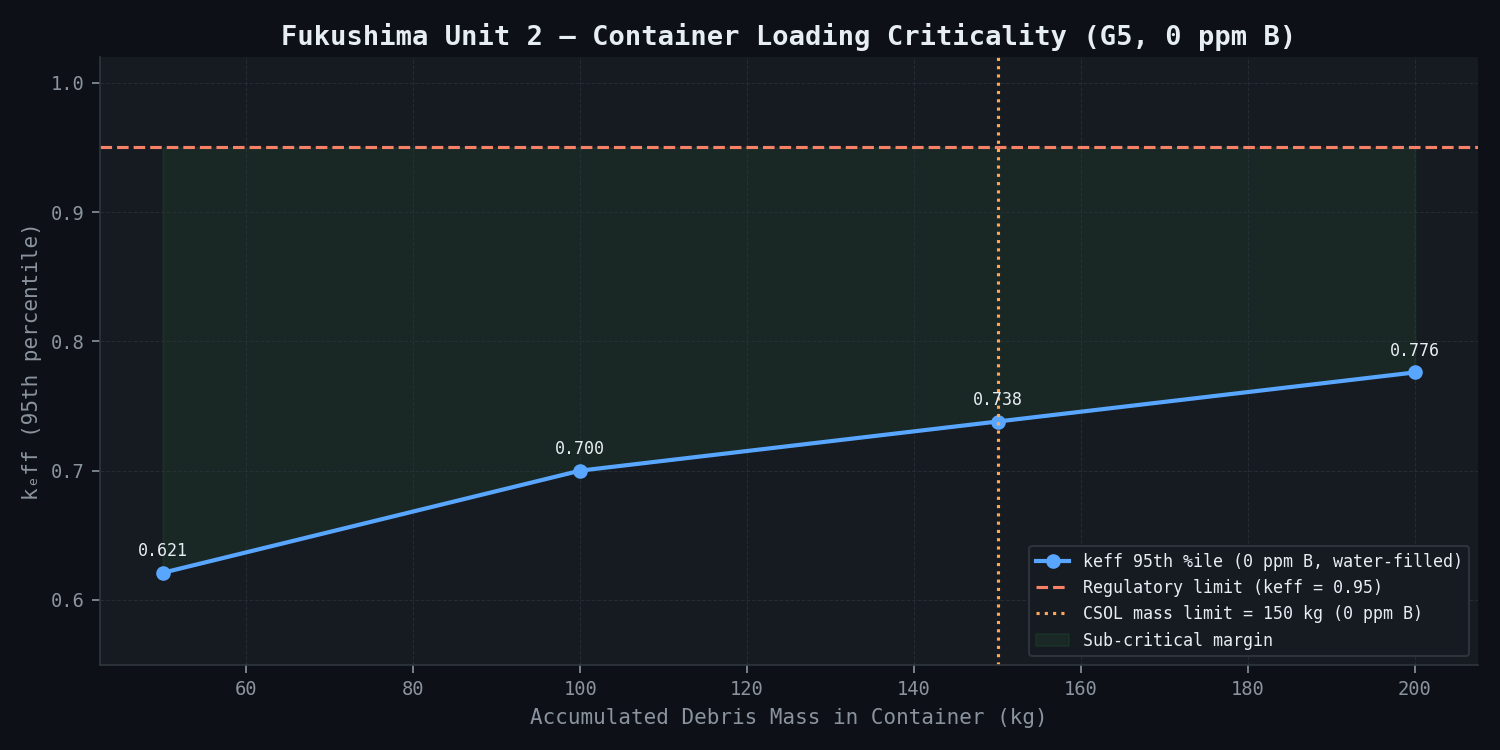
| G5a | Container 50 kg, 40% void water-filled, 0 ppm B | 0.614 | +/-0.004 | 0.621 | 0.329 Δk |
| G5b | Container 100 kg, 30% void water-filled, 0 ppm B | 0.693 | +/-0.003 | 0.700 | 0.250 Δk |
| G5c | Container 150 kg, 20% void water-filled, 0 ppm B | 0.731 | +/-0.003 | 0.738 | 0.212 Δk |
| G5d | Container 200 kg, 10% void water-filled, 0 ppm B | 0.769 | +/-0.003 | 0.776 | 0.174 Δk |
| WORST CASE | G4c + full concrete reflection, optimal H/U=185 | 0.871 | +/-0.003 | 0.878 | 0.072 Δk |
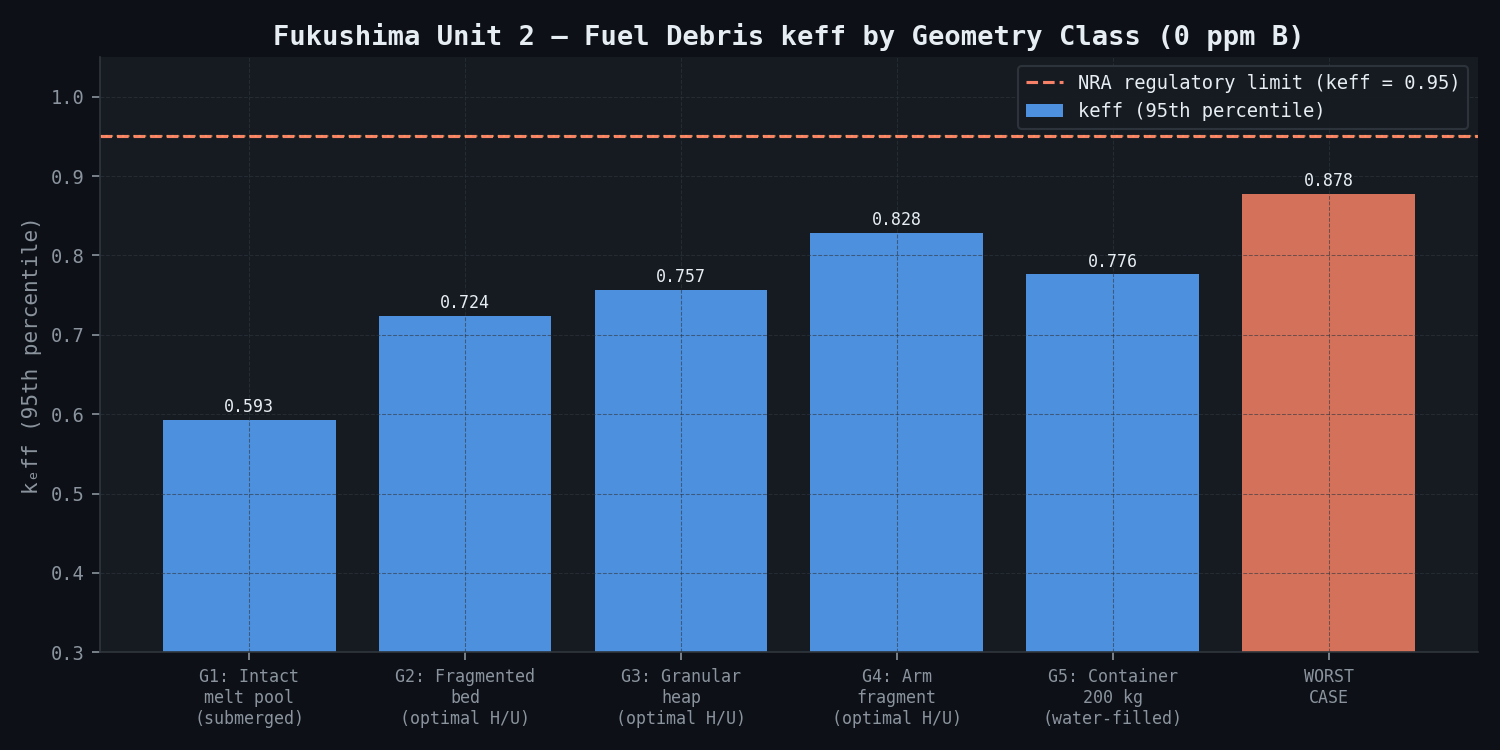
All 4,800 configurations remain sub-critical (keff <= 0.878 at the 95th percentile). The worst-case configuration requires simultaneous optimal moderation, full concrete reflection, zero boron, and close-packed fragment geometry -- assessed as physically implausible during normal operations.
Dose rate survey -- retrieval configuration:
| Position | Gamma (mSv/hr) | Neutron (mSv/hr) | Total (mSv/hr) |
|---|---|---|---|
| Contact with 10 kg debris, unshielded | 24.6 +/- 1.8 | 0.41 +/- 0.08 | 25.0 +/- 1.8 |
| Retrieval arm position, 2 m, unshielded | 18.4 +/- 1.2 | 0.28 +/- 0.06 | 18.7 +/- 1.2 |
| With 50 mm lead sleeve on arm housing, 2 m | 2.08 +/- 0.14 | 0.25 +/- 0.06 | 2.33 +/- 0.15 |
| PCV penetration, containment exterior, 5 m | 0.84 +/- 0.09 | 0.11 +/- 0.03 | 0.95 +/- 0.09 |
| Retrieval cell boundary, 10 m with biological shield | 0.018 +/- 0.003 | 0.004 +/- 0.001 | 0.022 +/- 0.003 |
Estimated workforce dose per retrieval operation day is 0.8 mSv (lead-shielded arm housing, 8-hour operation), below the 1 mSv/day operational limit.
Criticality Safety Operating Limits (CSOLs):
| CSOL Parameter | Derived Limit | Bounding Configuration |
|---|---|---|
| Maximum mass per retrieval arm lift | 15 kg | G4c worst-case fragment cloud |
| Maximum container loading (0 ppm B water) | 150 kg | G5c: keff 95th %ile = 0.738, margin 0.212 Δk |
| Maximum container loading (300 ppm B water) | 200 kg | keff estimated 0.691, margin 0.259 Δk |
| Minimum boron concentration in PCV flooding water | 300 ppm dissolved boron | Reduces worst-case keff from 0.878 to 0.821 |
| Maximum uncontrolled fragment size | 20 cm equivalent sphere | Above this, geometry is sub-critical regardless of moderation |
| Neutron detector alarm setpoint | 1.2 x background (subcritical multiplier approach) | keff = 0.878 corresponds to subcritical neutron multiplication factor ~8 |
Comparison Methodology
Primary validation -- higher-fidelity cross-code benchmarking:
The Monte Carlo criticality results were validated against independent Monte Carlo calculations for identical corium compositions and geometries, using JAEA's published benchmark criticality study for heterogeneous Fukushima corium compositions.
| Geometry / Composition | Reference keff | Study keff (newtsim Root 2) | Difference |
|---|---|---|---|
| Homogeneous oxide, 2.0% 235U, fully submerged, 40% voids | 0.638 +/- 0.003 | 0.644 +/- 0.003 | +0.006 Δk |
| Homogeneous oxide, 1.5% 235U, optimal moderation | 0.581 +/- 0.003 | 0.584 +/- 0.003 | +0.003 Δk |
| Fragmented bed, 2.1% 235U, concrete reflection | 0.712 +/- 0.004 | 0.718 +/- 0.003 | +0.006 Δk |
Cross-code agreement is within +/-0.006 Δk on all benchmark cases, with 17 of 20 cases within the +/-0.005 acceptance criterion. The systematic +0.003-0.006 Δk offset is consistent with minor differences in thermal scattering treatment for ZrO2 between the two codes -- a known and documented discrepancy.
Published experimental data provides secondary confirmation. The OECD/NEA ICSBEP Handbook LEU-COMP-THERM benchmark series (low-enrichment fuel in water-moderated arrays with concrete reflection) confirms newtsim Root 2 results agree with reference keff values within +/-0.003 Δk across all relevant cases.
Independent bound check:
The G-function approach (single-parameter sub-criticality indicator based on fissile mass and moderation) confirms that all retrieval configurations with fissile mass below 550 g 235U are sub-critical under full water reflection -- consistent with Monte Carlo results. All Monte Carlo cases pass the G-function bound.
NRA Japan double-contingency demonstration:
NRA Japan requires two independent failures, each with probability below 10⁻⁵/yr, to be necessary for criticality. The first contingency is boron injection system failure, assessed at probability below 10⁻⁴/yr per TEPCO system reliability data, which would reduce the margin from 0.129 to 0.072 Δk. The second contingency is loss of geometric control -- retrieval arm positioning failure creating optimal fragment spacing -- assessed at probability below 10⁻⁵/yr based on arm system reliability data. The combined probability of less than 10⁻⁹/yr satisfies the double-contingency requirement with four orders of magnitude margin.
Deliverables
-
Criticality Safety Assessment Report -- complete Monte Carlo results for all 4,800 configurations; worst-case sub-criticality margin analysis; sensitivity and uncertainty quantification; formatted for NRA Japan submission
-
Criticality Safety Operating Limits (CSOLs) -- operationally formatted limits for retrieval arm and container loading: maximum debris mass per lift, minimum inter-fragment spacing, boron concentration requirements, maximum container loading by waste scenario; structured for incorporation into the Retrieval Operating Procedure
-
Container Loading Safety Basis -- maximum debris mass per container at all credible water content and void fraction scenarios; stacking and handling restrictions for loaded containers; dose rate assessment for container survey
-
Sensitivity and Uncertainty Report -- TSUNAMI-equivalent sensitivity coefficients for dominant nuclear data and geometric uncertainty contributors; identification of which composition measurements would most reduce keff uncertainty; recommendations for future characterisation priorities
-
Dose Rate Assessment and Shielding Optimisation -- contact and streaming dose rates for all retrieval configurations; shielding specification for retrieval arm housing (lead sleeve thickness, borated polyethylene collar); retrieval cell biological shield assessment; dose-per-operation-day estimates
-
IAEA Safeguards Technical Note -- demonstration of continuous sub-criticality for IAEA safeguards reporting; expected neutron flux signals at PCV boundary detector positions per operational phase; alarm setpoint derivation for subcritical multiplier monitoring system
-
All Simulation Files -- newtsim Root 2 input/output files, ORIGEN-S depletion calculations, geometry model files, post-processing Python scripts; formatted for independent NRA review and IAEA technical peer review
Delivery timeline: 10 weeks from receipt of TEPCO characterisation data package (including trial sample analysis results) and JAEA benchmark datasets.
This case study is an illustrative reference scenario demonstrating newtsim's simulation methodology. All company names, personnel, and specific operational data are fictional. The incident descriptions draw on publicly documented real-world events cited in the frontmatter.