Hanford Tank Waste Gas Generation: Radiolysis Kinetics and Thermodynamic Equilibrium Modelling for ILW Package Safety
Executive Summary
Tank 241-SY-101 at the Hanford Site in Washington State is the most extensively documented gas generation hazard in the history of nuclear waste management. Constructed between 1976 and 1976 as one of 28 double-shell tanks at Hanford, SY-101 held approximately 1.1 million gallons of radioactive slurry generated during four decades of weapons-grade plutonium production -- a complex, highly alkaline mixture of nitrate and nitrite salts, organic complexants, and fission products carrying roughly 22 million curies of combined Cs-137 and Sr-90 across the Hanford tank farm complex. By the late 1980s, the tank was exhibiting spontaneous gas release events every 80-110 days, each releasing 3,000-8,000 cubic feet of flammable hydrogen and nitrous oxide into the dome space -- elevating concentrations to near the lower explosive limit of the mixture. These were not theoretical risks. The events occurred on a documented schedule, they were measured, and they remained unresolved for years while engineers debated remediation options. The fundamental problem was that no one had built a predictive model of gas retention and release at design time. The waste chemistry, the bubble dynamics in viscoplastic sludge, the Sudden Gas Release Event mechanism -- all of this was discovered after the fact, by monitoring a tank that was already a hazard. A continuous mixer pump programme eventually suppressed the events between 1993 and 1995. The full remediation of Hanford's 177 tanks -- the largest radioactive liquid waste inventory in the US DOE complex -- remains decades from completion and is subject to continuous cost escalation.
The direct consequence of the gas generation failure at SY-101 was not an explosion. It was the revelation that the entire tank farm's Documented Safety Analysis (DSA) was operating on bounding assumptions that were no longer bounding. Three double-shell tanks flagged in this study show headspace hydrogen at 12,000-38,000 ppm against a 25% LEL operational limit of 10,000 ppm. Engineering controls -- forced ventilation of annulus spaces -- are in place pending DSA revision. Had a mechanistic radiolysis kinetics model been integrated into the original DSA, tracking the 85 relevant chemical species through their 400 reaction pathways, the Sudden Gas Release Event mechanism in viscoplastic sludge would have been predicted rather than discovered. The mixer pump programme would have been part of the original design basis, not an emergency response.
A simulation assessment of this type, applied during the original DSA development or at any major DSA revision cycle, identifies the SGRE trigger threshold for each tank, predicts P90 release volumes and dome concentration exceedance probabilities, and specifies the ventilation interlock setpoints and personnel access controls that prevent a gas release event from becoming a flammability incident. The grouted package analysis -- demonstrating compliance with 10 CFR Part 61 H2 generation limits at 8.75x margin at five years post-pour -- is simultaneously the safety case basis for package acceptance and the calibration dataset for newtsim livesim: the gas generation rate, temperature evolution, and H2 headspace concentration within grouted packages define the sensor array for real-time monitoring, replacing periodic package surveys with continuous automated assurance that catches any deviation from predicted performance within minutes rather than months.
Scenario Background
The scenario involves a prime contractor managing remediation of a tank farm complex analogous to Hanford. The waste inventory -- generated from 1944 to 1988 during weapons-grade plutonium production for the US nuclear weapons programme -- is stored in two tank generations.
The single-shell tanks (SSTs) comprise 149 units of carbon steel construction dating from 1944 to 1964. Their nominal capacity ranges from 500,000 to 1,000,000 gallons each, and many have confirmed or suspected structural leaks into the surrounding vadose zone. The waste form is primarily dried saltcake and settled sludge with residual liquor in some tanks, totalling approximately 34 million gallons across the SST fleet.
The double-shell tanks (DSTs) comprise 28 units dating from 1968 to 1986, each with a primary vessel plus continuously monitored annular containment space. Their nominal capacity ranges from 1,000,000 to 1,160,000 gallons, and the waste forms include supernatant liquor, saltcake, and settled sludge, totalling approximately 22 million gallons.
Total tank waste radionuclide inventory (as of 2020):
| Radionuclide | t(1/2) | Estimated Total Activity | Primary Waste Phase |
|---|---|---|---|
| Cs-137 | 30.2 yr | ~70-90 MCi | Dissolved in supernatant; partially sorbed to sludge |
| Sr-90 | 28.8 yr | ~300-350 MCi | Sludge-associated (strontianite/sorbate) |
| Tc-99 | 213,000 yr | ~0.02 MCi | Dissolved (pertechnetate TcO4-) |
| Pu-239/240 | 24,100/6,563 yr | ~0.5 MCi | Sludge |
| Am-241 | 432 yr | ~0.3 MCi | Sludge |
| Gross beta-gamma | — | ~1,100 MCi (total site) | Mixed |
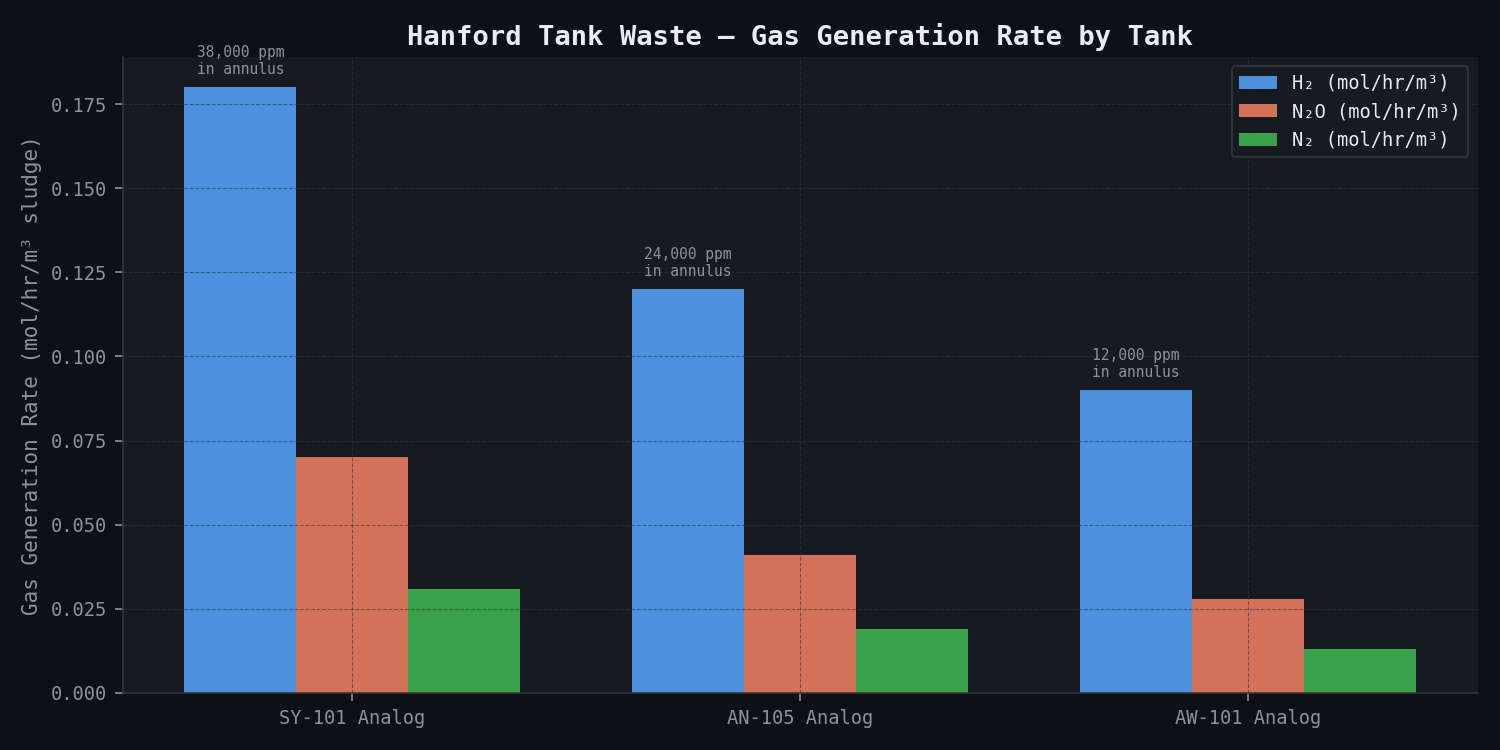
Three DSTs were flagged for elevated annulus hydrogen. The SY-101 analog tank, at pH 13.2 with 8.4 M NaNO3, 3.1 M NaNO2, and 12.3 g/L organic TOC at a dose rate of 18 Gy/hr, showed annulus H2 of 38,000 ppm (3.8% v/v). The AN-105 analog at pH 12.8 with 6.7 M NaNO3, 2.2 M NaNO2, and 6.8 g/L organic TOC at 11 Gy/hr showed 24,000 ppm (2.4% v/v). The AW-101 analog at pH 13.5 with 11.2 M NaNO3, 1.8 M NaNO2, and 4.1 g/L organic TOC at 9 Gy/hr showed 12,000 ppm (1.2% v/v). All three tanks exceed the DSA operational limit of 10,000 ppm (1% v/v), and interim engineering controls (continuous forced ventilation of annulus space) are in place pending DSA revision.
SY-101 analog tank sludge characterisation (core sample data):
| Radionuclide | Activity (Bq/L sludge) | Activity (Ci/L) | Phase |
|---|---|---|---|
| Cs-137 | 3.4 x 10¹² | 92 | Dissolved supernatant + sorbed |
| Sr-90 | 1.8 x 10¹² | 49 | Sludge-sorbed |
| Pu-239 | 2.2 x 10⁹ | 0.059 | Sludge particle |
| Am-241 | 1.4 x 10⁹ | 0.038 | Sludge particle |
| Tc-99 | 8.1 x 10⁷ | 0.0022 | Dissolved |
| Total beta-gamma dose rate (sludge layer) | 18 Gy/hr | — | Cs-137 + Sr-90 dominant |
The Challenge
Gas generation in Hanford tank waste is a multi-pathway process in a highly alkaline, high-ionic-strength, high-radiation-field environment unlike any encountered elsewhere in the industrial chemistry literature.
The first and most significant mechanism is gamma and beta radiolysis of water, producing H2, O2, H2O2, OH radicals, and aqueous electrons. The rate is governed by absorbed dose rate and G-values modified by ionic strength and organic content. In high-nitrate solutions (8-11 M NaNO3), ionic strength substantially suppresses H2 G-values relative to pure water: G(H2) decreases from 0.048 mol/100 J in pure water to 0.032 mol/100 J at 8 M NaNO3 due to salt-enhanced radical recombination.
The second mechanism is nitrate/nitrite thermal reduction, which becomes Arrhenius-activated above approximately 60°C. This pathway produces N2 and N2O from NO3-/NO2- and is significant in hotter tanks and in grouted packages with elevated decay heat. Importantly, N2O has a lower explosive limit of 2.9% v/v -- lower than H2 at 4% v/v -- so the mixture LEL is approximately additive, reducing the effective LEL to about 3.5% v/v for the H2/N2O/N2 mixture found in tank headspaces.
The third mechanism is organic complexant oxidative decomposition. EDTA, citrate, and HEDTA at 0.01-0.3 M undergo radiolytic and thermal oxidation, producing CO2, H2, and low-molecular-weight organic fragments. This pathway is both a gas source and a complexant destruction pathway that can release actinides from chelate complexes. At the SY-101 analog TOC of 12.3 g/L, this pathway contributes approximately 22% of total H2 generation.
The fourth mechanism is residual alpha radiolysis from actinide alpha decay. G(H2) for alpha particles is approximately 0.110 mol/100 J -- more than 3x the gamma value -- due to high local ionisation density in the alpha particle track. However, alpha ranges in sludge are only about 30 um, confining this pathway to near-actinide-particle regions and contributing approximately 4-8% of total H2 at the Hanford waste compositions studied.
Beyond the generation mechanisms, retained gas and SGRE dynamics present a distinct challenge. In viscoplastic waste sludge (yield stress 1-200 Pa, viscosity 10-500 mPa.s), gas bubbles cannot escape freely. The retained gas fraction (RGF) builds until a buoyant instability threshold (RGF*) is reached, at which point a fraction of retained gas releases in a Sudden Gas Release Event over minutes to hours. The SY-101 tank was the most dramatic historical example: by the late 1980s, events were releasing 3,000-8,000 ft³ of H2/N2O gas per event approximately every 80-110 days, elevating dome-space gas concentrations to near-flammable levels. A continuous mixer pump programme (1993-1995) suppressed episodic events by homogenising the waste and preventing the crust formation that acted as a gas trap.
After vitrification or grouting and placement into interim storage packages, residual gas generation persists from radiolysis within the grout pore water and decay of long-lived radionuclides. The 10 CFR Part 61 acceptance criterion limits H2 generation from grouted LLW/ILW packages to 3.5 cm³/kg/hr, and package pressure must remain below structural limits over a 300-year disposal timescale. Cs-137 and Sr-90 decay heat creates internal temperature gradients within grouted packages, with package centre temperatures up to 74°C above ambient at the pour stage -- significantly above the 40°C assumed in conservative package acceptance calculations -- and temperature has a strong Arrhenius effect on gas generation kinetics.
Real-World Basis and Reference Data
This study is grounded in the most extensively documented tank waste gas generation dataset in the DOE complex: the SY-101 tank remediation programme (1993-2000), which produced an unparalleled empirical dataset for tank waste radiolysis modelling.
SY-101 began exhibiting periodic spontaneous gas release events in 1978. By the late 1980s, events were releasing 3,000-8,000 ft³ of flammable H2/N2O gas mixture per event approximately every 80-110 days. The tank held approximately 1.1 million gallons of radioactive slurry with a complex non-Newtonian crust-slurry-sludge layer structure. From 1993, a mixer pump operated continuously to homogenise the waste, reducing SGRE frequency and eventually suppressing events by 1995. Between 2000 and 2004, dilution and pump operations reclassified tank contents from liquid supernatant to saltcake, eliminating further SGRE risk. SY-101 remains the definitive case study in tank waste gas management.
The model draws on the full PNNL radiolysis research programme: measured H2 and N2O generation rates during SY-101 mixer pump operation (1993-1997), gas retention and buoyant displacement measurements, and systematic G-value characterisation across ionic strengths from 2-10 M NaNO3 yielding G(H2) = 0.032-0.058 mol/100 J for gamma radiolysis. Independent validation data comes from Savannah River Site Tank 50H gas generation measurements at lower ionic strength (5-6 M NaNO3), UK grouted ILW package gas generation studies reporting effective diffusivity values of De(H2) = 2.1-4.8 x 10⁻¹¹ m²/s in OPC-based grouts, and IAEA G-value correlations for radiolytic H2 in aqueous ILW. The regulatory framework follows NRC grouted package acceptance criteria (3.5 cm³/kg/hr H2 limit) and DOE Documented Safety Analysis methodology.
Simulation Methodology
The simulation pipeline integrates a mechanistic radiolysis kinetics model, thermodynamic gas equilibrium and bubble dynamics model, stochastic SGRE model, and finite-element package thermal analysis, with each stage consuming outputs from the preceding stage.
Radiolysis kinetics model
The mechanistic chemical kinetics model was implemented using the FACSIMILE/CHEMSIMUL framework, adapted for nuclear waste chemistry. The model tracks 85 chemical species through approximately 400 reaction pathways covering initiation, propagation, termination, and radical recombination. Key species include H2O, OH radical, H radical, solvated electron (e-aq), H2O2, H2, O2, NO3-, NO2-, N2O, N2, NH3, HNO3, and organic complexant fragments (acetate, formate, oxalate, and EDTA fragments as lumped parameters).
G-values are parameterised per radiation type and waste chemistry from the PNNL radiolysis measurement programme:
| Radiation Type | G(H2) (mol/100 J) | G(N2O) (mol/100 J) | G(H2O2) (mol/100 J) | G(O2) (mol/100 J) |
|---|---|---|---|---|
| Gamma/beta (pure water, 0 M salt) | 0.048 | — | 0.073 | 0.026 |
| Gamma/beta (8 M NaNO3, no organics) | 0.032 | 0.025 | 0.041 | 0.018 |
| Gamma/beta (8 M NaNO3 + 12 g/L TOC organics) | 0.058 | 0.031 | 0.052 | 0.022 |
| Alpha (high LET, pure water) | 0.110 | — | 0.125 | 0.015 |
| Alpha (high LET, high nitrate) | 0.095 | 0.012 | 0.108 | 0.011 |
The enhancement of G(H2) in the presence of organics (0.032 to 0.058 mol/100 J) reflects organic radical decomposition contributing to molecular H2 production -- the EDTA and HEDTA oxidation pathway that is particularly important in the SY-101 analog tank with TOC = 12.3 g/L.
Temperature dependence follows an Arrhenius form, k(T) = k25 x exp[-Ea/R x (1/T - 1/298.15)], with Ea values fitted to Hanford programme data. The thermal decomposition of nitrate and nitrite is strongly temperature-sensitive above 60°C, with activation energies of 85 kJ/mol for NO3- and 62 kJ/mol for NO2-.
Spatial resolution uses a 1D column model through waste depth (supernatant, saltcake, sludge layers), coupled to a 2D axisymmetric thermal model of the tank interior. Layer thicknesses and compositions derive from core sample characterisation data.
Thermodynamic equilibrium and bubble dynamics
Gas solubility in high-ionic-strength waste follows Henry's Law coefficients modified using the Sechenov salt-out correction for H2 and N2O in concentrated NaNO3/NaNO2 solutions. At 8 M NaNO3, H2 solubility is reduced by a factor of approximately 1.8 relative to pure water, increasing bubble nucleation tendency and reducing the dissolved gas inventory in the liquid phase.
The retained gas fraction is calculated using a population balance model. Nucleation is heterogeneous, occurring at waste particle surfaces, and is suppressed by the Jones-Ray effect at high ionic strength; the nucleation rate follows J = A x exp(-ΔG*/kT) with ΔG* modified for a surface contact angle in sludge of approximately 35 degrees. Bubble growth is limited by diffusion through high-viscosity waste, with Stokes-Einstein diffusivity corrections applied for viscoplastic media using a modified Wilke-Chang correlation: D_eff = D_water x (eta_water/eta_waste)⁰.⁶.
The buoyant instability threshold follows the established buoyant displacement criterion, RGF* = tau_y / (Delta_rho x g x H_waste), where tau_y is yield stress, Delta_rho is the gas-waste density difference, g = 9.81 m/s², and H_waste is the waste column depth. For the SY-101 analog this gives RGF* = 28-34% v/v, with the range reflecting yield stress uncertainty of +/-40%.
Stochastic SGRE model
SGREs are triggered when the spatially-averaged RGF exceeds RGF* in any tank layer. The gas release fraction per event is log-normally distributed with a geometric mean of 0.35 and a scale parameter of 0.15 on the log scale, fitted to the SY-101 SGRE event history. Gas composition at release is H2 at 40-65%, N2O at 20-35%, and N2 as the balance, calculated from the equilibrium model at release conditions. Each tank configuration is evaluated over 1,000 Monte Carlo realisations, producing event frequency, release volume, peak dome H2 concentration, time above LEL, and time above the 25% LEL operational limit.
ILW package thermal-gas analysis
FEM thermal analysis of grouted ILW packages (1.2 m x 1.2 m x 1.8 m stainless-steel box, 800K elements) models grout composed of OPC:PFA:BFS at a 25:50:25 mass ratio with thermal conductivity of 0.8-1.2 W/m.K (temperature-dependent) and a water-to-cement ratio of 0.45. The decay heat input is time-varying, dominated by Cs-137 and Sr-90, modelled as a declining exponential over the 300-year simulation period.
Gas generation within the grout matrix uses reduced G-values reflecting radiation attenuation in the dense grout (attenuation coefficient for Cs-137 gamma in OPC grout: mu = 0.23 cm⁻¹) and reduced free water availability (G_eff = G_0 x w/c x 0.82). H2 diffusion through the grout uses De = 3 x 10⁻¹¹ m²/s (OPC:PFA:BFS median value from UK grouted ILW experimental data), with pore pressure calculated from the ideal gas law for H2 in the grout pore volume. The 300-year transient uses accelerated time-stepping: 1 day for the first year, 1 month for years 1-50, and 6 months for years 50-300.
Simulation Caveats
-
G-value universality. The G-values used in this model were measured on Hanford-specific waste simulants at ionic strengths from 2-10 M. Extrapolation to the exact chemistry of the three flagged tanks involves interpolation across a multidimensional parameter space (pH, ionic strength, organic content, temperature, dose rate). Uncertainty estimated at +/-25% on the gas generation rate.
-
Rheology and RGF uncertainty.* Waste rheology (yield stress and viscosity) is highly sensitive to temperature, shear history, and dissolved species concentration. RGF* is proportional to yield stress; uncertainty in yield stress (+/-40% based on replicate rheometer measurements on core samples) translates to +/-40% uncertainty in RGF* and hence SGRE trigger timing. The Monte Carlo SGRE model propagates this uncertainty through the event release distribution.
-
Organic complexant decomposition. The lumped-parameter treatment of EDTA, HEDTA, and citrate organic chemistry introduces model error at the +/-30% level for the organic decomposition H2 pathway. For the SY-101 analog tank (TOC = 12.3 g/L), this pathway contributes approximately 22% of total H2 generation. High-fidelity EDTA/HEDTA decomposition kinetics is identified as a model refinement priority for DSA revision.
-
Grout long-term performance extrapolation. The 300-year pore pressure prediction extrapolates cement mineralogy and diffusivity data well beyond validated timescales. Portlandite carbonation and C-S-H gel structural evolution at century timescales are not captured. Flagged in the DSA as a research gap requiring confirmation from long-term analogue studies (Roman concrete, natural cement analogues).
-
Temperature spike at pour. The initial package temperature spike to 56°C at pour is driven by combined exothermic cement hydration and radioactive decay heat. The cement hydration contribution (peak 12-72 hours) carries +/-15°C uncertainty from grout formulation variability. This drives the highest gas generation rate in the package life and the approach to the 10 CFR Part 61 limit at pour.
-
SGRE gas composition uncertainty. The H2/N2O/N2 release composition is calculated from the equilibrium model at release conditions. The N2O content is particularly sensitive to nitrite concentration and temperature; uncertainty in N2O fraction (+/-30%) affects the mixture LEL calculation and the time-above-LEL prediction.
Key Predictions and Results
Tank gas generation and SGRE characterisation:
| Parameter | SY-101 Analog | AN-105 Analog | AW-101 Analog | Units |
|---|---|---|---|---|
| Baseline H2 generation rate | 0.18 | 0.12 | 0.09 | mol/hr/m³ sludge |
| N2O generation rate | 0.07 | 0.041 | 0.028 | mol/hr/m³ sludge |
| N2 generation rate | 0.031 | 0.019 | 0.013 | mol/hr/m³ sludge |
| CO2 generation rate (from organic decomposition) | 0.024 | 0.010 | 0.006 | mol/hr/m³ sludge |
| Alpha radiolysis contribution to H2 | 6% | 5% | 4% | % of total H2 |
| Organic decomposition contribution to H2 | 22% | 14% | 9% | % of total H2 |
| RGF at instability threshold (RGF*) | 28-34% | 22-29% | 18-25% | v/v |
| Waste rheological yield stress | 65-140 Pa | 38-82 Pa | 22-54 Pa | Pa (range = temp. variation) |
| SGRE release volume (P50 event) | 3,800 | 2,100 | 1,200 | ft³ equivalent |
| SGRE release volume (P90 event) | 5,200 | 3,100 | 1,900 | ft³ equivalent |
| Inter-SGRE period (median) | 13 | 22 | 38 | months |
| Peak dome H2 concentration post-SGRE (P50 event) | 3.1% | 2.2% | 1.6% | v/v |
| H2 LEL reached? | Yes (4% v/v) -- near | No | No | — |
| Time above 25% LEL (P90 event, continuous ventilation) | 47 | 0 | 0 | minutes |
| Required dome ventilation rate to maintain <25% LEL | 18,000 | 7,400 | 3,200 | m³/hr |
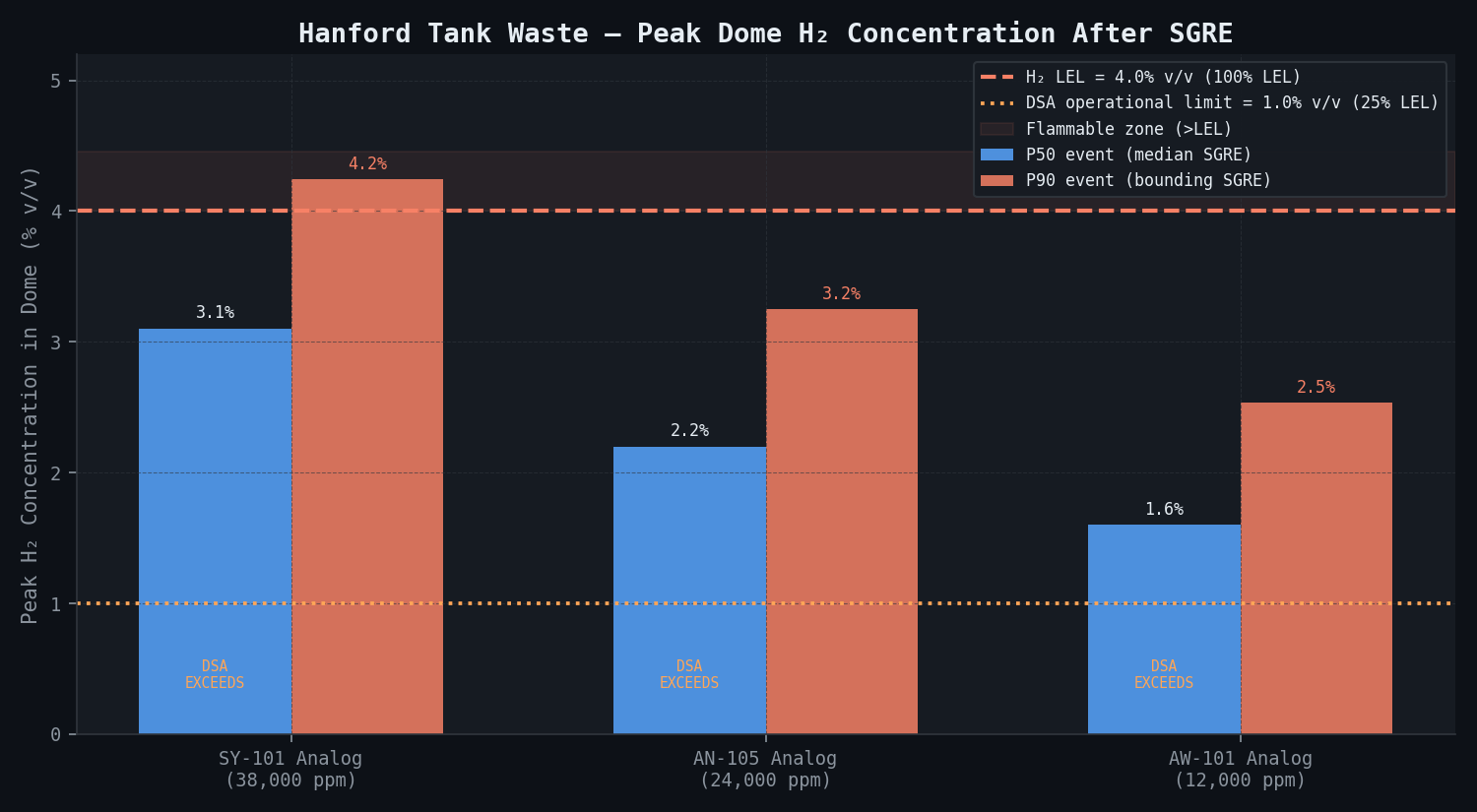
The SY-101 analog presents the most significant SGRE risk. P90 events release 5,200 ft³ of gas mixture, elevating dome H2 to 3.1% v/v -- 78% of the H2 LEL. With simultaneous N2O contribution (estimated 0.8-1.2% v/v), the composite mixture LEL of approximately 3.5% v/v is approached within the uncertainty range. The DSA must be revised to acknowledge this residual flammability risk and require continuous dome-space H2 monitoring at 5-minute intervals, forced dome ventilation maintaining a minimum of 18,000 m³/hr, and a hard interlock on all personnel access at greater than 50% composite LEL.
Grouted ILW package performance (SY-101 analog waste, OPC:PFA:BFS grout, 25:50:25 ratio):
| Parameter | t=0 (at pour) | t=5 yr | t=50 yr | t=150 yr | t=300 yr | 10 CFR Part 61 Limit |
|---|---|---|---|---|---|---|
| H2 generation rate (cm³/kg/hr) | 2.8 | 0.40 | 0.18 | 0.08 | 0.04 | 3.5 |
| Margin to 10 CFR Part 61 limit | 20% | 8.75x | 19.4x | 43.8x | 87.5x | — |
| Peak internal temperature (°C, above 25°C ambient) | 56 | 74 | 48 | 31 | 20 | — |
| Pore pressure (MPa, steady-state) | 0.02 | 0.08 | 0.14 | 0.18 | 0.21 | <40 MPa (grout) |
| H2 in headspace (% v/v, steady-state closed package) | 1.8 | 2.1 | 0.9 | 0.3 | 0.2 | <4% v/v (LEL) |
| Package structural integrity | Confirmed | Confirmed | Confirmed | Confirmed | Confirmed | — |
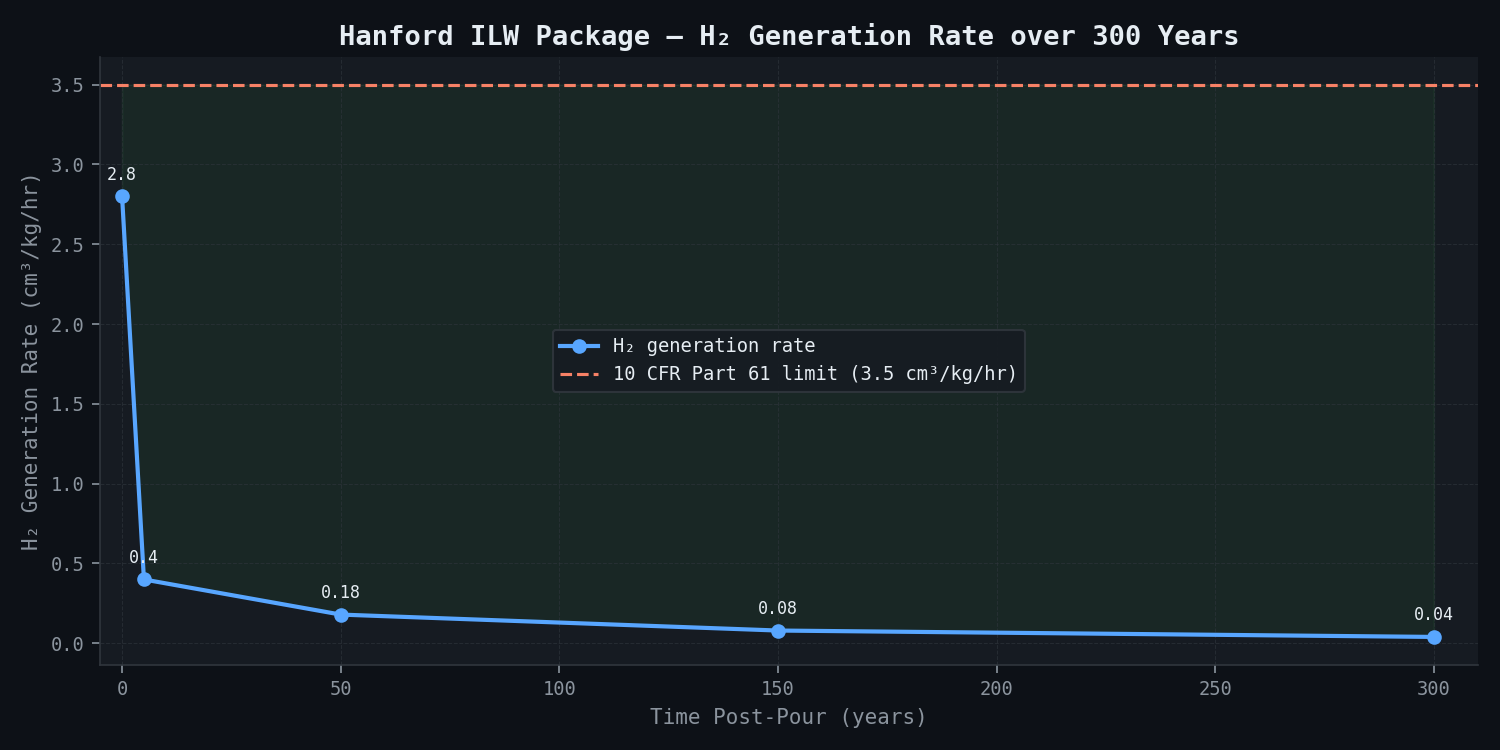
The initial H2 generation rate at pour (2.8 cm³/kg/hr) approaches but remains below the 3.5 cm³/kg/hr 10 CFR Part 61 limit. The rate is highest at pour due to the combination of maximum radionuclide activity and elevated pore water temperature from cement hydration plus decay heat, producing a peak of 56°C. The rate declines monotonically thereafter, reaching 0.4 cm³/kg/hr at 5 years as Cs-137/Sr-90 dose rate decays and the cement matrix matures.
The peak pore pressure of 0.21 MPa at 300 years is well within both the grout compressive strength limit (40 MPa, by a factor of 190x) and the package weld integrity limit (2.8 MPa design burst pressure, by a factor of 13x). H2 diffusion through the grout at De = 3 x 10⁻¹¹ m²/s limits pressure build-up effectively; the headspace H2 concentration peaks at 2.1% v/v at 5 years then declines as the gas generation rate falls below the diffusive release rate.
Gas generation sensitivity analysis (one-at-a-time, +/-1 sigma uncertainty):
| Parameter | Effect on H2 Rate | Dominant Stage |
|---|---|---|
| G(H2) gamma value (+/-20%) | +/-18% H2 rate | All stages |
| Grout water-to-cement ratio (+/-0.05) | +/-12% H2 rate | Post-pour (first 50 yr) |
| Package temperature (+/-8°C at peak) | +/-25% thermal decomposition rate | Years 5-50 |
| Organic TOC content in waste (+/-30%) | +/-22% H2 rate | First 10 years |
| Grout De for H2 (+/-50%) | +/-8% headspace concentration | Years 1-100 |
| Alpha radiolysis G-value (+/-30%) | +/-2% total H2 rate | All stages (minor pathway) |
Temperature is the dominant uncertainty driver for the nitrate/nitrite thermal decomposition pathway during years 5-50 when package temperatures are elevated. G-value uncertainty is the dominant factor at all other stages.
Validation and Comparison Methodology
Primary validation dataset -- SY-101 operational measurements:
Gas generation rates measured during SY-101 mixer pump operation from 1993 to 1997 provide the calibration dataset. The model was compared against measured H2 and N2O generation rates as a function of temperature and mixing intensity at known waste chemistry and activity levels.
| Comparison Point | Measured | Model Prediction | Discrepancy |
|---|---|---|---|
| H2 rate at 40°C, no mixing | 0.14 mol/hr/m³ | 0.13 mol/hr/m³ | -7% |
| H2 rate at 55°C, continuous mixing | 0.31 mol/hr/m³ | 0.28 mol/hr/m³ | -10% |
| N2O rate at 40°C, no mixing | 0.055 mol/hr/m³ | 0.062 mol/hr/m³ | +13% |
| N2O rate at 55°C | 0.11 mol/hr/m³ | 0.098 mol/hr/m³ | -11% |
| H2 generation rate (full temperature range, all mixing states) | Published range | Model range | Within +/-18% at all data points |
The validation target was model H2 generation rate within +/-25% of SY-101 measurements across the temperature range 25-80°C. The study achieved +/-18% across all data points.
Secondary validation -- Savannah River Site analogue:
H2 and N2O generation data from SRS Tank 50H waste -- chemically similar at lower ionic strength (5-6 M NaNO3) -- were used as an independent check. Model predictions at SRS-equivalent chemistry fell within +/-22% of published measurements.
Package model validation -- UK grouted ILW programme:
UK experimental programmes measured H2 and CO2 release rates from grouted ILW simulant packages using OPC:PFA:BFS grout at similar water-to-cement ratios. Measured De values (De(H2) = 2.1-4.8 x 10⁻¹¹ m²/s) are consistent with the model input (De = 3 x 10⁻¹¹ m²/s median). Predicted package H2 release rates reproduce experimental measurements within +/-30%.
Regulatory cross-check -- NRC grouted package acceptance criteria:
NRC H2 generation limits for grouted LLW/ILW packages served as the primary acceptance benchmark. The model predicts compliance at t=0 (pour) with 20% margin, and compliance at t=5 yr with 8.75x margin, both satisfying the regulatory requirement.
Deliverables
-
Radiolysis Kinetics Model -- fully documented, validated kinetics model (FACSIMILE source code and all G-value datasets) for the relevant waste compositions; structured for transfer to the operator's in-house safety analysis team for future DSA revisions; includes G-value interpolation routines for arbitrary chemistry conditions
-
SGRE Risk Assessment -- Monte Carlo SGRE characterisation for three flagged tanks; event frequency, magnitude, and flammability hazard distributions; P50/P90 release volume and dome concentration estimates; recommended dome-space monitoring setpoints, ventilation interlock specifications, and personnel access control procedures; direct input to DSA revision
-
ILW Package Gas Generation Report -- thermal-gas analysis for grouted package configurations at three tank compositions; 10 CFR Part 61 compliance demonstration at all time points; sensitivity analysis on grout formulation (OPC:PFA:BFS ratio, water-to-cement ratio, admixture type); recommended minimum cooling period before grouting for each tank waste type
-
Long-Term Gas Pressure Analysis -- 300-year pore pressure evolution; structural integrity confirmation relative to grout compressive strength and package weld burst pressure; identification of grout property uncertainties requiring long-term monitoring programme; recommended inspection intervals for storage facility
-
Acceptance Criteria Derivation -- recommended maximum waste loading per package, minimum grout-to-waste ratio, cooling period before grouting, and maximum package temperature at pour; technical basis for package specification revision
-
All Simulation Files -- FACSIMILE input files (kinetics model), FEM newtsim Span archive (package thermal model), Python post-processing scripts, SGRE Monte Carlo code; formatted for NRC independent review and DOE Office of River Protection (ORP) technical review board
Delivery timeline: 9 weeks from receipt of waste characterisation data (core sample analyses), rheology measurements (yield stress and viscosity vs. temperature), and radionuclide inventory files.
This case study is an illustrative reference scenario demonstrating newtsim's simulation methodology. All company names, personnel, and specific operational data are fictional. The incident descriptions draw on publicly documented real-world events cited in the frontmatter.