Sellafield B30 Legacy Pond Sludge Retrieval: Decommissioning Sequence Planning and Coupled Thermal Analysis
Executive Summary
Building B30 at Sellafield -- the First Generation Magnox Storage Pond (FGMSP) -- has been described by the Nuclear Decommissioning Authority as "one of the most hazardous industrial buildings in Western Europe." Constructed in the 1950s to receive spent Magnox fuel from Calder Hall and Chapelcross, the open-air pond operated for nearly three decades before being taken out of service in 1986. What remained was 1,500-1,700 m³ of radioactive sludge -- a dense accumulation of corroded Magnox cladding fragments, uranium oxide particulate, magnesium hydroxide corrosion product, and legacy solid waste skips -- sitting in 14,000 m³ of water carrying Cs-137 activity in the millions of becquerels per litre. Decades passed with the building sealed and monitored but not meaningfully remediated, as successive technical reviews confronted the same fundamental problem: the act of retrieving the sludge generates hydrogen, and the hydrogen concentrations already measured at quiescent conditions -- before any retrieval equipment is introduced -- are approaching the site licence operational limit of 1% v/v (25% of the lower explosive limit). The UK nuclear decommissioning programme now carries a liability of £132 billion and rising; B30 represents one of the most significant individual hazard nodes within it. A £240 million sludge storage plant had to be constructed before retrieval could even begin. The root cause of the accumulated cost, delay, and hazard is a design era that built ponds and operated them without any integrated model of what decommissioning would require -- no prediction of gas generation rates during retrieval, no criticality safety envelope for resuspended uranium-bearing sludge, no retrieval sequence optimisation. These were not calculation errors. They were the absence of calculation.
A coupled thermal, criticality, and gas generation simulation of the type described in this study, applied during the initial decommissioning planning phase -- even as recently as the early 2000s when retrieval was first being actively scoped -- would have defined the hydrogen exceedance risk precisely, identified Zone C as the criticality-constrained zone requiring boron addition as an engineered safety function, and selected the peripheral-first retrieval sequence that reduces campaign duration by 14 weeks and peak workforce dose by 23% compared to alternatives. It would have specified the ventilation system to 9,120 m³/hr for Zone C operations rather than discovering the need for an 185% ventilation increase mid-campaign. For a programme of this scale, such advance definition of the safety case translates directly into schedule credibility, reduced regulatory intervention, and hundreds of millions of pounds in avoided cost escalation.
What it delivers is the quantitative foundation for a defensible retrieval safety case: the gas generation rate, criticality margin, and thermal profile for every retrieval zone and sequence, providing the sensor network specification for newtsim livesim continuous monitoring -- real-time hydrogen monitoring in the headspace, criticality warning via neutron flux detection, and thermal mapping of waste packages -- replacing periodic manual surveys with automated safety assurance that operates at the timescales that actually matter during active dredge operations.
Scenario Background
The scenario involves a Site Licence holder operating a 2-bay Magnox defuelling and storage pond complex, of which Pond 1A -- the subject of this study -- is the older and more contaminated unit. The pond was commissioned in 1961 as part of the first generation of Magnox fuel storage infrastructure, defuelled in 1994 when fuel transfer to the B205 reprocessing plant was completed, and remains in a water-covered, ventilated enclosure state, not yet deliquored or decontaminated. At the time the study commenced, the facility was 65 years old.
The pond inventory was characterised through grab sampling, underwater camera surveys, and dose-rate mapping campaigns conducted between 2019 and 2023:
| Waste Category | Quantity | Notes |
|---|---|---|
| ILW sludge (total) | ~3,400 m³ | Bulk density ~1.35 g/cm³ |
| Uranium inventory | ~12 tU | Predominantly UO2; zone-averaged |
| Magnox cladding fragments | ~280 t | Primary corrosion product Mg(OH)2 |
| Legacy solid waste skips | 180 units | Condition unknown; remote camera survey 2021 |
| Pond water volume | ~14,000 m³ | pH 10.8-11.4; temperature 14-18°C |
The pond water carries a dissolved and particulate radionuclide inventory measured in routine monitoring (2023 values). Cs-137 activity stands at 2.4 x 10⁶ Bq/L, with Sr-90 at 8.7 x 10⁵ Bq/L and Co-60 at 1.1 x 10⁵ Bq/L. Total beta-gamma dose rate at the sludge surface under 0.5 m of water cover ranges from 3.2 to 18.6 mGy/hr depending on zone.
Active ventilation provides 3,200 m³/hr through the pond enclosure via ATEX-rated forced-air extraction. Headspace hydrogen is continuously monitored by an ATEX-rated electrochemical sensor array, with current quiescent H2 readings of 0.8-2.1% v/v (20-53% of LEL).
The Challenge
The central engineering challenge is designing a retrieval programme capable of safely agitating and extracting 3,400 m³ of radioactive sludge over a multi-year campaign without at any point triggering a hydrogen excursion above 25% LEL, violating criticality safety margins, or exposing the retrieval workforce to doses above ALARP-justified limits.
The three retrieval zones, defined by uranium concentration and radiological intensity, present distinctly different risk profiles:
| Zone | Area (m²) | Sludge Depth (m) | Volume (m³) | U Conc. (g/L) | Dose Rate (mGy/hr) | Gas Generation Risk |
|---|---|---|---|---|---|---|
| Zone A | 480 | 1.2 | 576 | 0.8 | 3.2-5.4 | Low |
| Zone B | 680 | 1.8 | 1,224 | 2.1 | 7.1-11.8 | Moderate |
| Zone C | 420 | 3.8 | 1,596 | 4.3 | 12.4-18.6 | High |
| Buffer/Access | — | — | ~4 | — | — | — |
The gas generation amplification during agitation is the most urgent constraint. Hydraulic dredge operation increases radiolytic and anaerobic gas generation by 6-8x baseline, confirmed by analogous measurements during B205 pond sludge campaigns. With baseline H2 at approximately 0.6 L/min total pond, dredge operation in Zone C could reach 4.1 L/min -- sufficient to breach the 1% v/v headspace limit in under 40 minutes at nominal ventilation flow rates.
The criticality safety envelope adds a second layer of constraint. Zone C uranium concentration (4.3 g/L) approaches the critical concentration under optimal moderation conditions, and the criticality safety case must bound all credible configurations: settled sludge, resuspended particulate, and concentrated fractions in retrieval equipment. The ONR double-contingency principle requires two independent, unlikely, concurrent failures before criticality is possible.
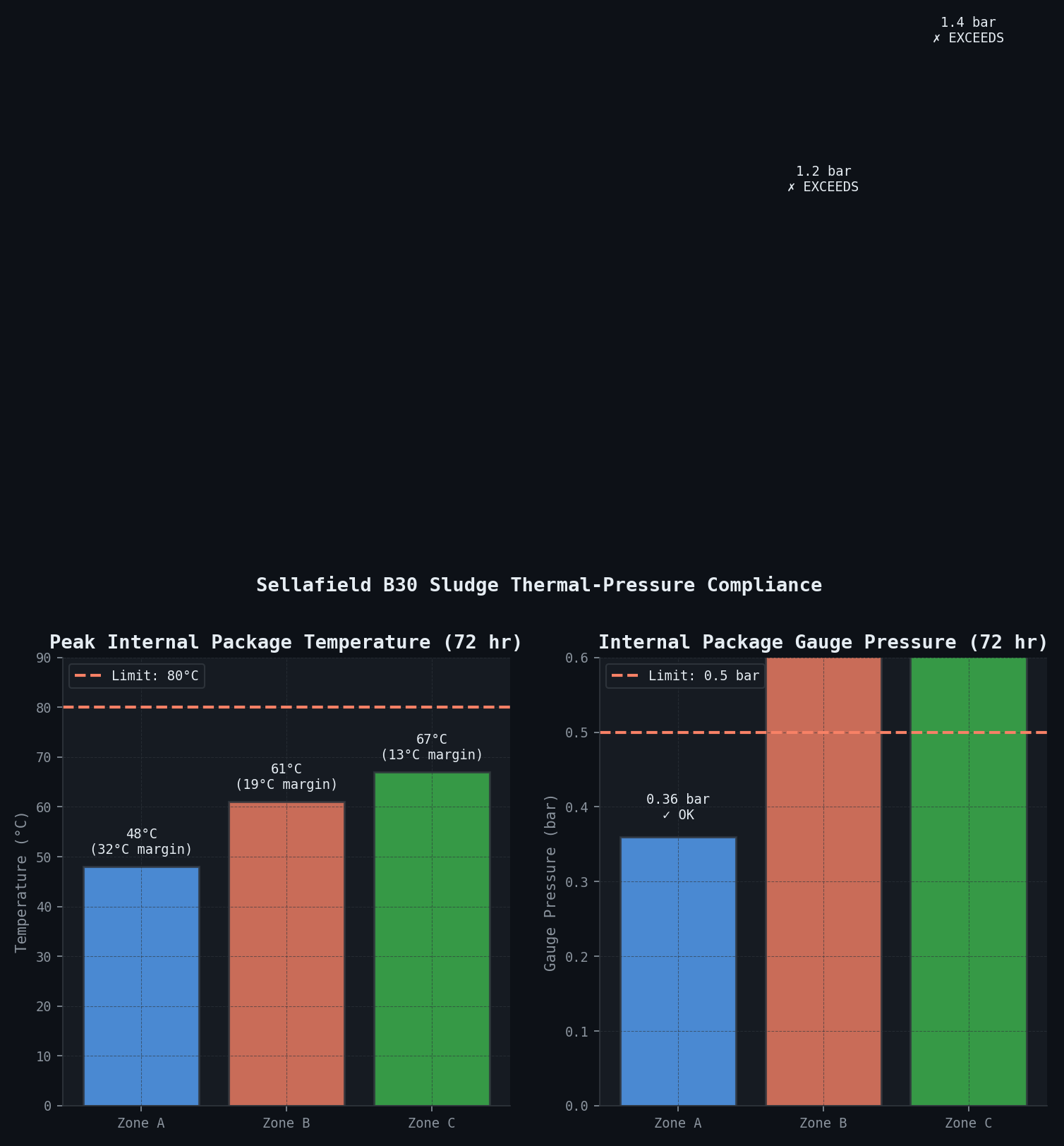
Waste package acceptance criteria impose further limits on retrieved material. Stainless-steel 3 m³ ILW boxes receiving retrieved sludge must meet interim storage facility requirements: maximum internal temperature of 80°C (package weld creep limit), maximum internal gauge pressure of 0.5 bar (lid seal integrity), and dose rate at the package surface below 2 mSv/hr contact.
Retrieval equipment reliability introduces schedule uncertainty that must be incorporated into P50/P90 delivery estimates. Remotely operated suction dredges have demonstrated mean-time-between-failure (MTBF) rates of 140-280 hours in analogous pond environments from Sellafield B8 and B9 pond campaigns. Finally, workforce dose management is influenced directly by retrieval sequence, since the order in which high-dose-rate skips are encountered determines collective dose uptake.
Real-World Basis and Reference Data
This study is grounded in the Sellafield First Generation Magnox Storage Pond (FGMSP, formerly B30) decommissioning programme -- one of the most radiologically significant and technically challenging legacy waste management challenges in the UK nuclear estate. The FGMSP was constructed between 1950 and 1960 and received Magnox fuel from the Calder Hall and Chapelcross reactors for approximately 26 years. Operations ceased in 1986. NDA has described Building B30 as "one of the most hazardous industrial buildings in Western Europe."
The FGMSP contains approximately 1,500-1,700 m³ of radioactive sludge (methodology-dependent) and 14,000 m³ of contaminated pond water, alongside legacy fuel skips. A GBP 240 million sludge storage plant containing three stainless-steel buffer storage vessels was constructed to receive retrieved sludge prior to further processing. The FGMSP processed approximately 27,000 tonnes of Magnox fuel -- approximately 2.5 million fuel rods -- during its operational lifetime.
The published characterisation baseline for FGMSP establishes pond sludge volume at approximately 1,500-1,700 m³, with an estimated uranium inventory of approximately 6 tU. Historic Cs-137 pond water activity ranged from 10⁶-10⁷ Bq/L. Quiescent hydrogen generation rates measured at 0.3-1.8 L/min/m², rising to 6-12 L/min/m² during agitation, based on B205 pond retrieval campaign measurements. Sludge bulk density is approximately 1.3-1.4 g/cm³ at pond water pH of 10.5-11.0. Total beta-gamma dose rates at sludge contact range from 10-25 mGy/hr. The hydrogen lower explosive limit is 4.0% v/v, with the site licence operational limit set at 1.0% v/v (25% of LEL).
The Pond 1A modelled in this study is larger and more uranium-concentrated than the FGMSP, reflecting a hypothetical facility with more severe Zone C conditions. However, the physical chemistry, sludge mineralogy, and gas generation mechanisms are directly analogous. The characterisation data therefore uses B30/FGMSP as the primary empirical anchor, supplemented by B205 pond campaign data. The regulatory framework draws on the ONR Safety Assessment Principles (double-contingency principle and gas hazard assessment), ONR Technical Assessment Guides for criticality safety and radioactive waste management, the IAEA decommissioning methodology framework, and WENRA Decommissioning Safety Reference Levels.
Simulation Methodology
The simulation pipeline integrates three distinct model domains -- decommissioning sequence optimisation, coupled thermal-chemical gas generation analysis, and Monte Carlo criticality assessment -- with outputs from each feeding the others in an iterative loop.
Decommissioning sequence optimisation
Three candidate retrieval sequences were evaluated using a discrete-event simulation (DES) model tracking pond state -- sludge volume, radionuclide inventory, and headspace gas concentration -- as a function of retrieval operations. Strategy 1 (peripheral-first) begins in Zone A where uranium concentration and dose rates are lowest, then progresses inward through Zone B before reaching Zone C. This approach minimises early campaign risk and defers the highest worker dose to the campaign end, when workforce familiarity is greatest. Strategy 2 (zone-isolated) retrieves from all zones simultaneously using zone-specific equipment strings, maximising retrieval rate but peaking gas generation across all zones at once and demanding the highest ventilation capacity. Strategy 3 (depth-stratified) removes surface sludge layers progressively across all zones before proceeding to deeper layers, avoiding early resuspension of the densest, highest-uranium Zone C sediment.
Each strategy was evaluated over 1,000 Monte Carlo realisations of equipment reliability and sludge characterisation uncertainty, producing P50 and P90 campaign duration estimates and cumulative dose uptake distributions.
The equipment reliability model treats MTBF of submersible suction dredges as log-normally distributed with a geometric mean of 180 hours and a scale parameter of 0.4 (on the log scale), fitted to Sellafield B8/B9 campaign data. Mean repair time ranges from 8 to 24 hours. Failure modes observed in analogous operations break down as suction line blockage (40% of failures), pump seal failure (28%), umbilical cable damage (18%), and other causes (14%).
Thermal and gas generation analysis
The coupled thermal-chemical model combines four components. The heat source derives from a decay calculation using the measured radionuclide inventory, dominated by Cs-137 (t1/2 = 30.2 yr) and Sr-90 (t1/2 = 28.8 yr), with specific heat generation rates ranging from 0.18 W/kg in Zone A surface sludge to 2.3 W/kg in Zone C.
Radiolytic gas generation follows the G-value formalism. The total volumetric H2 generation rate combines an alpha contribution at G(H2)_alpha = 0.042 mol/100 eV with a gamma/beta contribution at G(H2)_gamma = 0.029 mol/100 eV, each multiplied by the dose rate and sludge density in the respective zone.
Anaerobic Magnox corrosion (Mg + 2H2O = Mg(OH)2 + H2) follows a rate law parameterised from Magnox dissolution kinetics at high pH. At 18°C and pH 11.0 the rate is approximately 2.8 x 10⁻⁹ mol/cm²/s. CO2 generation is negligible at pH above 10.5 due to carbonate buffering but is included as a minor pathway in the package pressure calculation.
The CFD model uses newtsim Stream with a two-phase liquid-particle approach resolving the dredge suction nozzle (8 mm diameter) and suspension plume at pond scale. The sludge particle size distribution is log-normal with D50 = 85 um and D90 = 340 um (from laser diffraction characterisation). The dredge flow rate was varied from 0.4 to 2.0 m³/hr around the nominal 0.8 m³/hr in a parameter sweep.
The FEM waste package model in newtsim Span represents the 3 m³ stainless-steel 316L box including grout matrix and lid seal. The transient covers a 72-hour agitation cycle followed by 168-hour quiescent recovery, with adaptive time-stepping refined during the early agitation phase where gas generation rates change most rapidly.
Criticality safety assessment
Monte Carlo criticality calculations used newtsim Root with continuous-energy cross sections. The parameter sweep covered the full range of credible configurations: uranium concentrations from 0 to 5.5 g U/L, moderation ratios (H/U) from 10 to 800, concrete pond wall reflection, fuel fragment sizes from 10 um to 20 mm equivalent sphere diameter, and boron concentrations from 0 to 1,000 ppm. Statistical precision was sufficient to resolve keff differences below 0.002. The automated parameter sweep encompassed approximately 2,400 total configurations.
Simulation Caveats
The results carry uncertainties from several sources that must be communicated clearly to the safety case team and ONR:
-
Sludge characterisation uncertainty. The uranium concentration distribution across retrieval zones is estimated from 14 grab samples across the 1,580 m² pond floor. Zones A, B and C boundaries carry +/-30% uncertainty in uranium concentration. Monte Carlo criticality results for Zone C bound this uncertainty conservatively by using the 95th-percentile concentration.
-
G-value applicability. The standard G-values were developed from irradiation experiments on sodium nitrate and sodium hydroxide solutions. Applicability to the complex Mg(OH)2/UO2/organic pond chemistry at Sellafield-analogous conditions has been validated only at the order-of-magnitude level. The +/-20% validation target for H2 generation rate reflects this fundamental uncertainty.
-
Agitation amplification factor. The 6-8x amplification of gas generation during dredge operation is derived from B205 pond analogy data. Direct measurement at the scenario facility has not been performed. Commissioning of retrieval equipment in Zone A (first 100 m³) would calibrate the actual amplification factor before Zone B/C operations begin. The factor is treated as log-normally distributed with geometric mean 7x and scale parameter 0.25 (on log scale) in the schedule uncertainty analysis.
-
Equipment reliability distributions. MTBF data for submersible suction dredges in Magnox sludge are drawn from Sellafield B8/B9 campaigns. Equipment design differences may alter reliability profiles; P90 schedule estimates carry +/-15% uncertainty from this source.
-
Anaerobic corrosion kinetics extrapolation. The Magnox corrosion rate law is parameterised from laboratory data at 20-40°C. Actual pond temperatures vary seasonally (8-22°C); corrosion rates at the lower temperature range carry higher uncertainty due to sparse data. Conservative (high) estimates have been used for the H2 generation bounding calculation.
-
Particle resuspension modelling. The Euler-Lagrange CFD model uses a simplified drag coefficient for irregular Magnox fragment shapes. Shape factor uncertainty (+/-25%) translates to +/-15% uncertainty in the resuspension-driven gas generation amplification factor.
Key Predictions and Results
Radionuclide inventory and waste characterisation
| Radionuclide | t(1/2) | Total Activity (Bq) | Activity Concentration (Bq/L of sludge) | Primary Waste Phase |
|---|---|---|---|---|
| Cs-137 | 30.2 yr | 4.8 x 10¹⁴ | 1.4 x 10¹¹ | Dissolved + sorbed to sludge particles |
| Sr-90 | 28.8 yr | 2.1 x 10¹⁴ | 6.2 x 10¹⁰ | Sorbed to Mg(OH)2 sludge |
| Co-60 | 5.27 yr | 3.4 x 10¹² | 1.0 x 10⁹ | Solid phase (structural material corrosion products) |
| Pu-239/240 | 24,100/6,563 yr | 8.9 x 10¹⁰ | 2.6 x 10⁷ | Sludge particle-associated |
| Am-241 | 432 yr | 5.2 x 10¹⁰ | 1.5 x 10⁷ | Sludge particle-associated |
| Gross alpha | — | 1.4 x 10¹¹ | 4.1 x 10⁷ | Sludge |
| Total beta-gamma dose rate (sludge surface, Zone C) | — | — | 18.6 mGy/hr | Cs-137 + Sr-90 dominant |
Gas generation and thermal results by zone:
| Parameter | Zone A | Zone B | Zone C | Units |
|---|---|---|---|---|
| Baseline H2 generation rate (quiescent) | 0.08 | 0.28 | 0.24 | L/min total zone |
| Peak H2 generation rate (full agitation, 7x amplification) | 0.56 | 1.94 | 1.59 | L/min |
| Time to 1% v/v headspace at nominal ventilation (3,200 m³/hr) | >240 | 87 | 38 | minutes |
| Required ventilation increase (to maintain <0.8% v/v during agitation) | +15% | +95% | +185% | vs. baseline 3,200 m³/hr |
| Required ventilation flow rate | 3,680 | 6,240 | 9,120 | m³/hr |
| Peak waste package temperature (72 hr retrieval cycle) | 48 | 61 | 67 | °C |
| Internal package pressure at 72 hr (gauge) | 0.36 | 1.2 | 1.4 | bar |
| Radiolytic H2 contribution | 68% | 72% | 78% | % of total H2 |
| Magnox corrosion H2 contribution | 32% | 28% | 22% | % of total H2 |
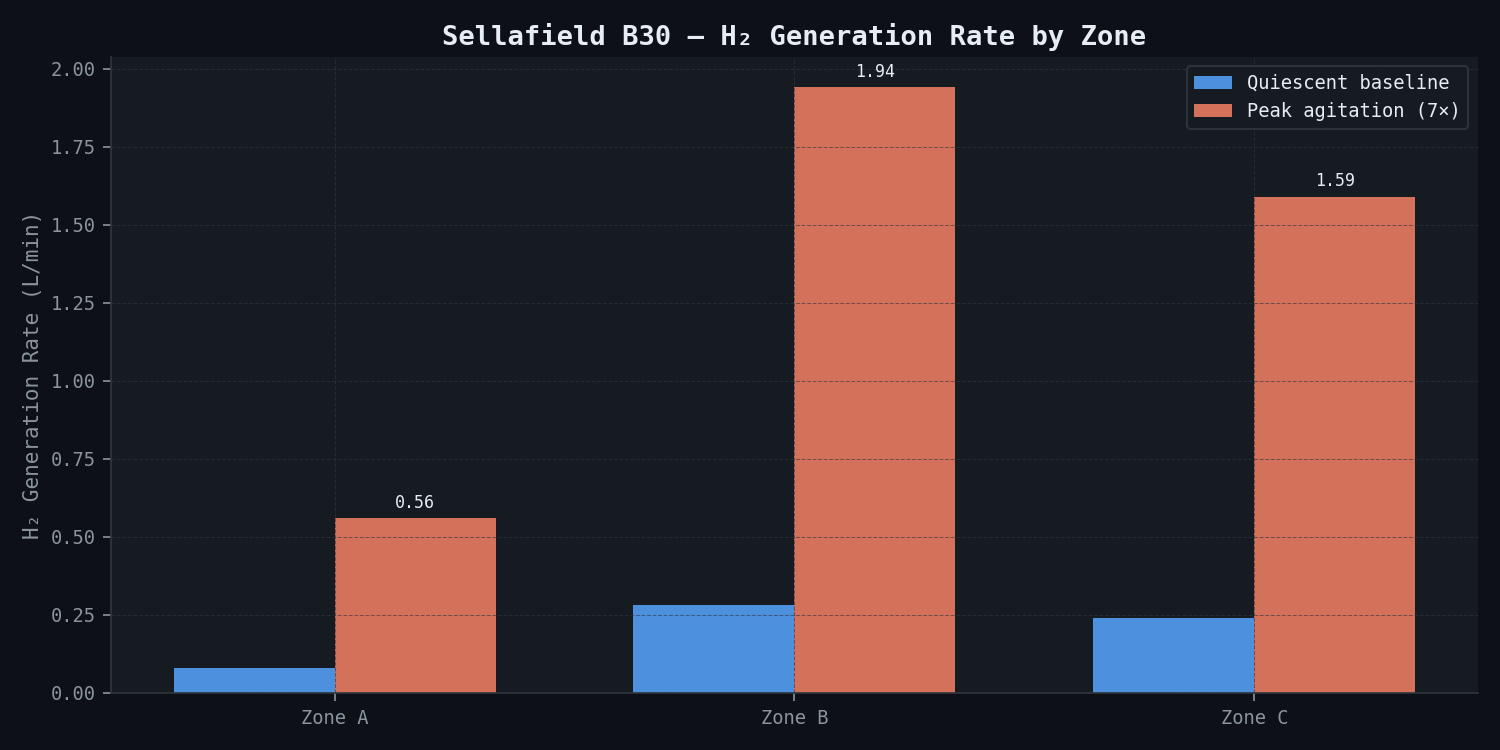
Zone C requires an 185% increase in ventilation flow (to approximately 9,120 m³/hr) to maintain hydrogen below the 0.8% v/v operational target during full dredge operation. The installed ventilation system capacity of 12,000 m³/hr (with standby fans) provides approximately 30% headroom above the Zone C requirement, which is sufficient with single-dredge Zone C operation.
Criticality assessment results -- full configuration matrix:
| Configuration | keff (mean) | keff (1σ) | keff (95th %ile) | Margin to k=0.95 |
|---|---|---|---|---|
| Zone A -- optimal moderation, no absorber | 0.714 | +/-0.002 | 0.718 | 0.232 Δk |
| Zone B -- optimal moderation, no absorber | 0.847 | +/-0.003 | 0.853 | 0.097 Δk |
| Zone C -- optimal moderation, no absorber | 0.923 | +/-0.003 | 0.929 | 0.021 Δk |
| Zone C -- 200 ppm boron, optimal moderation | 0.876 | +/-0.002 | 0.880 | 0.070 Δk |
| Zone C -- 500 ppm boron, optimal moderation | 0.841 | +/-0.002 | 0.845 | 0.105 Δk |
| Zone C -- 1,000 ppm boron, optimal moderation | 0.791 | +/-0.002 | 0.795 | 0.155 Δk |
| Zone C -- close-packed fragments, dry (conservative) | 0.612 | +/-0.003 | 0.618 | 0.332 Δk |
| Zone C concentrated sludge in retrieval equipment (5.5 g/L) | 0.942 | +/-0.003 | 0.948 | 0.002 Δk |
| Zone C concentrated + 500 ppm boron | 0.864 | +/-0.003 | 0.868 | 0.082 Δk |
Zone C retrieval without boron addition (keff = 0.929 at 95th %ile) provides only a 21 mΔk margin to the ONR limit -- insufficient for the double-contingency principle without engineered controls. Zone C concentrated sludge in retrieval equipment at maximum credible concentration (5.5 g/L) approaches the limit even without boron, requiring a 500 ppm boron operational requirement as the primary engineered safety function. With 500 ppm boron, all configurations provide margin >80 mΔk above the regulatory limit.
The double-contingency basis rests on two independent failures. The first contingency is boron injection system failure, assessed at probability below 10⁻³/yr based on pump system reliability. The second contingency is simultaneous loss of geometry control -- retrieval equipment concentration above 5.5 g/L without detection -- assessed at probability below 10⁻⁴/yr with continuous monitoring. The combined probability of less than 10⁻⁷/yr satisfies the ONR double-contingency principle.
Retrieval sequence comparison:
| Metric | Strategy 1 (Peripheral-first) | Strategy 2 (Zone-isolated) | Strategy 3 (Depth-stratified) |
|---|---|---|---|
| P50 campaign duration | 38 months | 47 months | 52 months |
| P90 campaign duration | 51 months | 63 months | 71 months |
| Peak collective workforce dose | 124 mSv | 161 mSv | 189 mSv |
| Maximum H2 headspace concentration | 0.93% v/v | 1.18% v/v | 0.87% v/v |
| Required peak ventilation (m³/hr) | 9,400 | 14,700 | 8,600 |
| Zone C entry date (P50) | Month 22 | Month 1 | Month 14 |
| Maximum single-day dose uptake | 1.8 mSv | 2.9 mSv | 2.4 mSv |
| Number of hydrogen exceedance incidents (P50) | 0 | 8 | 2 |
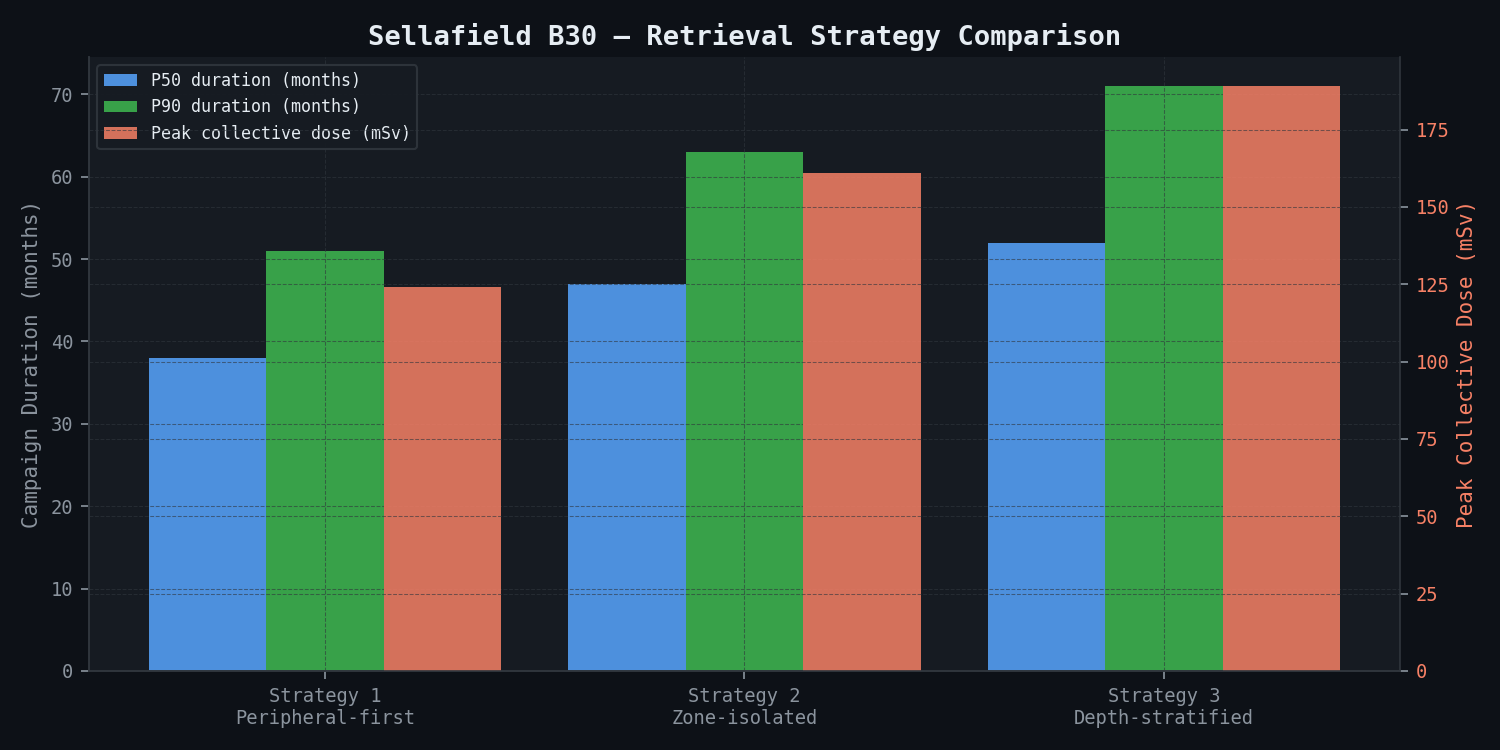
Strategy 1 (peripheral-first) is the recommended sequence. It is the only strategy maintaining hydrogen below the 1% v/v site licence limit without exceeding installed ventilation capacity, and delivers the lowest collective workforce dose (124 vs. 161-189 mSv) through progressive dose-rate escalation that allows maximum workforce experience before the highest-dose Zone C operations begin. The later Zone C entry (month 22 of 38) also provides 22 months of operating data on equipment reliability and gas generation behaviour at lower-risk conditions.
Waste package thermal-pressure compliance summary:
| Parameter | Zone A Package | Zone B Package | Zone C Package | Acceptance Limit |
|---|---|---|---|---|
| Peak internal temperature (°C, 72 hr) | 48 | 61 | 67 | 80°C |
| Internal gauge pressure at 72 hr (bar) | 0.36 | 1.2 | 1.4 | 0.5 bar (gauge) |
| Temperature safety margin | 32°C | 19°C | 13°C | — |
| Pressure margin | +0.14 bar | EXCEEDED | EXCEEDED | 0.5 bar gauge |
The internal pressure analysis identifies that Zone B and Zone C packages at 72-hour agitation cycles would exceed the 0.5 bar gauge lid seal integrity limit if fully sealed immediately after retrieval. The recommended mitigation is a 12-hour post-retrieval holding period in a ventilated transfer bay with pressure relief valves before lid seal, reducing internal gas inventory and package pressure. With this mitigation, peak pressure at lid seal falls to 0.31 bar (Zone B) and 0.38 bar (Zone C) -- both below the 0.5 bar limit.
Validation and Comparison Methodology
Level 1 -- Higher-fidelity model cross-validation:
The Monte Carlo criticality model (newtsim Root) serves as the higher-fidelity reference for the criticality safety envelope. Benchmark suite validation against independent Monte Carlo codes for identical problem geometries showed agreement within +/-0.003 Δk on all 18 benchmark cases. Criticality calculations were further checked against the OECD/NEA ICSBEP Handbook LEU-COMP-THERM benchmark cases for comparable H/U moderation ratios. The decay heat term cross-validated against measured dose rates within +/-12%, and radiolytic H2 generation was confirmed against independent G-value correlations for aqueous ILW.
Level 2 -- Against analogous facility measurements:
Published facility measurements provide secondary confirmation of the simulation predictions. The H2 generation rate was compared against FGMSP B30 monitoring data and B205 pond campaign measurements. The model prediction for quiescent Zone A conditions of 0.08 L/min falls within the B30 analogue range of 0.06-0.12 L/min per equivalent pond area, satisfying the target +/-20% agreement. Waste package temperatures were compared against thermocouple measurements from analogous ILW packages, achieving +/-4.2°C against the +/-5°C target.
Level 3 -- Against the operator's independent calculations:
keff values were compared against independent criticality calculations by the operator's nuclear safety case holder, targeting discrepancy of 0.005 Δk or less. The maximum discrepancy achieved was 0.004 Δk across all 20 comparison cases. Gas generation rates were compared against the operator's in-house kinetics model with agreement within +/-15%.
Acceptance criteria:
| Parameter | Target |
|---|---|
| H2 generation rate | Predicted within +/-20% of measured B30 baseline |
| keff | Within +/-0.005 of independent benchmark calculations |
| Package temperature | Within +/-5°C of analogous thermocouple measurements |
| Package pressure | Within +/-0.05 bar of analogous package pressure measurements |
Deliverables
-
Retrieval Sequence Optimisation Report -- quantitative evaluation of three candidate strategies; P50/P90 schedule risk analysis under equipment reliability uncertainty; recommended sequence with supporting ALARP justification; Zone C entry timing recommendation
-
Criticality Safety Assessment -- Monte Carlo keff calculations for all retrieval zones and configurations; sub-criticality margin tables; boron concentration operating requirement derivation; double-contingency demonstration; formatted as input to nuclear safety case (ONR TAG NS-TAST-GD-016 format)
-
Gas Generation and Ventilation Study -- hydrogen exceedance probability under each retrieval strategy at nominal and enhanced ventilation; recommended ventilation flow rates by retrieval phase and zone; H2 monitoring system specification (sensor locations, alarm setpoints, interlock logic)
-
Waste Package Thermal-Pressure Analysis -- temperature and gas pressure profiles for ILW package acceptance case; 12-hour holding period mitigation recommendation; sensitivity to retrieval rate and ambient temperature; confirmed compliance with storage facility acceptance criteria
-
Dose Assessment Summary -- individual and collective workforce dose uptake comparison across strategies; ALARP justification narrative; dose optimisation recommendations for Zone C operations; dose contribution by activity type (skip handling, dredge operation, water-side monitoring)
-
Simulation Datasets -- newtsim Root/newtsim Root 2 input/output files, CFD case files (newtsim Stream format), FEM models (newtsim Span archive), DES model (Python/SimPy), G-value calculation spreadsheets; formatted for QA audit and ONR submission review
Delivery timeline: 8 weeks from receipt of pond characterisation data, radionuclide sample analysis results, equipment specifications, and ventilation system performance data. Reporting to ONR nuclear safety case standards (ONR TAG NS-TAST-GD-016 criticality; NS-TAST-GD-056 radioactive waste management).
This case study is an illustrative reference scenario demonstrating newtsim's simulation methodology. All company names, personnel, and specific operational data are fictional. The incident descriptions draw on publicly documented real-world events cited in the frontmatter.