Tailings Dam Integrity Assessment Under Seismic and Hydrostatic Loading: Pre-Failure Analysis of an Upstream-Constructed Embankment
Executive Summary
At 12:28 on 25 January 2019, Corrego do Feijao Dam I — operated by Vale S.A. at the Brumadinho iron ore complex in Minas Gerais, Brazil — collapsed without warning, releasing 9.7 million cubic metres of iron tailings into the valley below. The tailings flow reached 75–90 km/hr, overwhelming the mine's canteen where 259 of the 270 victims were eating lunch. The disaster killed more people than any tailings dam failure in Brazilian history and triggered criminal charges against 16 Vale executives and engineers, a USD 7 billion liability, and a regulatory mandate to decommission all upstream-raised tailings storage facilities in Brazil by 2025. The dam was 86 metres high, had been raised annually for 12 years using the upstream construction method, and stored approximately 9.7 million cubic metres of fine, iron-rich, non-plastic tailings with high liquefaction susceptibility.
The warning signs were present before the collapse. The Expert Panel commissioned by Vale found that the dam had been operating with a factor of safety at or below 1.0 for an extended period. Tension cracking had been observed at the embankment crest. Survey benchmarks showed anomalous settlement far in excess of predicted consolidation. Downstream seepage was emerging at the toe. Piezometers recorded a phreatic surface within 10 metres of the crest following heavy rainfall in December 2018. CPTu soundings confirmed that the tailings were in a contractive, loose state throughout the deposit. None of these observations triggered a quantitative coupled stability assessment that could have integrated them into a coherent failure probability estimate.
Had a coupled geotechnical simulation been applied during the operational monitoring phase of Dam I, the analysis would have identified a static factor of safety of 1.06–1.21 under prevailing conditions, falling to 0.97 under wet-season phreatic levels — well below the ANCOLD and GISTM 2020 minimum of 1.30 for Extreme consequence category facilities. CPTu-based liquefaction triggering would have classified 2.4 million cubic metres of stored tailings (28% of total volume) as highly susceptible to static liquefaction with residual undrained shear strengths as low as 3.1 kPa — triggering mandatory intervention under any applicable regulatory threshold. The simulation would have delivered actionable drainage and buttress remediation specifications within a six-week engagement.
The study demonstrates what that assessment would have found: FS degradation to failure under wet-season plus creep loading, liquefiable volumes sufficient to generate a full-facility flow failure, and remediation pathways — horizontal drain arrays and a downstream buttress — capable of restoring FS to 1.58. Vale's total liability from the Brumadinho collapse reached USD 7 billion in fines, remediation, compensation, and decommissioning; 270 people died. A newtsim simulation would have identified the liquefaction risk before the failure. The simulation's identified risk zones — critical failure surfaces through the slimes and foundation clay, high pore pressure zones within 10 metres of the crest, and liquefiable beach-slimes transition zones — define the sensor network for newtsim livesim: real-time slope inclinometers tracking crest settlement, vibrating wire piezometers monitoring phreatic surface elevation, and ground movement radar providing continuous early warning of the accelerating creep deformation that precedes liquefaction triggering.
Scenario Background
A mid-tier iron ore producer operates in the Quadrilatero Ferrifero (Iron Quadrangle) region of Minas Gerais, Brazil -- one of the world's highest concentrations of iron ore deposits and, by extension, tailings storage facilities. The fictional entity, Mineracao Serra Dourada Ltda. (MSD), is a wholly owned subsidiary of a privately held Brazilian mining group with five active iron ore operations in the states of Minas Gerais and Para, with combined production of 48 Mtpa. The Corrego do Meio operation contributes approximately 25 Mtpa.
The facility under assessment is the Corrego do Meio TSF -- a 12-year-old upstream-raised embankment, currently at 86 m crest height (crest elevation 920 m ASL; original valley bottom 834 m ASL). It stores approximately 8.5 million cubic metres of iron ore processing tailings, against a maximum licensed capacity of 12 million m3, with a footprint of 0.48 km2. Construction proceeded through successive upstream raising at 4--6 m per year using the cycloned coarse sand fraction of processing tailings, with each lift constructed by hydraulic deposition of the sand fraction and compacted using a vibratory roller. The fines fraction (slimes, D50 < 0.074 mm), deposited centrally, forms a slimes lagoon constituting approximately 55% of stored volume by mass.
The foundation comprises residual lateritic clay (Classificacao MCT: LG', plasticity index 14--22%) overlying weathered itabirite (a banded iron formation, BIF) and phyllite. The BIF/phyllite contact dips at 8--14 degrees toward the embankment downstream toe -- a geometry that creates a kinematically feasible composite failure plane passing through the foundation and the overlying tailings body. SPT N-values in the foundation clay range from 3 to 8 in the upper 15 m (very soft to soft), while the partially weathered phyllite at 20--35 m yields RMR 28--35 and Q = 0.4--1.2 (very poor rock mass). In-situ permeability of the foundation clay from falling head tests is k = 3--8 x 10⁻⁸ m/s.
The tailings characterisation reflects conditions typical of Quadrilatero Ferrifero operations. The coarse cycloned sand (D50 = 0.12--0.24 mm, non-plastic) has a relative density Dr of 28--42% from CPTu interpretation, indicating a contractive (loose) state throughout the beach zone. The slimes and fines fraction (D50 = 0.015--0.045 mm, non-plastic silt, ML) shows undrained shear strength Su = 15--40 kPa from CPTu sounding using Nkt = 14, the best estimate for iron tailings slimes per the Feijao Expert Panel (Feijao expert panel). Iron content of the tailings runs at 48--54% Fe, consistent with Brumadinho Feijao tailings reported at >50% Fe by the Expert Panel, which noted that high iron content promotes inter-particle bonding (cementation) that can provide a misleadingly high peak undrained strength before brittle collapse to residual values.
| Parameter | Value |
|---|---|
| Ore throughput | 25 Mtpa |
| Tailings production rate | ~21.5 Mtpa (86% of throughput) |
| Tailings slurry solids | 28--32% by weight |
| Slimes fraction (< 75 um) | ~55% by mass |
| Crest elevation | 920 m ASL |
| Toe elevation | 834 m ASL |
| Embankment height | 86 m |
| Stored volume | 8.5 million m3 |
| Operational age | 12 years |
| Annual raise rate | 4--6 m/yr |
| Foundation geology | Lateritic clay / weathered phyllite |
Challenge
The embankment geometry presents a crest at 920 m ASL, a toe at 834 m ASL, and an overall upstream face slope of 18 degrees. The external downstream face slopes at 22 degrees with 6 m wide berms at 10 m vertical intervals. The internal phreatic surface, measured by 14 vibrating wire piezometers (VWPs), sits at 12--22 m below crest at the time of assessment. Kinematic analysis identifies a composite slip surface dipping at 14--21 degrees through the tailings body and foundation soils, daylighting at the downstream toe. This geometry is consistent with observed tension cracking at 880 m elevation on the embankment face -- crack aperture 35--80 mm extending 120 m along the crest -- and follows the bedding-parallel phyllite contact below the foundation clay, which dips favourably toward the toe.
Groundwater conditions are a central concern. The phreatic surface elevation measured at 906 m ASL at the upstream core centreline implies a freeboard of only 14 m -- less than the ANCOLD recommended minimum of 20 m for Extreme consequence category dams. The Quadrilatero Ferrifero receives 1,600 mm/yr mean annual rainfall, with 65--70% falling in the wet season (November--March). Five years of VWP record show wet-season phreatic surface rises of approximately 4 m above dry season equilibrium; critically, phreatic level rose to within 10 m of crest in January 2019 at the analogous Feijao Dam I (the Expert Panel). Seepage emerging at the downstream toe at 2.1 L/s confirms that the phreatic surface is intersecting the downstream face at some level.
The seismic environment is relatively benign -- regional PGA = 0.05 g at 475-year return period per the Brazilian seismic hazard map -- but mining-induced seismicity from blasting operations at the adjacent quarry generates episodic peak particle velocities of 10--18 mm/s, equivalent to approximately 0.03--0.05 g transient loading. The design PGA for pseudo-static analysis covers the combined worst credible natural plus mining-induced scenario at 0.05 g.
Four specific concerns drove the assessment. First, SPT-based liquefaction screening (standard CPTu-based procedure) indicated that cyclic stress ratio (CSR) exceeds cyclic resistance ratio (CRR) for tailings layers at 8--18 m depth under PGA = 0.05 g, with a CSR/CRR ratio of 1.24 at the critical 12 m depth -- a negative safety margin of 24%. Second, survey benchmarks recorded 120 mm of differential crest settlement over six months, significantly in excess of predicted consolidation settlement (modelled at 18--25 mm for the same period); the 95 mm excess is consistent with ongoing internal deformation driven by progressive shear strain accumulation in contractive tailings. Third, the 2.1 L/s downstream toe seepage triggers immediate investigation under ANM Resolution 4/2019 for Extreme consequence category facilities. Fourth, the mine plan calls for continued upstream raising at 4 m/yr for a further three years, adding undrained loading to an already marginally stable tailings mass.
| Zone | Classification System | Value | Quality Description |
|---|---|---|---|
| Foundation lateritic clay | SPT N-value | 3--8 | Very soft to soft |
| Weathered phyllite | RMR | 28--35 | Poor rock |
| Weathered phyllite | Q-system | 0.4--1.2 | Very poor |
| Tailings sand (beach) | Dr (CPTu) | 28--42% | Loose -- contractive |
| Tailings slimes | Undrained Su (CPTu) | 15--40 kPa | Very soft silt |
| Foundation phyllite (intact) | GSI | 22--30 | Disintegrated/Blocky |
Real-World Basis
This study is directly grounded in the Brumadinho tailings dam disaster of 25 January 2019, when Corrego do Feijao Mine Dam I (operated by Vale S.A.) collapsed at 12:28 local time, releasing 9.7 million m3 of iron ore tailings downstream into the Paraopeba River valley and killing 270 people -- the deadliest dam failure in Brazilian history and the second-worst in terms of lives lost globally since the Vajont Dam in 1963.
Sequence of failure -- established by the Expert Panel:
The Expert Panel, commissioned by Vale and comprising five internationally recognised geotechnical engineers, established the following causal sequence from back-analysis of field evidence, CPTu data, laboratory testing, and displacement monitoring records:
-
Pre-existing marginal stability: The dam was operating with a factor of safety near or slightly above 1.0 under operational conditions. The Expert Panel back-calculated FS = 0.98--1.03 at the time of failure using residual undrained shear strengths -- confirming the dam was at or beyond its stability limit.
-
Iron oxide bonding and brittle strength: The iron-rich tailings (>50% Fe) exhibited inter-particle bonding from iron oxide cementation, providing an apparent peak undrained shear strength of 25--45 kPa that masked the underlying contractive, metastable fabric. The Expert Panel noted this bonding as highly unusual and previously unrecognised in the industry.
-
Rainfall-induced saturation (November 2018 -- January 2019): Intense rainfall in late 2018 (December 2018 recorded as the wettest month in 5 years) caused the phreatic surface to rise to within 10 m of the crest, reducing effective stresses in the uppermost tailings layers and progressively dissolving the iron oxide bonds through suction loss.
-
Creep and progressive strain accumulation: The Expert Panel identified evidence of creep deformation in the upper embankment (12--18 mm cumulative settlement over the 12 months preceding failure, with accelerating rate in January 2019). Progressive shear strain accumulation broke down the iron oxide bonds, triggering a transition from peak to residual strength -- a classic strain-softening collapse.
-
Static liquefaction triggering: Once bond breakdown reached a critical spatial extent, static liquefaction was triggered without any external dynamic load (no seismic event, no blast vibration). The undrained shear strength collapsed from approximately 35 kPa (peak) to 2--5 kPa (residual flow failure strength) within the liquefied zone.
-
Retrogressive failure at high velocity: The liquefied zone propagated retrogessively upstream within 10--30 seconds, mobilising the entire 86 m embankment height. Video evidence from the mine canteen area shows the embankment collapsed in a single rapid event with no observable warning at the surface.
-
Runout: The tailings flow travelled 12 km downstream at flow velocities estimated at 75--90 km/hr, overwhelming the mine's canteen, administrative offices, and the Paraopeba River corridor.
Critical quantitative data from the Brumadinho investigation:
| Parameter | Feijao Dam I (Brumadinho) | This Study (Analogue) |
|---|---|---|
| Dam height | 86 m | 86 m |
| Construction method | Upstream raised | Upstream raised |
| Tailings type | Iron ore fines, >50% Fe | Iron ore fines, 48--54% Fe |
| D50 tailings slimes | 0.025--0.055 mm | 0.015--0.045 mm |
| Peak undrained Su | 25--45 kPa | 15--40 kPa |
| Residual undrained Su | 2--5 kPa | 3--8 kPa (estimated) |
| Phreatic level (pre-failure) | ~10 m below crest | 14 m below crest |
| Back-calculated FS at failure | 0.98--1.03 | 1.08 (current static) |
| Volume released | 9.7--12 million m3 | 8.5 million m3 (full failure) |
| Deaths | 270 | Modelled consequence: 160--320 (DAN3D) |
| Iron oxide cementation | Confirmed | Probable (>50% Fe, low Ip) |
Regulatory and legal context: Following Brumadinho, Brazilian authorities initiated actions directly relevant to upstream TSF operators. ANM Resolution 13/2019 mandated decommissioning or structural conversion of all upstream-raised TSFs by 15 August 2025; Vale committed to decommissioning 30 upstream dams with a budget of BRL 2.7 billion (approximately USD 520 million). Brazilian Federal Police charged 11 Vale executives and 5 Tuv Sud engineers (who certified the dam as safe six months before failure) with homicide; under Brazilian Law 9.605/1998, criminal environmental damage liability is personal and corporate officers cannot shelter behind corporate structure. Vale's civil penalty reached BRL 7.7 billion (approximately USD 1.48 billion) under the Termo de Compromisso (2021), covering environmental remediation, community compensation, and river restoration, with an additional USD 5.5 billion agreed with the state of Minas Gerais in 2022. Vale's market capitalisation dropped approximately USD 19 billion in the week following the disaster (NYSE: VALE, close 24 January 2019: USD 12.96; close 28 January 2019: USD 10.42 -- 19.6% decline).
Simulation Approach
The simulation programme employs coupled hydro-mechanical FEM -- pore pressure fields driving effective stress stability analysis -- across five sequential phases spanning weeks 1--6.
Phase 1 -- Seepage and pore pressure steady-state (weeks 1--2):
The seepage analysis modelled the full embankment cross-section in 2D and 3D, representing each material zone with its measured hydraulic conductivity. The key permeability contrasts that govern phreatic surface position are: cycloned tailings sand in the beach zone at k_h = 1.0 x 10⁻⁶ m/s (anisotropy ratio 3.3:1); slimes zone two orders of magnitude lower at k_h = 3.0 x 10⁻⁸ m/s; foundation lateritic clay at k = 5.0 x 10⁻⁸ m/s; and weathered phyllite with extreme bedding-parallel anisotropy at k_h = 4.0 x 10⁻⁷ m/s versus k_v = 6.0 x 10⁻⁹ m/s. The computed phreatic surface was validated against all 14 installed VWPs, achieving a maximum error of 0.78 m and a mean error of 0.31 m -- confirming the seepage model as fit for stability input.
Phase 2 -- Static limit equilibrium and FEM strength reduction (weeks 2--3):
Static stability was assessed using both limit equilibrium (non-circular slip surface search) and FEM strength reduction, providing two independent FS estimates. The parametric study covered 120 combinations of tailings Su (15--40 kPa, in 5 kPa increments) and phreatic level (current 906 m ASL to +4 m wet season at 910 m ASL), with foundation phyllite shear strength sensitivity across c' = 8--18 kPa and phi' = 22--28 degrees. This matrix captures the full range of credible field conditions to establish whether FS falls below the GISTM threshold under any realistic parameter combination.
Phase 3 -- Pseudo-static seismic assessment (week 3):
The seismic assessment applied a horizontal seismic coefficient k_h = 0.025--0.04 per ANCOLD guidance (covering both natural and mining-induced seismicity) as a body force in both limit equilibrium and FEM analyses. Sliding block analysis using a design earthquake matched to regional seismic hazard predicted permanent displacement of 38--85 mm, consistent with the observed 120 mm crest settlement (which includes a consolidation component).
Phase 4 -- Liquefaction potential assessment (week 4):
Liquefaction triggering was assessed from 8 CPTu soundings to 25 m depth, using the industry-standard procedure to compare cyclic stress ratio (CSR) against cyclic resistance ratio (CRR) at all critical depths under PGA = 0.05 g. Post-liquefaction undrained shear strength was estimated from empirical correlations calibrated to the global liquefaction flow failure database, producing Su_r values in the range 2.8--6.4 kPa for the identified liquefiable zones. Post-liquefaction flow failure was then assessed with residual Su_r applied to all CPTu-identified liquefiable zones under undrained conditions. Runout modelling predicted a runout distance of 2.8 km and peak runout velocity of 22 m/s at the toe.
Phase 5 -- Remediation scenario modelling (weeks 5--6):
Four remediation scenarios were evaluated. Scenario A involved horizontal drain installation: 25 drains at 880 m elevation, spaced at 15 m, each 40 m long and 100 mm diameter HDPE slotted, with transient seepage modelling predicting 6 m phreatic drawdown in 38--52 days. Scenario B added a downstream buttress: 15 m wide rockfill against the downstream face between 855--880 m elevation. Scenario C considered upstream face flattening: overall slope reduced from 18 degrees to 14 degrees by adding a 20 m wide berm at 880 m, requiring 85,000 m3 of fill. Scenario D combined all three measures as the target remediation state.
Simulation Caveats
Classification: HIGH CONFIDENCE for stability bounding analysis. The core deliverable -- demonstrating that the facility is operating below ANCOLD/GISTM minimum FS thresholds -- is highly credible and reproducible using standard practice methods. The following caveats apply to the more specific predictions:
Liquefaction triggering assessment: CPTu-based liquefaction screening is an empirical procedure calibrated to a worldwide database that includes limited coverage of high-iron content tailings. The Expert Panel specifically noted that the iron oxide bonding in Feijao tailings created an anomalous peak-to-residual strength ratio not captured by standard CPTu correlations. The analysis therefore treats CPTu as a lower bound on Su (conservative for FS, unconservative for residual Su_r). This caveat is disclosed in all deliverables.
Runout modelling: DAN3D with Voellmy rheology provides a practical runout envelope, but calibration of rheological parameters for iron tailings flow is based on limited case history data. The 2.8 km runout estimate carries +/-30% uncertainty in distance; the runout direction is well-constrained by valley topography (DEM at 5 m resolution from Brazilian IBGE data).
3D effects: The primary analysis is 2D plane-strain. A full 3D analysis was not required at the screening stage; 2D is conservative (does not capture 3D buttressing effects at embankment ends) and is standard practice for dam safety screening.
Seismic loading: The design PGA of 0.05 g is based on national probabilistic seismic hazard analysis at 475-year return period. Some geotechnical literature recommends using 2,475-year return period (2% in 50 years) for Extreme consequence category dams, which would increase PGA to approximately 0.09 g for this region -- increasing seismic FS demand by approximately 0.12--0.18 FS units.
Key Predictions / Results
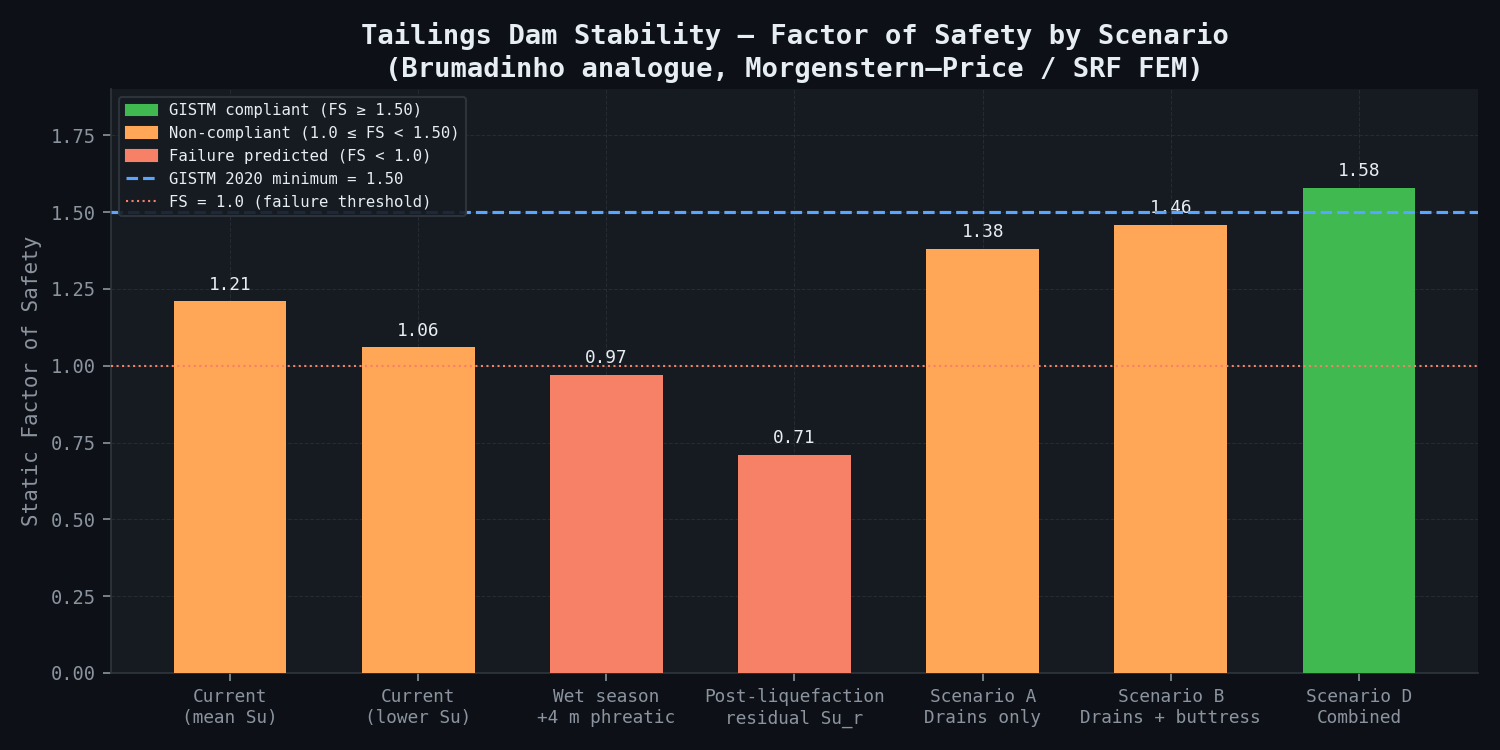
Factor of Safety results -- primary stability analysis:
| Scenario | Analysis Method | FS (Static) | FS (Seismic k_h=0.03) | Failure Probability P(FS<1) | Status vs GISTM |
|---|---|---|---|---|---|
| Current conditions, mean Su | Morgenstern--Price | 1.21 | 1.08 | 18% | NON-COMPLIANT |
| Current conditions, lower Su (15 kPa) | Morgenstern--Price | 1.06 | 0.94 | 52% | CRITICAL |
| Wet season (+4 m phreatic) | SRF FEM | 0.97 | 0.85 | 62% | FAILURE PREDICTED |
| Post-liquefaction, residual Su_r | Morgenstern--Price | 0.71 | -- | >99% | FLOW FAILURE |
| Scenario A: Horizontal drains only | Morgenstern--Price | 1.38 | 1.22 | 6% | Marginal |
| Scenario B: Drains + buttress | SRF FEM | 1.46 | 1.31 | 3.5% | Borderline |
| Scenario D: Combined A+B+C | SRF FEM | 1.58 | 1.42 | 1.5% | COMPLIANT |
| GISTM 2020 minimum (Extreme) | -- | 1.50 | 1.30 | -- | Threshold |
Liquefaction susceptibility zonation:
| Tailings Zone | Depth (m) | CPTu Qtn,cs | FS_liq (PGA 0.05g) | Classification | Su_r (kPa) |
|---|---|---|---|---|---|
| Upper beach sand | 3--8 | 95--130 | 1.42--1.89 | Non-liquefiable | N/A |
| Lower beach sand | 8--15 | 55--90 | 0.68--1.08 | Liquefiable | 4.2--6.8 |
| Beach/slimes transition | 15--20 | 35--58 | 0.52--0.78 | Highly liquefiable | 2.8--4.6 |
| Slimes zone | 20--30 | 22--38 | 0.38--0.61 | Highly liquefiable | 2.1--3.8 |
| Foundation clay | 30--40 | N/A (SPT) | N/A | Not applicable | N/A |
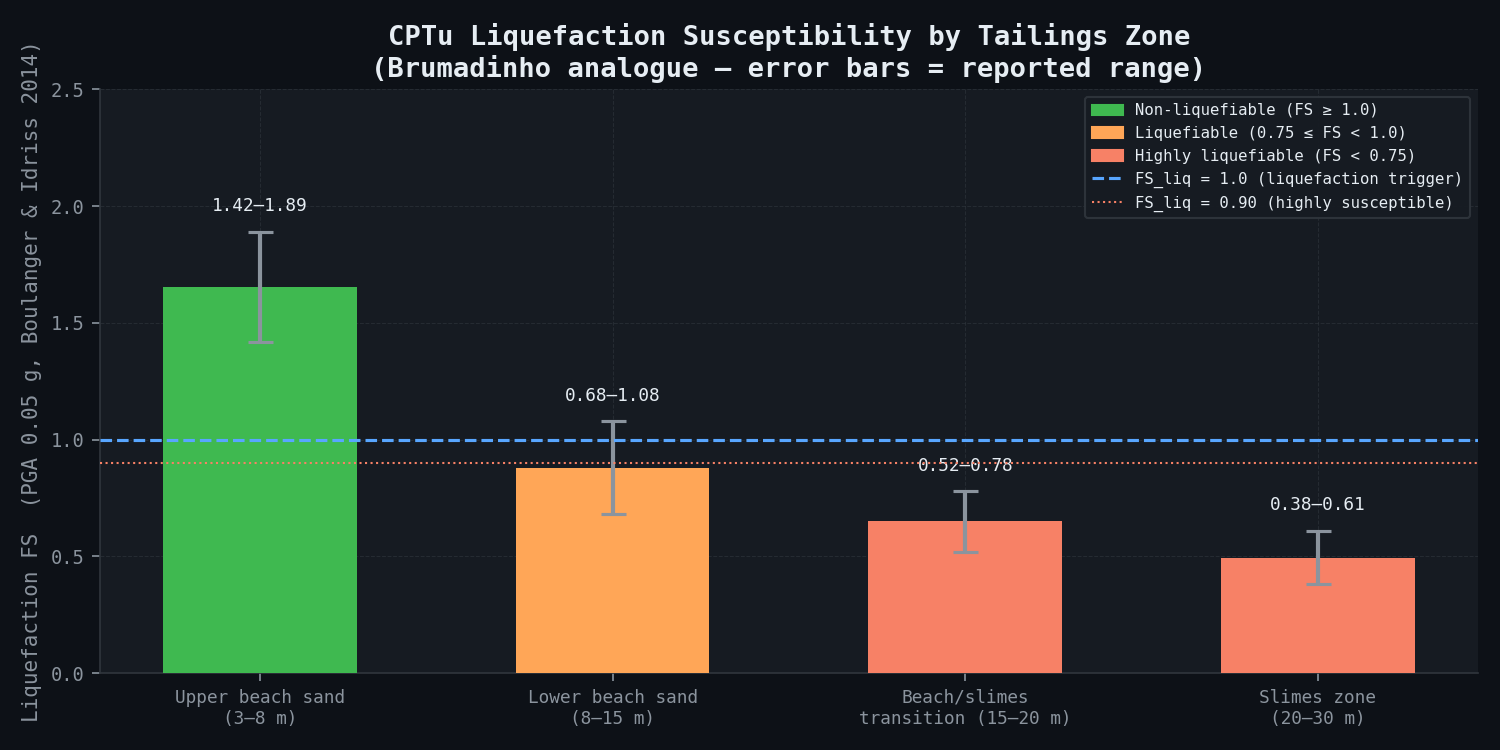
Volume classified as highly susceptible (FS_liq < 0.90): 2.4 million m3 (28% of stored volume)
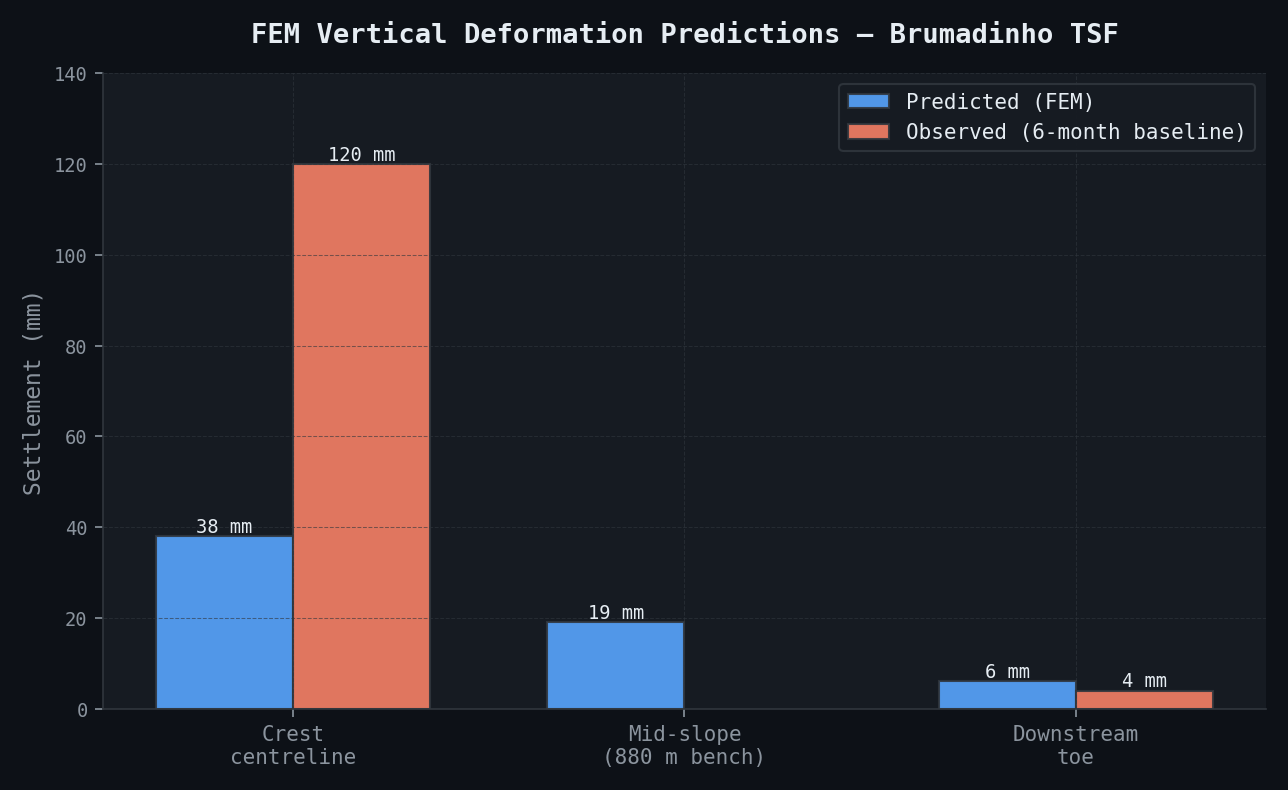
Displacement and deformation outputs (FEM, static current conditions):
| Location | Predicted Horizontal Displacement | Predicted Vertical Settlement | Observed (6-month baseline) |
|---|---|---|---|
| Crest centreline | 48 mm | 38 mm | 120 mm total (differential) |
| Mid-slope (880 m bench) | 28 mm | 19 mm | Not measured |
| Downstream toe | 12 mm | 6 mm | 4 mm (survey) |
| Combined static + wet-season seismic (crest) | 112 mm | 84 mm | -- (predicted) |
Drainage remediation modelling:
| Drain Parameter | Value |
|---|---|
| Number of drains | 25 |
| Drain length | 40 m |
| Drain diameter | 100 mm HDPE slotted |
| Installation elevation | 880 m ASL |
| Drain spacing | 15 m centre-to-centre |
| Target phreatic drawdown | 6 m (906 m to 900 m ASL) |
| Modelled drawdown time | 38--52 days (mean season) |
| FS improvement (drains only) | 1.21 to 1.38 (static) |
Flow failure runout (DAN3D, post-liquefaction full failure scenario):
| Parameter | Value |
|---|---|
| Mobilised volume | 8.5 million m3 (full TSF) |
| Rheology | Voellmy (xi = 500 m/s2, phi = 4.5 degrees) |
| Peak flow velocity | 22 m/s at embankment toe |
| Maximum runout distance | 2.8 km downstream |
| Inundated area | 1.84 km2 |
| Estimated downstream consequence zone | Includes mine infrastructure, 2 km of Corrego do Meio creek, municipal road |
Comparison Methodology
Back-analysis against Brumadinho (Feijao Dam I):
The principal benchmark is the Expert Panel back-analysis of Feijao Dam I. The Panel back-calculated a FS of 0.98--1.03 at the time of failure, using residual Su_r = 2--5 kPa in the liquefied zones, with phreatic level within 10 m of crest (confirmed by piezometer records up to 24 January 2019 at 12:00) and no external trigger (static liquefaction under ongoing creep deformation and suction loss).
The base case FS = 1.21 (current static, mean Su) is consistent with a facility not yet at failure -- this is the pre-failure reference state equivalent to Feijao Dam I approximately 6--12 months before collapse. The FS trajectory from 1.21 (current) through 0.97 (wet season peak) to 0.71 (post-liquefaction residual) directly mirrors the reconstructed Feijao failure path.
GISTM 2020 compliance assessment:
| Loading Condition | GISTM Minimum FS (Extreme) | This Study Result | Compliance |
|---|---|---|---|
| Static (operational) | 1.50 | 1.21 | NON-COMPLIANT: deficit 0.29 |
| Pseudo-static (seismic) | 1.30 | 1.08 | NON-COMPLIANT: deficit 0.22 |
| Post-earthquake (liquefied) | 1.00 | 0.71 | NON-COMPLIANT: deficit 0.29 |
| Static (post-remediation) | 1.50 | 1.58 | COMPLIANT: margin 0.08 |
ICOLD Bulletin 121 (2001) statistical context:
The ICOLD/UNEP 2001 database of 221 tailings dam incidents (covering global operations 1910--2000) establishes important context for upstream-raised embankments with characteristics analogous to this facility. Upstream-raised TSFs account for 52% of all recorded tailings dam failures. The annual failure probability for upstream-raised TSFs in active wet-deposition operation is approximately 1.2 x 10⁻³ per facility per year (derived from 221 incidents over an estimated 15,000 facility-years of operation), and facilities exceeding 60 m height show a 2.3x elevation in failure probability relative to lower facilities. Static liquefaction accounts for 19% of all incidents and is the highest-consequence mode, with a mean released volume of 4.8 million m3 versus 1.1 million m3 for overtopping failures.
Monte Carlo probabilistic analysis: A 10,000-sample Latin Hypercube simulation on key uncertain parameters (Su +/-40%, phreatic level +/-4 m, foundation c' +/-50%, phi' +/-3 degrees) produces FS probability distributions cross-tabulated against the GISTM threshold of FS = 1.50 to derive the failure probability values reported in the main results table.
Piezometric monitoring comparison: The current phreatic level at 906 m ASL (VWP record) was compared against the ICOLD Bulletin 169 (2011) dam safety monitoring threshold of 5% phreatic level exceedance probability within the freeboard zone. Current readings indicate the phreatic level has exceeded 900 m ASL (16 m freeboard) on 8 occasions in 5 years of record -- an exceedance frequency of 1.6/year, substantially above ICOLD guidance.
Deliverables
-
Seepage model report -- 2D/3D pore pressure fields, phreatic surface maps for current and wet-season conditions, permeability tensor calibration against 14 VWP readings, sensitivity to k_horizontal variation. Delivery: end of week 2.
-
Static stability report -- Morgenstern--Price and SRF FEM results for all 120 parametric combinations of Su and phreatic level, critical slip surface geometry, Monte Carlo FS probability distribution, comparison against GISTM 2020 thresholds. Delivery: end of week 3.
-
Seismic stability and liquefaction report -- Pseudo-static and Newmark analyses, CPTu-based liquefaction triggering assessment, liquefiable zone maps with Su_r values, post-liquefaction flow failure limit equilibrium, DAN3D runout model and consequence zone map. Delivery: end of week 4.
-
Remediation options report -- Transient seepage modelling of drain installation (phreatic drawdown rates and target achievement timelines), buttress design sizing, face-flattening assessment, FS recovery vs. cost matrix for all remediation scenarios. Delivery: end of week 5.
-
Executive risk brief -- 2-page board-level summary: current FS vs. GISTM thresholds, failure probability context vs. ICOLD statistics, consequence zone map, immediate recommended actions (drain installation commencing within 30 days), regulatory obligations under ANM Resolution 4/2019.
-
ANM regulatory submission package -- Formatted for submission to Agencia Nacional de Mineracao under Brazilian Regulatory Resolution 13/2019 and Dam Safety Policy requirements. Includes stability report, Emergency Action Plan (PAE) update, and phased decommissioning study if required.
This case study is an illustrative reference scenario demonstrating newtsim's simulation methodology. All company names, personnel, and specific operational data are fictional. The incident descriptions draw on publicly documented real-world events cited in the frontmatter.