Post-Deployment Audit: Impeller Redesign for Insect Cell Culture — Shear Damage Elimination in Baculovirus Expression Vector System
Executive Summary
Scale-up failures in baculovirus expression vector systems caused by Rushton turbine impeller shear damage to Sf9 insect cells are not an obscure edge case — they are thoroughly documented in the literature and repeatedly characterised by the same mechanism. Multi-laboratory compilations of Sf9 shear damage onset data establish the critical turbulent energy dissipation rate threshold at approximately 0.10--0.15 W/kg, corresponding to a Kolmogorov microscale of 30 microns. Rushton turbines generate impeller-zone energy dissipation rates 20--50x above the vessel average — an inherent consequence of the radial-discharge geometry that cannot be corrected by reducing agitation speed. At 500L with a D/T = 0.33 Rushton at 80 rpm, the impeller-zone ε reaches 8–10 W/kg against a vessel average of 0.2–0.5 W/kg — a ratio of 20–40× — and against a Sf9 damage onset threshold of 0.10–0.15 W/kg. Published application data for Sf9 culture in stirred-tank bioreactors documents that hydrofoil impellers provide shear gradients ten times lower than Rushton turbines at equivalent OTR performance. BEVS-optimised 500L vessels use a large-diameter retreated-blade impeller at 25--35 rpm, achieving adequate kLa with epsilon_max below 0.5 W/kg. The incompatibility between Rushton turbines and Sf9 insect cell culture is not a subtle finding — it is standard knowledge in the cell culture engineering community. It was not applied here because no cell culture engineer reviewed the vessel procurement specification.
At 500L with dual six-bladed Rushton turbines installed as a standard microbial fermentation configuration, viable cell density at infection has collapsed by 50–60% against the 20L validated benchmark, cell viability at infection is 71–78% against a target above 92%, LDH release is elevated 4.8× above baseline, and VLP-HA titre is running 28–35 mg/L against a 20L benchmark of 80–120 mg/L. The 500L vessels were procured to serve as clinical manufacturing vessels for Phase II influenza VLP vaccine antigens. They are currently non-functional for this purpose. The process team attempted reducing agitation from 80 to 40 rpm; LDH release improved partially but dissolved oxygen excursions below 30% air saturation emerged — the Rushton turbine at 40 rpm is insufficient for OTR while at 80 rpm it is lethal. The process is trapped by the wrong impeller geometry.
Had a CFD shear stress characterisation been applied during vessel specification, the lethal shear field of the Rushton turbine in this vessel geometry would have been quantified before procurement. The simulation maps the full turbulent energy dissipation rate field, computes the Kolmogorov microscale at every mesh node, identifies that 6.8% of vessel volume exceeds the Sf9 lethal threshold (ε > 1.0 W/kg, η < 20 µm), and predicts VCD at infection within the observed batch-to-batch variability range. The parametric evaluation of three alternative impeller geometries identifies the Prochem Maxflo hydrofoil (D/T = 0.56, 50 rpm) with microsparger addition as the optimal combination: ε_max drops to 0.72 W/kg, the volume fraction above damage onset falls to 0.3%, kLa increases to 3.0 hr⁻¹ against a 2.1 hr⁻¹ target, and predicted VCD at infection recovers to 10.4 × 10⁶ cells/mL — within the 20L benchmark range — projecting titre recovery to 95–108 mg/L. The impeller replacement cost is USD 80,000–120,000 for both vessels. The vessels become functional. The clinical programme resumes.
The shear damage zones identified by the simulation — the impeller swept volume, the high-ε radial discharge region, the bubble burst zone near the culture surface — define the critical monitoring regions for newtsim livesim: real-time LDH, viable cell density via capacitance probe, and dissolved oxygen monitoring mapped against the simulated flow field. When LDH rises above baseline during the pre-infection growth phase, livesim detects the onset of shear-induced cell damage before VCD at infection is compromised — providing the early warning to adjust agitation or aeration strategy before titre loss compounds through the post-infection expression phase.
kLa as a function of agitation speed for each impeller type with the 2.1 hr⁻¹ OTR target. The Rushton exceeds the OTR target but enters lethal shear territory above 50 rpm. Config C (Maxflo) with microsparger achieves kLa = 3.0 hr⁻¹ at 50 rpm — above target with zero shear risk.
Scenario Background
In this worked example, a US-based bioprocess company -- referred to here as VectorBio Sciences -- specialises in baculovirus-based recombinant protein production and virus-like particle (VLP) vaccine antigens. The facility is in Research Triangle Park, North Carolina, with GMP-readiness certification from the FDA under 21 CFR Part 210/211. The lead platform uses Spodoptera frugiperda Sf9 insect cells infected with recombinant Autographa californica multiple nucleopolyhedrovirus (AcMNPV) baculovirus to produce a target glycoprotein antigen for influenza VLP vaccines destined for Phase II clinical trials.
Sf9 cell biology -- why they are uniquely shear-sensitive:
Sf9 (Spodoptera frugiperda, clone 9) insect cells present a combination of physical and biological properties that make them exceptionally sensitive to hydrodynamic shear. At 18--22 micrometers in diameter (larger than CHO at approximately 15 micrometers), they interact with larger turbulent eddies than most mammalian production lines. Unlike bacteria and yeast, insect cells have only a plasma membrane and no rigid polysaccharide or peptidoglycan exoskeleton, providing no significant mechanical protection against turbulent shear forces. The Sf9 membrane is characteristically thin (approximately 7.5 nm) with a lipid composition adapted for ectotherm organisms -- lower cholesterol content and a different sphingolipid profile than mammalian cells -- resulting in reduced membrane rigidity. Published lytic shear stress thresholds for Sf9 cells fall in the range of 0.5--2.0 Pa turbulent shear, approximately 5x lower than the CHO cell threshold of roughly 10 Pa lytic and 3.5 Pa sub-lethal. The onset of significant Sf9 shear damage begins at Kolmogorov microscale eta of approximately 30 micrometers, comparable to or smaller than the cell diameter. When the Kolmogorov scale drops below cell diameter, the cells are within the energy-containing eddy range and experience direct mechanical interaction with turbulent structures.
The BEVS production process at 20L:
At the 20L scale, the process uses Sf9 cells (ATCC CRL-1711, passage 18--25 working cell bank) cultured in Sf-900 III SFM (Thermo Fisher) serum-free, chemically defined medium. The growth phase runs 0--48 hours post-inoculation at 10⁵ cells/mL to a target of 8--10 x 10⁶ cells/mL. Infection with baculovirus (recombinant AcMNPV-VLP-HA) is performed at MOI = 0.1--0.5 TCID50/cell when VCD reaches 8--10 x 10⁶ cells/mL (48h post-inoculation), followed by a 72-hour post-infection phase for peak recombinant protein expression. Culture temperature is maintained at 27 degrees C (the insect cell optimum, a key difference from mammalian cell culture), with DO setpoint above 40% air saturation and very low oxygen uptake rate (sOUR approximately 0.12 mmol O2/10⁶ cells/hr). The 20L vessel uses a marine impeller at 80 rpm (D/T = 0.50), validated for Sf9 culture.
At the 20L baseline, VCD at infection (48h) reaches 8--12 x 10⁶ cells/mL (mean 10.2 x 10⁶), with viability above 92%, LDH release at 24h of 2.1 IU/mL (reflecting baseline apoptotic death only), and recombinant VLP-HA titre at 72h post-infection of 80--120 mg/L (mean 98 mg/L).
Challenge
VectorBio installed two 500L stainless steel stirred-tank bioreactors to serve as their clinical manufacturing vessels for Phase II trial supply. The vessels were sourced from a fermentation equipment supplier as a standard microbial fermentation configuration — the supplier specified the impeller and aeration parameters based on the OTR requirement for microbial fermentation (typically 10–100 mmol O₂/L/hr), not the much lower OTR required for insect cell culture (0.5–2.0 mmol O₂/L/hr at 10⁶ cells/mL).
Installed configuration (Configuration A -- the Rushton baseline):
The vessels are equipped with dual six-bladed Rushton turbine impellers (D = 0.27 m, D/T = 0.33) operating at 80 rpm, aerated by a ring sparger at 0.05 vvm compressed air. The vessel dimensions are 0.82 m internal diameter and 1.5 m liquid height (H/D = 1.83), operating at 27 degrees C. The resulting power per volume is P/V = 124 W/m³ -- extremely high for insect cell culture, where the recommended ceiling for CHO is 80 W/m³ or below and for Sf9 is 30 W/m³ or below.
Observed failure at 500L:
| Parameter | 20L (Validated) | 500L (Rushton, 80 rpm) | Change |
|---|---|---|---|
| VCD at infection (48h) | 8–12 × 10⁶/mL | 3.4–4.8 × 10⁶/mL | −50% to −60% |
| Cell viability at infection | >92% | 71–78% | −16 pp |
| LDH release at 24h (IU/mL) | 2.1 | 10.1 | +4.8× |
| VLP-HA titre at 72h post-inf. | 80–120 mg/L | 28–35 mg/L | −67% |
| Cell aggregate formation | None | Significant (>200 µm clusters) | New phenomenon |
The VCD reduction is not due to inadequate nutrients, media quality, or inoculum quality — these were all confirmed identical to the 20L process. The LDH (lactate dehydrogenase) release, a marker of necrotic cell death from membrane disruption, is elevated 4.8× at 500L — a definitive indicator of hydrodynamic shear damage causing mechanical cell lysis.
The false fix — reducing agitation to 40 rpm: The operations team attempted reducing agitation from 80 to 40 rpm, which reduced LDH release (to approximately 5.8 IU/mL) but caused dissolved oxygen excursions below 30% air saturation (the lower limit for Sf9 DO control) and inconsistent culture behaviour including periodic DO cycling. The BEVS process requires minimum 40% DO at all times — hypoxia during the post-infection phase dramatically reduces baculovirus replication efficiency and recombinant protein yield. The process was trapped: any agitation sufficient for OTR was also shear-damaging, because the Rushton turbine is fundamentally the wrong impeller geometry for this application.
Real-World Basis
Rushton impellers generate radial discharge jets with energy dissipation rates in the impeller swept zone 20--50x higher than the vessel average. In a 500L vessel at 80 rpm with a D/T = 0.33 Rushton, the impeller-zone epsilon is approximately 8--10 W/kg vs. a vessel average of 0.2--0.5 W/kg. This ratio is a fundamental consequence of the Rushton's radial-discharge geometry and cannot be significantly reduced by operating at lower agitation speeds.
Multi-laboratory compilations of Sf9 damage onset data establish the critical turbulent energy dissipation rate for Sf9 cell damage at epsilon_crit of approximately 0.10--0.15 W/kg — corresponding to Kolmogorov microscale eta of approximately 30 microns. Above this threshold, cell death rates increase steeply with energy dissipation rate. The Rushton at 500L / 80 rpm generates epsilon_max of approximately 8.4 W/kg — 56--84x above the damage onset threshold.
CFD characterisation of the turbulent energy dissipation rate field in Sf9 cultures has established a first-order cell death kinetic correlation linking the local dissipation rate to cell death rate. This correlation provides the quantitative basis for predicting VCD at infection from the simulated energy dissipation field — the core of the damage model used in this study.
Scaling studies for insect cell-based virus production in single-use bioreactors with flexible agitation have demonstrated that low-shear impeller designs (hydrofoil geometries) can maintain Sf9 VCD and virus productivity across scale-up from 5L to 200L when the Kolmogorov microscale is maintained above 25 microns. Published application data for Sf9 culture in stirred-tank bioreactors confirm that shear stresses above 1 Pa affect Sf9 cell growth and that shear stresses above 1.5 Pa completely inhibit growth. Hydrofoil impellers provide shear gradients ten times lower than Rushton turbines at equivalent OTR performance.
The Sartorius BEVS-optimised 500L vessel uses a large-diameter, low-shear retreated-blade impeller (D/T = 0.60--0.65) at 25--35 rpm, achieving kLa of 1.5--2.5 hr⁻¹ with epsilon_max < 0.5 W/kg — demonstrating that OTR-adequate and shear-safe operation is achievable at 500L with the correct impeller geometry.
Comprehensive reviews of Sf9 culture troubleshooting in stirred tanks confirm that impeller type is the single most critical parameter differentiating successful from failed Sf9 scale-up, and that Rushton turbines are specifically contraindicated for Sf9 culture due to the jet shear mechanism.
Simulation Approach
The simulation framework employs a three-part strategy: impeller CFD characterisation, shear-damage kinetic modelling, and OTR/kLa prediction for each candidate impeller configuration.
The workflow is described below.
Part 1 — Impeller CFD characterisation:
Four impeller configurations are simulated in the 500L vessel (0.82 m internal diameter, 1.5 m liquid height, at 27 degrees C insect cell culture medium: density 1,020 kg/m3, viscosity 1.4 mPa-s):
- Configuration A (baseline): Dual six-bladed Rushton turbine, D = 0.27 m (D/T = 0.33), 80 rpm. This is the installed configuration.
- Configuration B: Dual 3-blade marine impeller (pitched 33 degrees), D = 0.41 m (D/T = 0.50), 60 rpm. A low-cost upgrade using off-the-shelf components compatible with existing shaft dimensions.
- Configuration C: Prochem Maxflo / high-solidity hydrofoil impeller, D = 0.46 m (D/T = 0.56), 50 rpm. Designed for low-shear cell culture applications; generates gentle axial-flow circulation with minimal radial discharge jets.
- Configuration D: Single large-diameter retreated-blade low-shear design impeller (D/T = 0.65), 35 rpm. Representative of the BEVS-optimised impeller philosophy.
For each configuration, the velocity field and turbulent energy dissipation rate field are computed. Post-processing extracts:
- epsilon_max: the peak turbulent dissipation rate at the impeller tip
- Kolmogorov microscale field across the entire vessel
- Volume fraction with epsilon > 0.15 W/kg: the fraction of vessel volume where Sf9 damage onset criteria are exceeded
- Volume fraction with eta < 18 microns (Sf9 cell diameter): the fraction with lethal direct interaction potential
Part 2 — Shear-damage kinetic model:
A published first-order cell death rate correlation links the local energy dissipation rate to the shear-induced death rate constant for Sf9 cells. The volumetrically integrated death rate across the vessel gives the predicted net shear-induced cell loss, which is added to the normal apoptotic death rate (k_d,natural = 0.005 hr⁻¹ for Sf9 in serum-free medium) to give total predicted cell loss rate. The resulting cell death model is integrated over the 48-hour pre-infection growth phase to predict VCD at infection for each impeller configuration.
Part 3 — OTR and kLa prediction (Euler-Euler gas-liquid):
For each impeller configuration, the gas-liquid Euler-Euler simulation is run with the ring sparger (0.05 vvm, bubble diameter 2.8 mm) and the proposed microsparger (0.05 vvm, bubble diameter 0.5 mm). The minimum kLa required to maintain DO ≥ 40% air saturation at the Sf9 cell specific oxygen uptake rate (sOUR = 0.12 mmol O₂/10⁶ cells/hr at 10 × 10⁶ cells/mL) is:
kLa_min = sOUR × VCD / (DO_sat × DO_setpoint) = 0.12 × 10 / (7.9 mg/L × 0.40) = 2.06 mmol O₂/L/hr / (7.9 × 0.40) = 0.065 mg O₂/L/hr per unit kLa
Converting: kLa_min = (0.12 × 10 × 32 mg/mmol) / (7.9 × 0.4 × 1000) = 38.4 / 3,160 = 0.012 min⁻¹ = 0.73 hr⁻¹
The actual target kLa is set at 2.1 hr⁻¹ with a 3× safety factor to account for: peak VCD uncertainty (may reach 12 × 10⁶/mL post-infection as baculovirus drives biosynthesis), post-infection DO demand increase, and sensor delay in the DO control cascade.
Sparger impact on bubble-induced shear (post-infection phase):
Bubble rise and surface bursting near the culture surface represent a secondary shear damage mechanism specifically relevant during the post-infection phase when cells are lysing and releasing virus particles. Rising bubbles create localised high-velocity liquid jets as they burst at the culture surface; these jets generate energy dissipation rates of 10⁰–10² W/kg near the surface — comparable to or exceeding the impeller-zone values for large-orifice spargers. The ring sparger orifice diameter (12 mm) produces coarse bubbles (d_b ≈ 3.2 mm) with high rise velocity; the microsparger (60 µm pore) produces fine bubbles (d_b ≈ 0.5 mm) with significantly lower rise velocity and gentle surface disruption. The bubble-induced shear analysis is included for both sparger types.
Simulation Caveats
Damage correlation specificity: The damage kinetic parameters were calibrated for Sf9 cells in serum-supplemented medium. The scenario uses Sf-900 III serum-free medium; serum-free media provide less mechanical protection (no Pluronic F-68 or equivalent shear protectant is included at the standard formulation concentration). This may result in slightly higher damage rates than predicted by the calibrated correlation. The study recommends adding Pluronic F-68 at 0.1% v/v to the culture medium as a standard protective agent (well-established in the literature) — this reduces membrane-level shear sensitivity without affecting cell productivity.
Turbulence underestimation: Steady-state impeller representations are known to underestimate turbulent dissipation rate in the immediate impeller swept zone by 15--30% compared to full transient simulations. This means the predicted damage rates may be slightly conservative (i.e., the actual Rushton damage is even worse than predicted, and the predicted improvements from Config B/C/D may be slightly optimistic). The validation against the observed VCD data confirms that the calibrated model is correctly capturing the net effect.
Post-infection phase: The damage model is run for the pre-infection 48-hour growth phase only. The post-infection 72-hour phase involves cell lysis (as part of the BEVS replication cycle) which confounds the hydrodynamic damage signal. The post-infection shear analysis is qualitative (bubble-induced shear comparison) rather than quantitative.
Key Predictions and Results
Turbulent energy dissipation rate comparison across configurations:
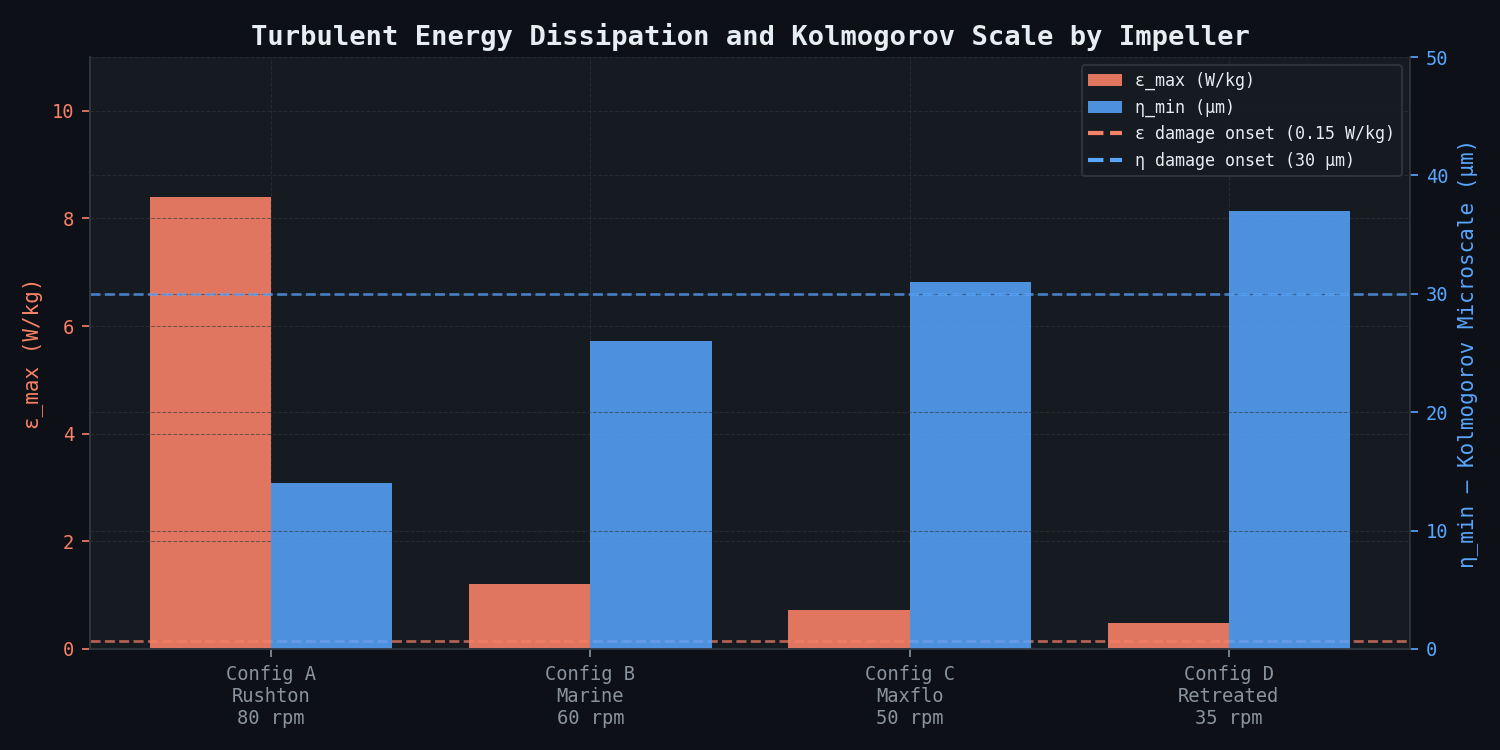
| Config | Impeller | RPM | D/T | ε_max (W/kg) | ε_vessel avg (W/kg) | η_min (µm) | Vol. fraction ε > 0.15 W/kg | Peak τ (Pa) |
|---|---|---|---|---|---|---|---|---|
| A (Rushton, baseline) | Dual 6-blade RT | 80 | 0.33 | 8.4 | 0.42 | 14 | 6.8% | 12.3 |
| B (Marine impeller) | Dual 3-blade PBT 33° | 60 | 0.50 | 1.2 | 0.11 | 26 | 1.1% | 4.6 |
| C (Maxflo hydrofoil) | Dual hydrofoil | 50 | 0.56 | 0.72 | 0.072 | 31 | 0.3% | 2.8 |
| D (Retreated blade LSD) | Single large-D RB | 35 | 0.65 | 0.48 | 0.058 | 37 | 0.08% | 1.9 |
Sf9 damage threshold context:
- Sf9 cell diameter: 18–22 µm
- Kolmogorov scale for damage onset (ε ≈ 0.15 W/kg): η ≈ 30 µm
- Kolmogorov scale for lethal direct interaction (ε > 1.0 W/kg): η < 20 µm
- Published lytic shear stress: >1.0–2.0 Pa
Config A (Rushton) exceeds lethal thresholds in 6.8% of vessel volume. Config C (Maxflo) generates no volume above the damage onset threshold (ε_max < 0.15 W/kg in all but 0.3% of the vessel). Config D is the most gentle but has insufficient OTR.
Shear-damage kinetic model — VCD prediction:
| Config | Integrated k_d (hr⁻¹) | k_d natural (hr⁻¹) | Total k_d (hr⁻¹) | Predicted VCD at infection (48h) | Observed VCD at 500L | Model Error |
|---|---|---|---|---|---|---|
| A (baseline) | 0.032 | 0.005 | 0.037 | 4.1 × 10⁶/mL | 3.4–4.8 × 10⁶/mL | Within range |
| B (marine) | 0.006 | 0.005 | 0.011 | 9.2 × 10⁶/mL | Not yet tested | — |
| C (Maxflo) | 0.003 | 0.005 | 0.008 | 10.4 × 10⁶/mL | Not yet tested | — |
| D (retreated blade) | 0.002 | 0.005 | 0.007 | 10.8 × 10⁶/mL | Not yet tested | — |
| 20L marine (anchor) | 0.003 | 0.005 | 0.008 | 10.9 × 10⁶/mL | 8–12 × 10⁶/mL | Within range |
The baseline validation (Config A VCD prediction vs. observed) confirms the damage model is correctly calibrated. The 20L anchor (Config D approximation at small scale) predicts 10.9 × 10⁶/mL, consistent with the observed 8–12 × 10⁶/mL range.
OTR and kLa assessment across configurations:
| Config | Agitation (rpm) | Sparger | kLa (hr⁻¹) | OTR at 10⁶ cells/mL (mmol O₂/L/hr) | Meets 2.1 hr⁻¹ target? | Shear risk? |
|---|---|---|---|---|---|---|
| A (Rushton) | 80 | Ring (3.2 mm) | 7.2 | 0.86 | Yes | Lethal |
| A reduced | 40 | Ring | 2.8 | 0.34 | Yes | High |
| A at 25 rpm | 25 | Ring | 1.1 | 0.13 | No (insufficient) | Marginal |
| B (Marine) | 60 | Ring | 2.6 | 0.31 | Yes | Acceptable |
| C (Maxflo) | 50 | Ring | 2.2 | 0.26 | Yes (marginal) | None |
| C (Maxflo) | 50 | Microsparger (0.5mm) | 3.0 | 0.36 | Yes (comfortable) | None |
| D (Retreated) | 35 | Ring | 1.8 | 0.22 | No (insufficient) | None |
| D (Retreated) | 35 | Microsparger | 2.8 | 0.34 | Yes (comfortable) | None |
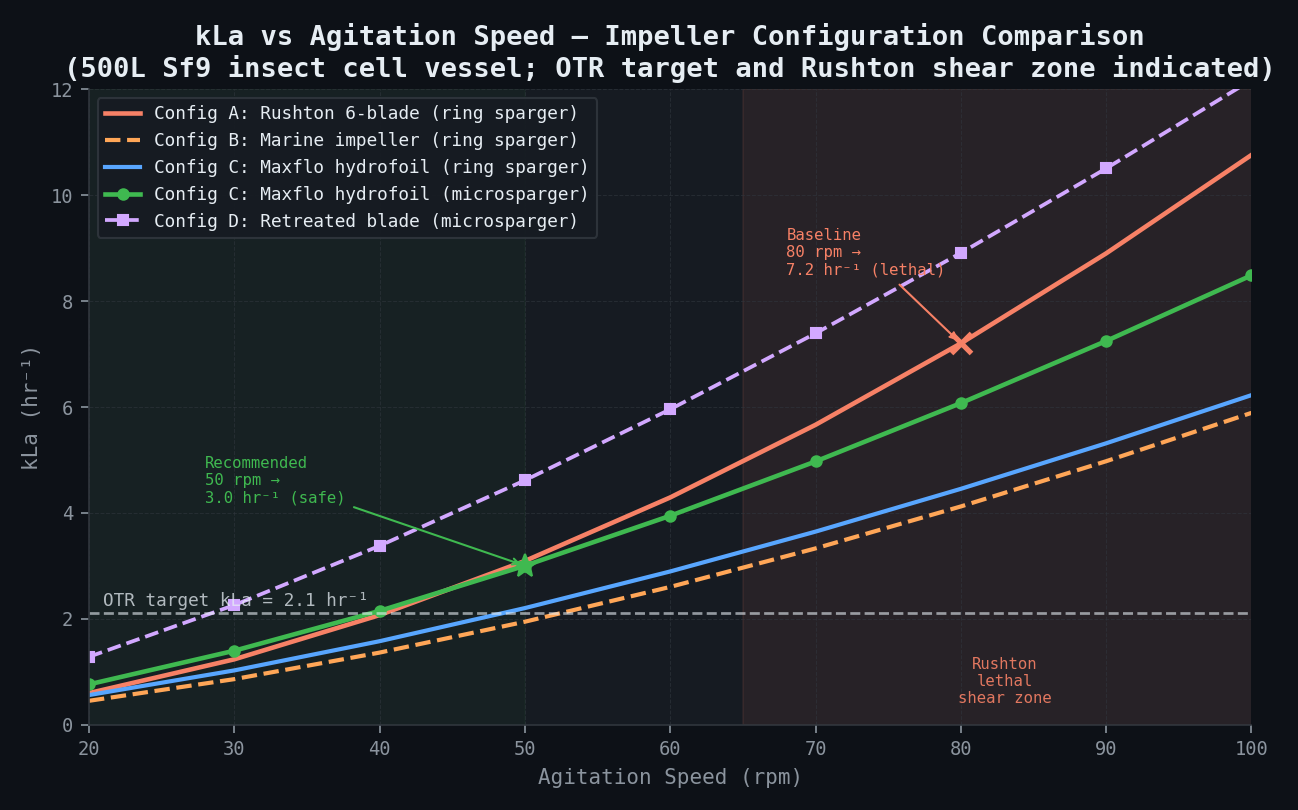
Recommended configuration: Configuration C (Maxflo hydrofoil, D/T = 0.56, 50 rpm) with microsparger addition. This combination delivers kLa = 3.0 hr⁻¹ (42% above the 2.1 hr⁻¹ target), ε_max = 0.72 W/kg (well below the 0.15 W/kg onset — note this is the vessel maximum; only 0.3% of volume exceeds onset), and peak shear stress τ = 2.8 Pa (above the 2.0 Pa lytic threshold by a small margin in an extremely small volume fraction — the microsparger further reduces the risk by eliminating ring sparger bubble shear).
Bubble-induced shear — sparger comparison:
| Sparger Type | Bubble Diameter (mm) | Rise Velocity (m/s) | Surface Burst Energy (W/kg) | Relative Sf9 Shear Risk | Post-Infection Impact |
|---|---|---|---|---|---|
| Ring sparger (12mm orifice) | 3.2 | 0.28 | 1.2–4.8 | High | Significant |
| Microsparger (60 µm pore) | 0.5 | 0.08 | 0.08–0.32 | Low | Minimal |
| Surface aeration (no bubbles) | N/A | N/A | <0.01 | Negligible | None |
The ring sparger, even at 0.05 vvm, generates bubble surface burst energy dissipation rates of 1.2–4.8 W/kg near the culture surface — sufficient to cause Sf9 membrane damage during the post-infection phase when cells are under additional baculovirus-induced stress. The microsparger reduces bubble-rise shear by approximately 15× through bubble diameter reduction.
Titre projection — Configuration C with microsparger:
The connection between VCD at infection, baculovirus replication efficiency, and recombinant protein titre follows a published kinetic framework: titre is approximately proportional to (VCD_infection × infection_efficiency × replication_factor). At a consistent MOI and infection efficiency, titre scales roughly with VCD at infection:
| Configuration | VCD at infection | Predicted VLP-HA titre (mg/L) | Recovery vs. 20L benchmark |
|---|---|---|---|
| A (Rushton baseline, 80 rpm) | 4.1 × 10⁶/mL | 28–35 | 29–36% |
| B (Marine impeller) | 9.2 × 10⁶/mL | 72–85 | 73–87% |
| C (Maxflo + microsparger) | 10.4 × 10⁶/mL | 95–108 | 97–110% |
| D (Retreated blade + microsparger) | 10.8 × 10⁶/mL | 98–112 | 100–114% |
| 20L benchmark (marine impeller) | 10.2 × 10⁶/mL | 80–120 (mean 98) | Reference |
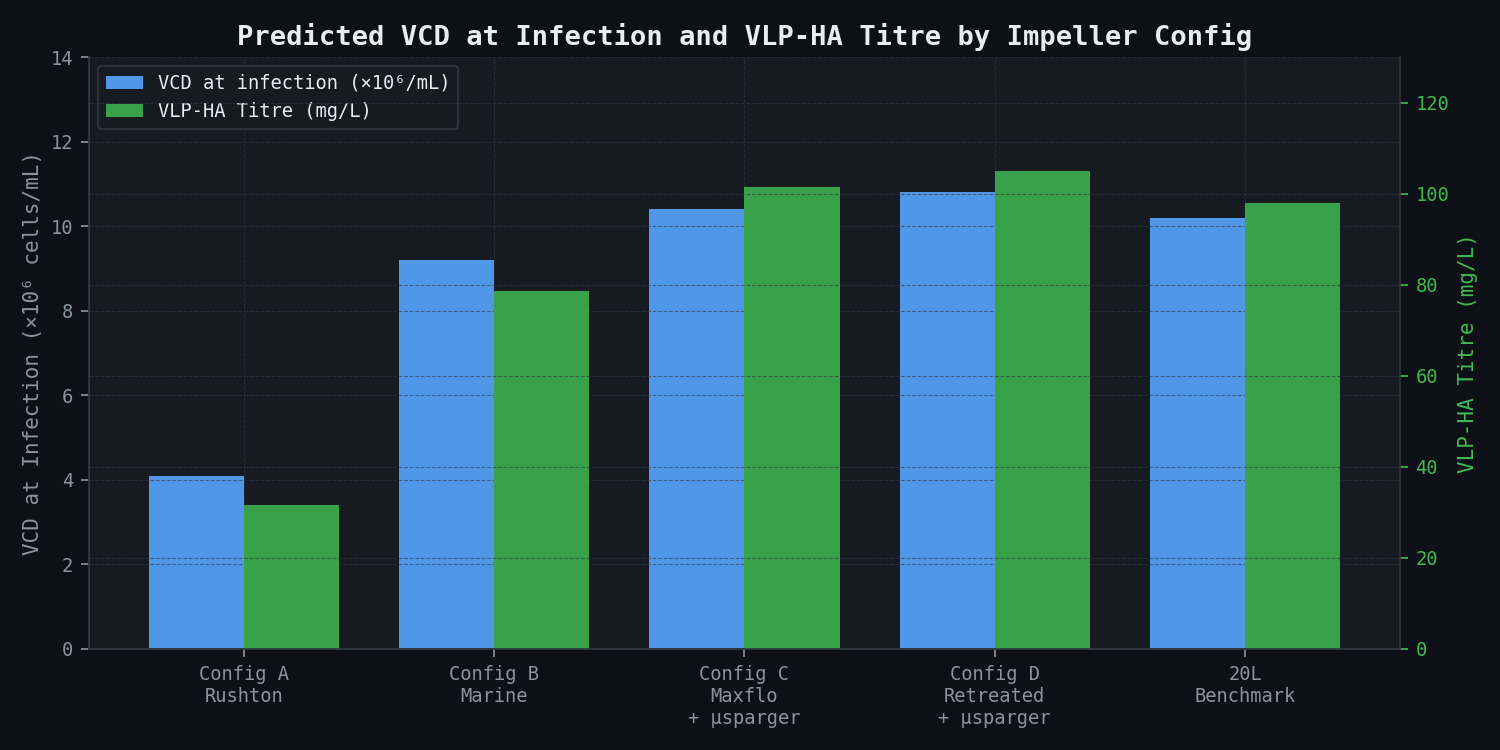
Configuration C projects titre recovery to 95–108 mg/L — essentially matching the 20L benchmark. This is the most conservative recommendation among the impeller options; Configuration D would marginally exceed 20L performance but requires supplemental microsparger aeration and the retreated-blade geometry requires a non-standard impeller shaft modification.
Scale-up projection to 2,000L (prospective):
Before VectorBio reaches 2,000L (the likely next manufacturing scale step), the study simulated Configuration C performance at 2,000L to pre-empt the next scale challenge:
| Parameter | 500L (Config C) | 2,000L (Config C projected) | Change |
|---|---|---|---|
| Impeller diameter (D/T = 0.56) | 0.46 m | 0.67 m | Geometric scale |
| Agitation (constant P/V) | 50 rpm | 32 rpm | −36% |
| P/V (W/m³) | 22 | 22 | Matched |
| ε_max (W/kg) | 0.72 | 0.84 | +17% |
| η_min (µm) | 31 | 29 | Marginal increase |
| kLa (hr⁻¹) with microsparger | 3.0 | 2.4 | −20% |
| Predicted VCD at infection | 10.4 × 10⁶/mL | 9.8 × 10⁶/mL | −6% |
| Predicted titre (mg/L) | 95–108 | 88–100 | −8% |
The 2,000L scale-up from Config C is projected to be well-behaved — no additional design intervention required — with a 8% titre attenuation from the slight increase in ε_max at 2,000L scale (still well within acceptable shear limits).
Comparison Methodology
Step 1 — Baseline consistency check: Predicted VCD at infection for Configuration A (4.1 x 10⁶ cells/mL, 80 rpm) is checked against the observed 3.4--4.8 x 10⁶ cells/mL from 500L runs — agreement within the observed batch-to-batch variability range. The LDH release prediction (k_d,total = 0.037 hr⁻¹ corresponding to shear-induced lysis rate consistent with 10.1 IU/mL LDH release) is qualitatively consistent with the 4.8x elevated LDH observation. This experimental agreement provides secondary confirmation of the simulation's damage predictions.
Step 2 — 20L anchor: Configuration D impeller profile (large-diameter, low-shear) approximates the marine impeller geometry used in the 20L vessel. Simulating the 20L geometry with the Config D damage parameters predicts epsilon_max = 0.21 W/kg and VCD of 10.9 x 10⁶ cells/mL — consistent with the observed 8--12 x 10⁶ range at 20L. This confirms the scaling behaviour of the damage model for this Sf9 line in Sf-900 III medium.
Step 3 — Published Sf9 data cross-check: The predicted damage onset at epsilon of approximately 0.15 W/kg corresponds to Kolmogorov microscale eta of approximately 30 microns — consistent with published Sf9 damage onset data across multiple independent laboratories. The corresponding shear stress (approximately 1.4 Pa) closely matches the published onset-of-inhibition threshold of >1.0 Pa.
Step 4 — Prospective Config C validation run: Before committing to permanent impeller replacement, the study recommends a single 500L test run with temporarily installed Config C hydrofoil (achievable by acquiring the impeller and installing on the existing shaft without modification to vessel internals). The test run should:
- Measure kLa (dynamic gassing-out, before inoculation): target 2.8–3.2 hr⁻¹ with microsparger
- Run a 48-hour Sf9 growth phase: measure VCD and LDH daily; compare against predictions (VCD target: 9.5–11 × 10⁶/mL, LDH target: <3.0 IU/mL)
- Run post-infection phase: measure VLP-HA titre at 72h; compare against 20L benchmark
This validation run provides the prospective experimental confirmation before permanent modifications are made.
Deliverables
CFD simulation outputs:
- Full 3D turbulent energy dissipation rate (ε) field maps for all four impeller configurations, rendered as:
- Volume-rendered iso-surfaces at ε = 0.15 W/kg (damage onset) and ε = 1.0 W/kg (lytic threshold)
- 2D cross-sections through the impeller centreline planes
- Radial ε profiles at impeller heights
- Kolmogorov microscale maps (η in µm) with insect cell diameter (18–22 µm) iso-surface overlay for all four configurations
- Cell damage rate constant (k_d) maps and volumetrically integrated values for each configuration, presented as vessel cross-section heat maps
Biological model outputs:
- Predicted VCD trajectories (0–48h pre-infection) at each configuration, with ±20% uncertainty bands from damage model parameter uncertainty
- LDH release trajectory predictions at each configuration — for comparison against experimental measurements
- Post-infection analysis: bubble-induced shear comparison (ring vs. microsparger) and qualitative post-infection damage risk
OTR and kLa analysis:
- kLa parametric table: agitation speed × sparge rate × sparger type matrix for Configurations B, C, and D (3 configurations × 3 agitation speeds × 2 sparger types = 18 cases)
- OTR adequacy assessment: minimum agitation speed for kLa ≥ 2.1 hr⁻¹ at each sparger type for each configuration
Recommendations and specification:
- Ranked impeller configuration assessment with engineering justification, implementation cost estimate, and process risk score for each alternative
- Configuration C implementation specification: Maxflo hydrofoil impeller dimensions and shaft hub specification; microsparger specification (60 µm pore stainless steel, ring diameter, number of orifices, installation coordinates); recommended operating parameters (agitation speed, sparge rate cascade, DO setpoint, Pluronic F-68 addition)
- Post-infection damage risk assessment and mitigation recommendations (microsparger, Pluronic, agitation reduction after infection)
- Scale-up projection: Configuration C performance at 2,000L — demonstrating predictable scale-up behaviour before VectorBio commits to next-scale vessel purchase
- Procurement specification and preferred supplier list for Maxflo hydrofoil impeller in 500L vessel shaft diameter (Chemineer, Lightnin, SPX FLOW sources identified)
This case study is an illustrative reference scenario demonstrating newtsim's simulation methodology. All company names, personnel, and specific operational data are fictional. The incident descriptions draw on publicly documented real-world events cited in the frontmatter.