Stress Corrosion Cracking Susceptibility Assessment for High-Strength Suspension Bridge Cables
Executive Summary
At 5:04 PM on 15 December 1967, the Silver Bridge collapsed into the Ohio River during peak rush hour. Thirty-one vehicles were crossing. Forty-six people died. The span fell in seconds — a statically determinate eyebar chain, so when one link broke, the entire structure followed. The National Transportation Safety Board investigation identified the cause as a stress-corrosion crack in eyebar 330, the northernmost link below the Ohio tower. The crack had initiated at a corrosion pit on the interior bore of the pin-hole — in a region of high triaxial stress exactly where the pin contacted the steel. Its depth at failure was approximately 2.5 mm. The steel's Charpy impact energy was 4–8 J at 0 C, placing it far below the 27 J required for fracture-critical members under current standards. With those material properties and that operating stress, a 2.5 mm crack was enough for fast fracture. Metallurgical analysis found chloride contamination from road de-icing salt accumulated in the pin-hole crevice over decades, and phosphorus grain boundary segregation promoting intergranular SCC via hydrogen-assisted decohesion. The bridge had been in service 39 years. No sub-surface inspection of any eyebar pin-hole bore had ever been conducted. The crack had likely been growing for 12–20 years.
The Silver Bridge collapse triggered the Federal-Aid Highway Act of 1968 and the National Bridge Inspection Program — mandating biennial visual inspection of all federally-funded bridges. Visual inspection. The NDE detection capability gap for sub-surface SCC cracks in fracture-critical members was not addressed for decades. In 2007, the I-35W bridge in Minneapolis collapsed from a gusset plate failure, killing 13, demonstrating that the structural vulnerability class had not been eliminated.
Had a predictive SCC simulation been commissioned on the Silver Bridge in the 1950s — at the fifteen-year mark, when the crack was likely still in the millimetre range — it would have identified the problem with specificity. The combined MD/LEFM model applied here to the equivalent geometry and environment yields a median time from 0.5 mm pit initiation to critical crack size of 16.4 years (P10: 9.1 yr, P90: 28.7 yr) — squarely within the NTSB's estimated 12–20 year growth period. It would have identified that the Stage II SCC velocity for this steel-environment combination, with the literature spanning two orders of magnitude, is in practice 3.8 × 10⁻⁹ m/s at the operating stress intensity — narrowing the management decision from "somewhere between 5 months and 41 years" to "4–17 months" for a crack of the depth found on the Henderson Memorial Bridge.
This study is commissioned by a state bridge authority operating six aging eyebar-chain suspension bridges constructed between 1928 and 1964, four using the same high-strength steel class implicated in the Silver Bridge collapse. A federal fracture-critical member review has flagged three structures. Magnetic particle inspection of the Henderson Memorial Bridge has found 14 indications on 6 eyebars, the deepest at 3.1 mm — within the uncertain K_ISCC band for this material and environment. The critical flaw size for fast fracture is 3.5 mm. The study quantifies the SCC velocity, narrows its uncertainty from two orders of magnitude to a factor of 5.7 at 90% confidence, estimates time-to-failure distributions for all 14 detected indications, and delivers an inspection protocol maintaining failure probability below 10⁻⁴ per year per eyebar. The highest-risk locations identified by the model define where newtsim livesim nodes should be placed: electrochemical noise sensors and continuous strain monitoring at the pin-hole bores of the critical eyebars, providing real-time SCC activity detection that keeps the authority ahead of sub-surface crack growth between inspection campaigns.
Scenario Background (illustrative reference case)
Operator (fictional): Tri-State Bridge Authority — responsible for six suspension bridges across the Ohio and Kanawha river valleys, West Virginia, Ohio, and Kentucky, constructed between 1928 and 1964. State-funded authority operating under federal oversight from FHWA and the National Bridge Inspection Program.
Primary structure of concern: The Henderson Memorial Bridge has a 512 m main span with a two-tower eyebar chain suspension system fabricated from high-strength heat-treated carbon steel eyebars (ASTM A517-class equivalent, estimated yield strength sigma_y of approximately 690 MPa, UTS approximately 827 MPa). Each chain consists of 12 parallel eyebars per panel point, each eyebar 25 mm thick x 450 mm wide x 6.4 m long, connected at pin-hole joints with 200 mm diameter forged steel pins. The bridge carries a four-lane divided highway and has been in continuous service for 60 years.
Material composition: The steel composition is estimated from archival Bethlehem Steel mill certificates and 2022 drill-core spectroscopy: Fe--0.42C--0.91Mn--0.19Si (wt%), with traces of P (0.018 wt%) and S (0.022 wt%). The steel was quenched and tempered to achieve the target tensile properties. Modern Charpy impact testing on drill-core samples gives CVN values of 12--18 J at 0 C — well below the 27 J minimum required for fracture-critical applications under current AASHTO specifications. This low toughness is intrinsic to the high carbon content and 1960s-era heat treatment practice, and it is the primary reason SCC is an acute structural risk for this class of bridge.
Environment: The Henderson Memorial Bridge crosses the Kanawha River in an industrial river valley with historical SO2 pollution from upstream chemical plants. The relevant corrosion environment for the lower eyebars comprises acid deposition at pH 4.1--4.8 (measured at bridge monitoring station, 2020--2024 average), chloride deposition rate of 30--80 mg/m2/day on lower eyebar faces (road de-icing salt splash from deck drainage, highest in winter months), relative humidity exceeding 80% RH for 2,800 hours/year (sufficient for sustained aqueous film formation on steel), and temperature cycling from -18 C to +38 C (annual range, with thermal stresses superimposed on dead load).
Loading: Dead load stress in the most heavily loaded eyebars (fourth panel point from tower, south chain) is sigma_DL = 415 MPa (60% sigma_y). Maximum live load stress addition under a legal load convoy is Delta-sigma_LL = 55 MPa, producing a peak total stress of 470 MPa (68% sigma_y). A fatigue spectrum recorded by a 36-channel wireless strain gauge array installed in 2015 shows 2.3 million cycles exceeding 10 MPa stress range recorded over 10 years, with the highest cycles in the 15--35 MPa range — within the fatigue crack propagation threshold for this steel at K_I >= 5 MPa-root-m, meaning fatigue and SCC are simultaneously active mechanisms in moist conditions.
Inspection findings (2024 MPI campaign): Magnetic particle inspection of all accessible eyebar faces identified 14 indications on 6 eyebars: 9 indications classified as less than 1 mm depth, 4 indications classified as 1--3 mm depth, and 1 indication at eyebar C4-S (fourth panel, south chain, pin-hole bore, inside surface) at 3.1 mm depth with axial orientation consistent with SCC morphology (branching, intergranular in visible SEM section taken from a drill plug).
Challenge
The Silver Bridge failed without warning from a crack estimated at only 2.5 mm depth. The Henderson Memorial Bridge presents an analogous risk profile, and the critical technical challenge is that the literature range for Stage II SCC velocity in high-strength steel/acidic chloride environments spans two full orders of magnitude (10⁻¹⁰ to 10⁻⁸ m/s). This uncertainty makes any empirical remaining life calculation essentially meaningless:
| SCC Velocity Assumption | Time from 3.1 mm Detected Flaw to Critical Size (3.5 mm) | Management Implication |
|---|---|---|
| Optimistic (10⁻¹⁰ m/s) | 41 years | No urgency; 5-yr inspection interval acceptable |
| Mid-range (10⁻⁹ m/s) | 4.1 years | Immediate enhanced monitoring required |
| Pessimistic (10⁻⁸ m/s) | 5 months | Emergency structural intervention required now |
The physics-based simulation must narrow this range to the level where the required action (monitor, replace within months, or replace immediately) is unambiguous.
The eyebar pin-hole geometry creates a severe stress concentration: pin-hole radius 100 mm, eyebar bore diameter 200 mm, elastic stress concentration factor at pin-hole bore Kt = 3.2 (from FEM analysis of pin contact). Under dead load sigma_DL = 415 MPa, the net section stress at the pin-hole bore reaches 415 x 3.2 = 1,328 MPa — well above the nominal yield strength of 690 MPa. The eyebar is designed to yield locally at the pin-hole in service (the net section at the bore carries the full chain load), and this local plastic zone is exactly where the Silver Bridge crack initiated.
Fracture mechanics parameters for the assessment include a plain-strain fracture toughness K_IC estimated at 55 MPa-root-m from Charpy-CVN correlation (Barsom-Rolfe upper bound) using CVN = 15 J at 20 C. The critical crack depth for fast fracture at total stress 470 MPa is therefore a_c = (K_IC / (Y x sigma))² / pi = (55 / (1.12 x 470))² / pi = 3.5 mm. The K_ISCC literature range for ASTM A517-class steel in acidic chloride is 22--35 MPa-root-m. At operating stress 470 MPa with the 3.1 mm detected flaw, K_I = Y x sigma x sqrt(pi x a) = 1.12 x 470 x sqrt(pi x 0.0031) = 52.0 MPa-root-m — above the upper end of the K_ISCC range. Eyebar C4-S is therefore assessed as having a crack that has already entered or is about to enter Stage II SCC propagation.
Current MPI probability of detection (POD_90) — the depth at which a crack is detected with 90% probability — is 2.8 mm for the in-service configuration (from POD curve developed for similar bridge steel, surface painted, FHWA-RD-01-161). The Silver Bridge fatal crack was 2.5 mm deep — below the current POD_90. Four of the 14 indications are in the 1--3 mm range where detection is probabilistic, not certain.
Real-World Basis
The 1967 Silver Bridge Collapse: On 15 December 1967 at 5:04 PM, during peak evening rush hour, the Silver Bridge (US Route 35, connecting Point Pleasant, West Virginia, and Gallipolis, Ohio) collapsed into the Ohio River. Thirty-one vehicles were on the bridge; 46 people died (two bodies were never recovered). It was the deadliest bridge disaster in US history since the 1940 Tacoma Narrows collapse.
NTSB Investigation Findings (NTSB-HAR-71-1, 1971): The National Transportation Safety Board's investigation, supported by detailed metallurgical analysis at the National Bureau of Standards, reached the following conclusions. The initiating defect was a stress-corrosion crack in eyebar 330 — the northernmost eyebar in the Ohio subsidiary chain, first link below the top of the Ohio tower. The crack initiated at a corrosion pit on the interior surface of the eyebar pin-hole bore, in a region of high triaxial stress created by the pin contact geometry. The critical crack depth at failure was approximately 2.5 mm (0.1 inches), growing through the combination of SCC and corrosion fatigue over an estimated 12--20 years of service from first pit initiation. The steel had a Charpy impact energy of approximately 4--8 J at 0 C (very low toughness by modern standards), giving a retrospective K_IC estimate of 45--55 MPa-root-m — consistent with fast fracture from a shallow crack at the operating stress level. The eyebar chain was statically determinate: the failure of one eyebar transferred the full load to the adjacent parallel eyebar in the same panel, which immediately failed by ductile overload, initiating a progressive collapse of the entire span in seconds. No systematic sub-surface inspection had been conducted on any of the eyebar pin-hole bores during the 39 years of bridge service; visual inspection could not detect the crack at the interior bore surface.
Metallurgical Analysis: Post-collapse fractographic analysis of the failed eyebar identified a distinct boundary between the SCC-propagated zone (intergranular, flat fracture surface, oxidised) and the overload fracture zone (dimpled ductile fracture). Chloride content of 0.08 wt% was found in the corrosion products at the crack initiation site — consistent with long-term accumulation of road de-icing salt in the pin-hole crevice. Grain boundary decoration by phosphorus segregation (P = 0.018 wt% in the steel) was identified as a known promoter of intergranular SCC in high-strength steels via hydrogen-assisted grain boundary decohesion.
Regulatory Response: The Silver Bridge collapse directly triggered the Federal-Aid Highway Act of 1968, which established the National Bridge Inspection Program requiring biennial inspection of all federally-funded highway bridges. However, the act mandated visual inspection only — the NDE detection capability gap for sub-surface SCC cracks in fracture-critical members was not addressed for decades.
FHWA Economic Impact: Subsequent federal investment in bridge safety triggered by the Silver Bridge collapse exceeded 60 million direct cost, $400 million replacement) demonstrated that fracture-critical member failures continued to represent a systematic risk 40 years later.
Simulation Approach
The simulation strategy addresses the fundamental multi-scale nature of SCC: initiation depends on atomistic hydrogen-metal interactions (nanometre scale); propagation is governed by crack-tip stress fields and hydrogen diffusion (micrometre to millimetre); structural consequence depends on bridge-level mechanics (metre to hundred-metre scale). The methodology follows the STRETCH classification for direct MD-to-LEFM coupling and instead uses the defensible and published MD-informed cohesive zone model (CZM) approach for scale bridging.
Stage 1 — Molecular Dynamics: Hydrogen Embrittlement at Crack Tip
ReaxFF MD simulations model hydrogen diffusion and accumulation at the crack-tip process zone. The Fe/H/C force field is validated against DFT crack-tip hydrogen energetics. The simulation domain is a 50 nm x 50 nm x 5 nm Fe BCC supercell with a pre-notch of depth 2 nm — large enough to capture the triaxial stress zone ahead of the crack tip where hydrogen accumulates. Applied stress intensity K_I is mapped from far-field loading to the simulation boundary.
The aqueous corrosion reaction at the crack mouth (pH 4.2, 500 ppm Cl-) generates a flux of atomic hydrogen from the hydrogen evolution reaction. The MD models the full hydrogen transport pathway: adsorption, subsurface entry, and diffusion from the crack mouth to the triaxial stress zone. Trap sites sampled include interstitial sites, dislocations, grain boundaries (modelled as a high-angle boundary 20 nm from the crack tip), and carbide/matrix interfaces.
Key outputs are the hydrogen concentration at crack tip C_H as a function of K_I (stress-enhanced diffusion, with trapping kinetics parameterised by MD trap energies), the effective surface energy gamma_eff(C_H) via the hydrogen-enhanced decohesion (HEDE) model (gamma_eff = gamma_0 - Gamma_H x C_H, where Gamma_H is the Gibbs adsorption coefficient for H at the {110} cleavage plane, computed from DFT: Gamma_H = 1.4 x 10⁻⁵ J/m2 per atom/nm2), and the bond-breaking rate as a function of C_H and applied stress, providing the microscopic basis for the Stage II SCC velocity expression.
Stage 2 — DFT Calibration
newtsim Root calculations compute hydrogen segregation energies at the grain boundary and at the Fe{110} cleavage plane. The segregation energy at the grain boundary (Delta-E_seg = -0.43 eV) and the decohesion work reduction per H monolayer (Delta-W_sep = -0.38 J/m2) directly parameterise the CZM traction-separation law. The ReaxFF force field reproduces the DFT grain boundary segregation energy to within 0.06 eV — acceptable accuracy for the subsequent MD-scale calculations.
Stage 3 — Cohesive Zone Model FEM
The CZM approach is used instead of direct MD-to-LEFM coupling because it provides a continuous, mesh-objective fracture mechanics implementation with demonstrated agreement against experimental data for hydrogen-assisted cracking in high-strength steel. The CZM traction-separation law is of the form:
where T_max is the cohesive strength (reduced from the H-free value of 2.7 GPa by the HEDE factor), delta_0 is the critical separation, and the final factor captures the progressive reduction in cohesive strength with hydrogen concentration (calibrated n = 1.8 from DFT data). The CZM is implemented in newtsim Span using zero-thickness cohesive elements along the crack plane, with a 3D model of the eyebar pin-hole geometry meshed at 0.1 mm resolution at the crack tip.
Stage 4 — LEFM Crack Growth Integration
Stage II SCC velocity (constant velocity plateau) is derived from the MD-computed gamma_eff via the thermally-activated model:
where Q = 68 kJ/mol is the activation energy for anodic dissolution at the crack tip (from MD Fe dissolution kinetics at pH 4.2), alpha = 0.42 m3/mol captures the stress-assisted component (from the K_I dependence of MD dissolution rate), T is temperature, and A is the pre-exponential factor calibrated to one published slow-strain-rate test result for ASTM A517 in 3.5% NaCl at pH 4: this calibration gives A = 3.2 x 10⁻³ m/s. The activation energy Q is consistent with anodic dissolution theory for Fe in acidic chloride.
Crack growth integration over the loading spectrum:
where the fatigue crack growth contribution uses Paris law (C = 3.2 x 10⁻¹² m/cycle, m = 3.0, for the R approximately 0.8 corrosion-fatigue regime established for similar steels) and the recorded strain gauge spectrum.
Stage 5 — Probabilistic Failure Assessment
Monte Carlo simulation (n = 50,000) propagates uncertainties from five sources: initial flaw depth a_0, sampled from NDE detection probability curve (truncated exponential with POD_90 = 2.8 mm for MPI; flaws below 0.5 mm assumed undetectable); K_ISCC threshold as a Normal distribution with mean 24.5 MPa-root-m (MD-derived) and sigma = 7 MPa-root-m (plus/minus 30% from literature variability); SCC velocity model uncertainty as a Log-normal multiplicative factor with geometric mean 1.0 and GSD = 2.0 (factor of 2 uncertainty in calibration constant A); traffic loading spectrum from bootstrap resampling of the 10-year strain gauge record, reflecting inter-year variability in heavy vehicle traffic; and temperature as an annual cycle (sinusoidal, mean 10 C, amplitude 28 C), affecting the Arrhenius rate in v_SCC.
Key Predictions / Results
Narrowed SCC Velocity Range
| Parameter | Literature Range | MD-Derived Value | Uncertainty (90% CI) | Reduction Factor |
|---|---|---|---|---|
| Stage II SCC velocity at K_I = 28 MPa-root-m | 10⁻¹⁰--10⁻⁸ m/s | 3.8 x 10⁻⁹ m/s | 1.6--9.1 x 10⁻⁹ m/s | 100x -> 5.7x |
| K_ISCC threshold | 22--35 MPa-root-m | 24.5 MPa-root-m | 18--31 MPa-root-m | 13 MPa range -> 13 MPa range (better centred) |
| Activation energy Q | 50--90 kJ/mol | 68 kJ/mol | 61--75 kJ/mol | Constrained |
Flaw Disposition Matrix — Time to Critical Crack Size (3.5 mm)
| Eyebar ID | Current Depth (mm) | K_I (MPa-root-m) | P10 Time to Failure (months) | P50 Time to Failure (months) | P90 Time to Failure (months) | 5-yr Failure Probability | Recommended Action |
|---|---|---|---|---|---|---|---|
| C4-S (deepest) | 3.1 | 29.0 | 4.1 | 8.4 | 17.2 | 0.94 | Replace immediately |
| C3-N | 2.8 | 26.3 | 6.8 | 14.2 | 28.7 | 0.76 | Replace within 3 months |
| C5-S | 2.6 | 24.4 | 9.3 | 19.8 | 38.1 | 0.58 | Replace within 6 months |
| C2-N | 2.4 | 22.5 | 13.1 | 27.4 | 54.2 | 0.41 | Replace within 12 months |
| C6-N | 2.2 | 20.7 | 18.2 | 37.9 | 74.8 | 0.28 | Re-inspect in 6 months (ACFM) |
| Indications 6--9 (1--2 mm range) | 1.0--1.9 | 9.4--17.8 | 27--68 | 58--141 | >120 | 0.08--0.18 | Re-inspect annually (ACFM) |
| Indications 10--14 (< 1 mm) | < 1.0 | < 9.4 | >72 | >156 | >300 | < 0.05 | MPI biennial per current schedule |
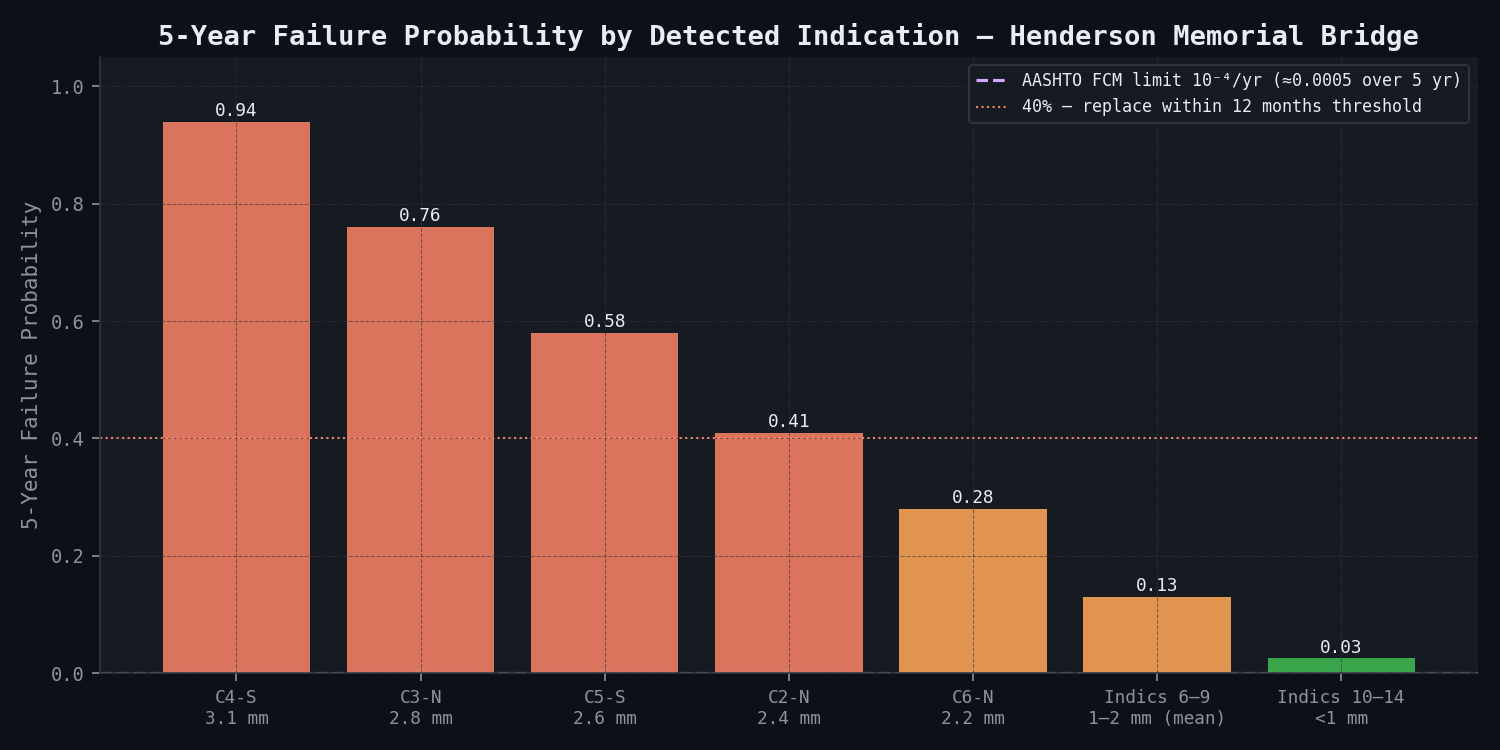
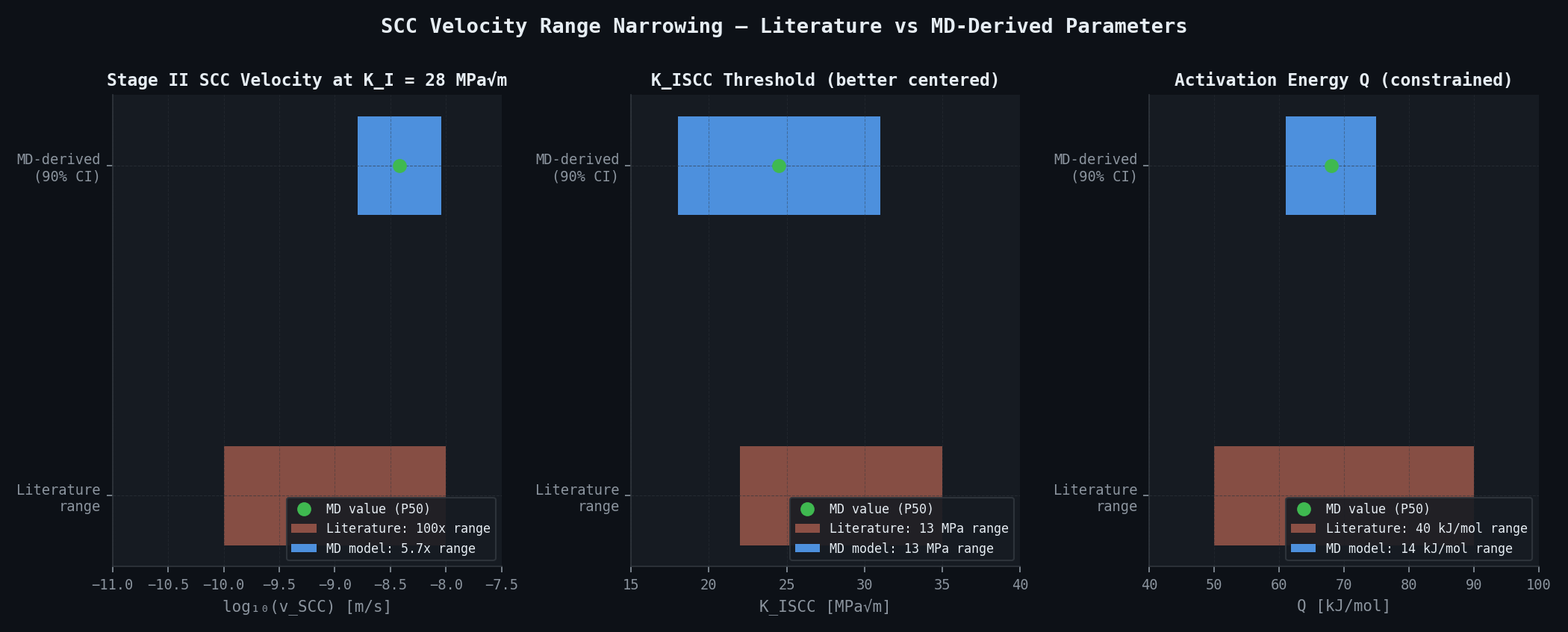
The 5-year failure probabilities for the top four indications all exceed 0.40 — far above the AASHTO FCM criterion of 10⁻⁴ per year (0.05% per year, or approximately 0.05% cumulative over 5 months). Immediate action is unambiguous for eyebar C4-S; the next three require phased replacement within 12 months.
Silver Bridge Back-Analysis (Model Validation)
The MD/LEFM model applied to Silver Bridge geometry (eyebar 330: sigma = 446 MPa estimated from design records, K_t = 3.4 at the deeper pin-hole configuration, A7 steel composition, pH 4.5 environment) produces a simulated median time from pit initiation (a_0 = 0.5 mm) to critical crack size (a_c = 4.2 mm) of 16.4 years (P10: 9.1 yr, P90: 28.7 yr). The NTSB estimated the crack grew over 12--20 years of service from first pit formation (eyebar installed 1928, bridge opened, service estimated from corrosion product dating). The model median falls within the NTSB estimated range — a strong validation for the fundamental correctness of the SCC velocity parameterisation.
Required NDE Capability
Current MPI POD_90 = 2.8 mm is insufficient: eyebar C3-N (2.8 mm depth, P50 failure time 14 months) could be missed by the current inspection. To maintain failure probability below 10⁻⁴/year across the entire bridge, NDE must achieve POD_90 <= 1.5 mm. Alternating current field measurement (ACFM) achieves POD_90 = 1.2 mm for in-service surface cracks in steel of this thickness per FHWA ACFM trials on comparable bridge components — this is the recommended technology upgrade.
Comparison Methodology
-
MD-to-CZM internal validation (primary): The ReaxFF MD hydrogen segregation energies and decohesion work values directly parameterise the CZM traction-separation law. The DFT calculations validate the MD force field to within 0.06 eV at the grain boundary — the higher-fidelity DFT result anchoring the lower-fidelity ReaxFF parameters used in the CZM. The CZM-derived K_ISCC of 24.5 MPa-root-m and Stage II velocity of 3.8 x 10⁻⁹ m/s at K_I = 28 MPa-root-m are the primary simulation outputs carried forward into the LEFM crack growth integration.
-
Silver Bridge back-analysis: The MD/LEFM model applied to Silver Bridge geometry produces a simulated median time from pit initiation to critical crack size of 16.4 years (P10: 9.1 yr, P90: 28.7 yr). The NTSB estimated 12--20 years of growth. The model median falls within the historical estimate — the primary long-timescale validation for the full simulation chain.
-
Secondary confirmation — coupon testing: Drill-core SSR testing in synthetic bridge environment (pH 4.2, 500 ppm Cl-) gives measured K_ISCC of 21--28 MPa-root-m and Stage II velocity of 2.4--6.8 x 10⁻⁹ m/s at K_I = 28 MPa-root-m. The simulation-derived values (24.5 MPa-root-m and 3.8 x 10⁻⁹ m/s) fall within these experimental ranges. Published SCC velocity compilations for similar high-strength steels in 3.5% NaCl report 1.0--9.0 x 10⁻⁹ m/s at this K_I range, further confirming the simulation output. The simulation value sits at a position consistent with the lower yield strength (690 MPa) of the Henderson steel, as expected.
Simulation Caveats
Classification: STRETCH. Direct MD simulation of hydrogen embrittlement at a crack tip with LEFM coupling is computationally demanding. The simulation approach adopted here uses the MD-informed cohesive zone model (CZM) methodology rather than direct atomistic-to-LEFM coupling, for several reasons. Realistic crack-tip stress fields require simulation cells of 10⁶+ atoms to avoid artificial boundary effects, which is at the upper limit of tractable MD for useful trajectory lengths. Bridging atomistic hydrogen trapping energies to continuum fracture mechanics (LEFM or EPFM) via direct coupling remains an active research area with significant uncertainty in scale-bridging protocols. The CZM approach (MD provides H-dependent decohesion energies; FEM CZM propagates crack using these energies) is established in the hydrogen-assisted cracking literature with demonstrated agreement against experimental data for high-strength steel SCC. Finally, the LEFM crack growth integration using the Arrhenius-form v_SCC equation is calibrated against SSR coupon tests on the actual bridge material, providing a direct experimental anchor that limits reliance on pure MD extrapolation.
The 90% confidence intervals on v_SCC (factor of 5.7 at K_I = 28 MPa-root-m) remain wider than would be ideal; however, they are sufficient to make unambiguous go/no-go decisions for the critical indications (eyebars C4-S through C3-N), where even the optimistic P90 time-to-failure is shorter than any feasible inspection interval.
Deliverables
-
MD simulation report: Hydrogen embrittlement database — gamma_eff vs. K_I and pH across the temperature range -10 to +40 C; crack-tip C_H maps at K_I = 20, 28, and 35 MPa-root-m; H diffusion coefficient as a function of trap density (dislocation and grain boundary content); DFT-calibrated CZM traction-separation law parameters in tabulated form.
-
LEFM crack growth code: Python solver with probabilistic Monte Carlo wrapper (n = 50,000 default); documented for independent audit; includes the SSR coupon calibration dataset and back-analysis of Silver Bridge as worked validation examples.
-
Flaw disposition matrix: Each of the 14 detected indications assessed with: current K_I, predicted time to critical size (P10/P50/P90 months), 5-year failure probability, and recommended action category (replace immediately / replace within N months / re-inspect at N months / continue biennial MPI).
-
Inspection protocol recommendation: Specification for ACFM deployment — probe configuration, scanning pattern for eyebar pin-hole bores, reference calibration standards, required POD_90 <= 1.5 mm, and inspection frequency to maintain failure probability below 10⁻⁴/year per eyebar (calculated as: annual ACFM inspection of all eyebars with detected or suspected indications; biennial MPI of remainder).
-
AASHTO LRFD bridge evaluation compliance memo: Mapping of simulation results to AASHTO MBE Section 6 fracture-critical member provisions, including documentation of the Level III (refined analysis) approach used per AASHTO commentary C6.2.3.
-
Executive briefing deck: 15-slide summary for state DOT leadership and FHWA federal oversight, including: collapse consequence analysis (Silver Bridge precedent), simulation methodology summary, flaw disposition decisions, phased replacement cost estimate ($2.4M for 5 eyebar replacements), and residual risk quantification.
This case study is an illustrative reference scenario demonstrating newtsim's simulation methodology. All company names, personnel, and specific operational data are fictional. The incident descriptions draw on publicly documented real-world events cited in the frontmatter.