Optimising Microencapsulated Herbicide Release Kinetics Using Molecular Dynamics: A Post-Deployment Formulation Audit
Executive Summary
Commercially registered microencapsulated agrochemical formulations showing bimodal release in post-registration field performance monitoring represent a recurring, well-documented pattern of formulation failure. Published characterisation work on polyurea-encapsulated acetochlor CS formulations showed burst fractions of 15–40% within 48 hours correlating directly with D10 < 5 um in the particle size distribution — the small-capsule subpopulation generated when interfacial polymerisation conditions are not tightly controlled. The inverse failure is equally well documented for encapsulated pendimethalin: excessively slow release from shells that are too impermeable, reducing field efficacy below the threshold for acceptable weed control. Both failure modes — too-fast burst release and too-slow diffusion — originate at the same point: the nanoscale physics of polymer shell formation, crosslink density, and AI diffusion through a semicrystalline matrix that empirical formulation development cannot resolve from first principles. A formulation team iterating MDI:amine ratios and emulsifier concentrations empirically will run 12–18 reformulation cycles at CHF 8,000–15,000 each before arriving at a process specification that eliminates burst release without shifting the registered t-half. The problem is not a lack of effort. It is that the mechanistic variables driving the outcome — crosslink density, free volume, defect geometry at the polymerisation closure seam — are invisible to batch characterisation by laser diffraction and TEM alone.
The root cause of burst release in polyurea capsule suspensions is structurally specific: capsules below approximately 4 um diameter experience a higher surface-area-to-volume ratio that accelerates interfacial polymerisation, producing incomplete shell closure — pinholes or thin-wall equatorial seam regions — before the shell achieves the minimum crosslink density needed for controlled diffusion. TEM characterisation of acetochlor CS formulations confirmed that capsules in the 3–5 um size fraction had shells of 8–25 nm mean thickness versus 45–120 nm for nominal 8–12 um capsules. The thin-wall subpopulation has a diffusion half-life of hours, not days. Its AI drains through pinhole defects under the osmotic pressure differential between the AI-saturated core and the external aqueous phase, producing the burst fraction before the registered t-half slow-release fraction begins. The burst fraction from a poorly controlled manufacturing batch can approach 30–35% of total AI within 48 hours. In the Argentine and Brazilian markets, where a clomazone CS500 formulation is applied pre-emergent and the 48-hour burst depletes the AI pool before late-germinating weed species emerge, this translates directly to field efficacy failure and customer complaints — and, in high-rainfall scenarios, to surface runoff concentrations approaching the regulatory acute aquatic risk threshold for the most sensitive species.
Had a molecular simulation of the diffusion and defect transport physics been conducted during the original formulation development programme, the relationship between MDI:HDA crosslink ratio, shell thickness in the small-capsule subpopulation, and burst release fraction would have been quantified before scale-up. A coarse-grained MD study of three crosslink density variants would have predicted that the low-crosslink shell of a 16-nm-thick small capsule gives a diffusion half-life of 10–17 hours rather than 14–21 days, identifying the D10 minimum specification of 6 um as the critical process quality indicator. The same simulation provides the multi-scale release model — integrating Fickian diffusion, hydrolytic shell erosion, and pinhole drainage — that defines the feasible operating window of MDI:HDA ratio versus D10 minimum. This window is the process specification. Without the simulation, it is found empirically over 9–15 months of formulation iterations. With it, it is defined in 8 weeks.
A microencapsulation formulation audit — coarse-grained MD for three crosslink variants, three-phase diffusion coefficients, metadynamics shell hydrolysis energetics, and DPD defect geometry — potentially avoids 12–18 experimental reformulation cycles, saves 9–15 months of timeline, and provides the mechanistic justification for a Type IB variation dossier that regulators and internal QA teams require. The failing-batch field efficacy losses from burst-release batches are estimated at USD 2.5–4.2 million per year from the Argentine and Brazilian markets alone; the simulation identifies and averts this outcome before failing batches reach the field. The simulation's predicted field concentration profiles and soil transport pathways also define the monitoring placement for newtsim livesim — real-time soil residue sensors that validate release model predictions at the field level, provide early evidence that the reformulated product meets the registered t-half specification, and flag soil-type-specific release anomalies before they accumulate into field efficacy complaints or regulatory surface water exceedances.
Scenario Background (illustrative reference case)
In this worked example, a Zurich-based agrochemical formulation specialist that develops and licenses CS, WDG (water-dispersible granule), and EW (emulsion in water) formulations for AI holders in the crop protection industry retained a simulation consultancy to investigate post-market performance failure. The company registered ClomaCap CS500 — a microencapsulated clomazone 500 g/L capsule suspension — in 2022 under Regulation (EC) 1107/2009 Annex III formulation data requirements.
The active ingredient clomazone (3-(2-chlorobenzyl)-4,4-dimethyl-1,2-isoxazolidin-3-one; CAS 81777-89-1) is an inhibitor of the 1-deoxy-D-xylulose-5-phosphate synthase (DXS) step in the DOXP/MEP isoprenoid biosynthesis pathway, disrupting chloroplast development and causing bleaching in susceptible weeds. It is used for pre-emergent and early post-emergent control of broadleaf weeds and annual grasses in soybean, direct-seeded rice, and maize, with a global market value of approximately $280 million annually.
The physicochemical properties relevant to encapsulation include a logP of 2.5 (moderate, partitioning between organic core solvent and aqueous soil phase), water solubility of 1.1 g/L at 25 deg C (moderate, with significant aqueous phase partitioning), vapour pressure of 19.2 mPa at 25 deg C (low but not negligible, as volatilisation from soil is a loss pathway), Koc of 300 mL/g (moderate soil adsorption, where encapsulation reduces early runoff leaching), DT50 soil (field) of 24--35 days (inherently short-lived, making the formulation aim to maintain bioavailable AI concentration for 5--7 weeks to cover the full pre-emergent weed control window), and Henry's Law constant of 4.2 x 10⁻⁴ Pa m3/mol (significant volatility from aqueous solution, where encapsulation reduces volatilisation losses).
The formulation specification for ClomaCap CS500 uses a polyurea shell formed by interfacial polymerisation of MDI (methylene diphenyl diisocyanate, 4,4'-isomer) in the core phase with HDA (1,6-hexamethylene diamine) in the aqueous phase. The core solvent is a C10-C12 alkylnaphthalene blend (high-boiling point aromatic solvent, BP > 300 deg C, density 0.93 g/mL). The nominal capsule diameter is 8--12 um (D50 = 9.8 um by laser diffraction), with shell thickness estimated at 30--80 nm by TEM (variable, consistent with 3--8 nm for a theoretical minimum at this capsule size). The MDI:HDA molar ratio specification is 1.2:1. The registered release half-life specification is t-half = 14--21 days in soil at 20 deg C (based on OECD 307-analogous soil incubation studies submitted for registration), the registered AI concentration is 500 g/L clomazone (as encapsulated AI), and the batch QC specification limits capsules < 4 um diameter to < 5% of total volume distribution.
Laboratory re-testing of retained batch samples from the 2023--2024 Argentine and Brazilian growing seasons revealed bimodal release behaviour in 7 of 18 batches tested. The burst fraction comprised 28--35% of total AI released within 48 hours (target specification: < 10%), while the slow-release fraction showed t-half = 18--25 days in soil at 20 deg C (within specification). The batch correlation is clear: burst fraction > 20% in all batches where D10 of the particle size distribution (smallest 10th percentile) is < 3.8 um, and burst fraction < 8% in all batches where D10 > 5.2 um.
The D10 threshold at 3.8 um is the primary process quality indicator: batches produced with slightly insufficient emulsifier (polysorbate 80) concentration or at slightly elevated interfacial polymerisation temperature generate an excess of very small capsules where rapid interfacial polymerisation produces incomplete shell closure before uniform coverage is achieved.
Challenge
The observed bimodal release profile can arise from three distinct mechanisms operating simultaneously.
The first mechanism is Fickian diffusion through an intact polyurea shell. For capsules with a complete, well-crosslinked polyurea shell, AI transport from the core to the external aqueous phase occurs by solution-diffusion through the polymer matrix. The diffusion coefficient D of a small organic molecule through MDI-based polyurea depends on the free volume between polymer chains, determined by the crosslink density, chain mobility (related to Tg), and the size and shape of the diffusing molecule. For clomazone (MW 239.7, logP 2.5), the expected D through well-crosslinked polyurea is in the range 2--8 x 10⁻¹² m2/s based on published small-molecule permeability measurements through MDI polyurea. This mechanism produces the 14--21-day t-half slow-release fraction.
The second mechanism is hydrolytic shell erosion. Polyurea urea bonds (--NH--CO--NH--) are susceptible to acid- or base-catalysed hydrolysis, producing diamine and CO2. For MDI-HDA polyurea in soil water at pH 5--8, published hydrolysis half-lives are 60--200 days — slow enough to allow the registered t-half window but non-negligible over the full soil persistence period. Hydrolysis is pH-sensitive: acidic soils in the Brazilian Cerrado (pH 4.8--5.5) show faster hydrolysis than the pH 6.5--7.0 Argentine Pampas soils. This mechanism contributes to release but does not explain the early (48-hour) burst fraction.
The third mechanism is pinhole drainage from defective small capsules. Incomplete shell closure in capsules below ~4 um diameter creates nanoscale pinholes or thin-wall regions at the point of last shell closure (the equatorial "seam" of the interfacial polymerisation). The internal core solvent phase (high-boiling aromatic solvent) drains through these pinholes under the osmotic pressure differential between the AI-saturated internal phase and the external aqueous phase. The drainage rate scales approximately as d⁻¹ (inversely with capsule diameter) for defect-dominated release, consistent with the observed D10-based correlation. This mechanism produces the 48-hour burst fraction.
The challenge is to quantitatively distinguish between these three mechanisms using molecular simulation, because each mechanism calls for a different manufacturing process intervention: diffusion-rate reduction requires higher crosslink density (process response: increase MDI:HDA ratio); hydrolysis rate reduction requires more hydrolysis-stable shell chemistry (longer-term R&D); pinhole elimination requires larger minimum capsule size (process response: increase emulsifier concentration and control emulsification temperature).
Soil-dependent release variability adds further complexity. Clomazone's moderate logP (2.5) means its partitioning between the internal organic solvent phase and external aqueous soil pore solution is sensitive to soil pH and organic carbon content. At pH 4.8 (Cerrado soils), the aqueous-phase activity of clomazone is higher than at pH 6.5 (Pampas soils), increasing the thermodynamic driving force for clomazone transport across the polyurea shell. This soil-specific partitioning effect modulates the effective t-half independently of the shell properties, contributing to the reported field variability.
The regulatory constraint is also important. The registered ClomaCap CS500 specification requires t-half = 14--21 days in soil at 20 deg C. Under EU Regulation 1107/2009 Annex III (formulation data requirements), a change to the manufacturing process specification (MDI:HDA ratio, minimum capsule size) that materially alters the release profile may require a minor variation application (Type IA or IB under Commission Regulation (EU) No 1234/2008). A change that maintains t-half within the registered 14--21-day specification does not require a variation — but any change to the burst-release specification or the addition of a minimum capsule size specification requires a Type IB variation with supporting formulation data. The computational study is designed to provide the mechanistic justification and supporting data for a Type IB variation application, if the process optimisation changes achieve the desired outcome.
Real-World Basis
The scenario is grounded in well-characterised failure modes from commercial polyurea microencapsulation.
Burst release from undersized capsules. Systematic characterisation of polyurea-encapsulated acetochlor CS formulations established the primary reference case. Burst fractions of 15--40% within 48 hours correlated with D10 < 5 um in the particle size distribution. MDI:amine ratio control proved critical: reducing from 1.25:1 to 1.10:1 (less crosslinker) increased burst fraction by 2.3-fold, whereas increasing to 1.40:1 reduced burst fraction to < 8% while maintaining overall release profile within specification. Shell thickness by TEM showed nominal capsules (8--12 um) with 45--120 nm shell (mean 78 nm), while small capsules (3--5 um) showed 8--25 nm shell (mean 16 nm), consistent with faster interfacial polymerisation outpacing uniform shell growth.
Soil-mediated release modulation. Published multi-soil-type release studies on pendimethalin ethyl cellulose microcapsules demonstrated that soil organic matter interactions — not solely shell diffusion — control the effective release rate. In high-OC soils, the concentration gradient driving diffusion out of the capsules is reduced by rapid SOM adsorption of the released AI, slowing effective release; in low-OC soils, released AI remains in the pore solution, maintaining a high concentration gradient and accelerating subsequent release. This three-phase soil/capsule/AI dynamics is directly analogous to the clomazone/polyurea/soil system.
Over-encapsulation failure. Industry measurements on encapsulated pendimethalin documented the inverse failure mode: reduced herbicidal activity compared to EC formulations, attributed to excessively slow release from polyurea capsules. The MDI:amine ratio critically determines the release rate: MDI:HDA = 1.0:1 produced a shell too permeable (t-half = 3 days), while 1.5:1 produced a shell too impermeable (t-half = 45 days). The 1.2:1 specification for ClomaCap is in the middle of this range — appropriate for t-half = 14--21 days — but the tolerance on this ratio is too wide in the current manufacturing process.
Simulation tooling. The newtsim Bond forcefield provides a systematic coarse-graining of polymer systems that maps 4 heavy atoms to 1 CG bead, reducing computational cost by ~100-fold relative to all-atom MD. newtsim Bond has been parameterised for polyurethane and polyurea systems and validated by reproducing density, Tg, and small-molecule diffusion coefficients of MDI-based systems. The speed gain makes it feasible to simulate a realistic capsule cross-section over microsecond timescales — capturing the transport physics at timescales relevant to the 48-hour burst release and 14-day slow-release windows.
DPD (dissipative particle dynamics) simulates mesoscale fluid dynamics at the micron-to-submicron scale using the Groot-Warren DPD forcefield and is an established method for modelling capsule morphology, shell defect formation, and phase separation in polymer/solvent/AI systems. For the pinhole defect study, DPD enables simulation of a full 4-um capsule cross-section (~10⁷ DPD particles) with explicit shell defect geometry at timescales of microseconds — directly relevant to the initial burst drainage event.
Permeability calibration. Published polyurea permeability benchmarks provide the quantitative calibration data:
| Gas/Molecule | MW (g/mol) | Diffusion Coefficient D through MDI Polyurea (m2/s) | Membrane Permeability P (cm3 cm/cm2 s cmHg) |
|---|---|---|---|
| O2 | 32 | 8.1 x 10⁻¹² | 1.2 x 10⁻¹³ |
| CO2 | 44 | 5.4 x 10⁻¹² | 2.8 x 10⁻¹³ |
| CH4 | 16 | 3.2 x 10⁻¹² | 4.1 x 10⁻¹⁴ |
| Ethanol | 46 | ~4 x 10⁻¹² (estimated) | -- |
| Clomazone | 239.7 | 2--8 x 10⁻¹² (predicted by scaling) | -- |
Clomazone D is estimated by scaling O2 permeability using the Wilke-Chang correlation (D proportional to MW⁻⁰.⁵ for size-dominated diffusion in rubbery polymer; MDI polyurea is at the rubber-glass transition boundary at 20 deg C). The predicted D range of 2--8 x 10⁻¹² m2/s gives t-half = L2/(6D) x ln(2) approximately equal to 14--18 days, directly matching the ClomaCap specification. Note: L in this formula is NOT the 50 nm shell wall thickness — inserting L = 50 nm gives t-half of approximately 5 x 10⁻⁴ s (microseconds). L is instead the effective diffusion path length, representing the capsule radius corrected for tortuosity through the polymer matrix; the capsule radius required to yield t-half = 14--18 days at D = 5 x 10⁻¹² m2/s is L = sqrt(D x t-half) = sqrt(5 x 10⁻¹² x 1.3 x 10⁶ s) approximately equal to 80 um, consistent with the nominal capsule radius of 50--100 um for the 8--12 um diameter capsule population. The shell wall thickness (50 nm) governs diffusivity selectivity and barrier integrity but is distinct from the geometric path length L that sets the release timescale.
Simulation Approach
The microencapsulation formulation audit for ClomaCap CS500 proceeds in five integrated stages.
Stage 1 -- Polyurea shell molecular model construction (Weeks 1--2)
Three MDI-HDA polyurea models are constructed using newtsim Bond coarse-graining. The CG mapping assigns one bead to each repeat unit of the polyurea chain: the MDI hard segment maps to 3 beads (aromatic ring + NCO groups); the HDA soft segment maps to 2 beads (hexamethylene chain). The polyurea chains are generated using a step-growth polymerisation algorithm with the target degree of polymerisation of n = 20 repeat units per chain. Three crosslink density variants are built by varying the proportion of inter-chain crosslinks at the urea nitrogen:
| Variant | MDI:HDA Ratio | Crosslink Density | Expected Tg | Application |
|---|---|---|---|---|
| Low crosslink | 1.0:1 | ~8% crosslinked urea N | ~45 deg C | Represents defective small capsules |
| Nominal spec | 1.2:1 | ~18% crosslinked urea N | ~65 deg C | Registered specification |
| High crosslink | 1.4:1 | ~28% crosslinked urea N | ~82 deg C | Process optimisation target |
Each polymer model is equilibrated over 500 ns NPT CG-MD (newtsim Bond 2023, Bussi-Donadio v-rescale thermostat at 293 K, Parrinello-Rahman barostat). Model validation covers density (target rho = 1.18--1.22 g/cm3 for MDI-based polyurea per literature), mean squared displacement of chain segments (confirming glass-like immobility at 20 deg C), and Tg estimated from density vs. temperature curves (10 K steps from 250 K to 400 K). Published Tg for MDI-HDA polyurea: 55--75 deg C (crosslink density dependent); the three variants should span this range.
Stage 2 -- Three-phase clomazone diffusion simulation (Weeks 2--5)
The full three-phase system is assembled using the newtsim Bond CG models. A polyurea shell slab (thickness 50 nm, area 20 x 20 nm, periodic in xy) is sandwiched between a core phase (C10-C12 alkylnaphthalene, CG-modelled using published newtsim Bond aromatic parameters) and an aqueous external phase (coarse-grained water beads, 150 mM NaCl, pH 6.5). Clomazone molecules are placed at the core/shell interface.
Production newtsim Bond runs for 200 ns NPT at 293 K for all three crosslink density variants. The mean-squared displacement of clomazone molecules in the polyurea layer is tracked by classifying each clomazone molecule as "core" (core solvent > 5 nm from shell), "shell" (within shell region), or "aqueous" (external phase > 5 nm from shell) at each frame, then computing MSD for molecules in the shell region using the Einstein relation D = MSD / (6t) for 3D diffusion, and finally computing flux across the shell inner and outer interfaces from the number of molecules crossing per unit area per unit time.
Release half-life prediction uses t-half = (L_shell2) / (6D) x ln(2), where L_shell is the shell thickness (50 nm nominal; 16 nm for the defective low-crosslink small capsule model). The newtsim Root implicit solvation model is used to compute the clomazone partition coefficient between the core solvent and the polyurea shell interior, providing the interfacial boundary condition for the diffusion calculation.
Stage 3 -- Shell hydrolysis kinetics modelling (Weeks 3--5, parallel)
The hydrolysis of urea bonds in the polyurea shell is modelled using two complementary methods.
Metadynamics (PLUMED 2.8 plugin for newtsim Bond) defines the collective variable (CV) for urea bond hydrolysis as the N-C(=O) bond length in a urea group at the low-crosslink-density shell surface. The metadynamics hill height is 0.5 kJ/mol with width 0.05 Angstrom; 500 ns metadynamics simulation explores the bond dissociation landscape. The free energy surface along the N-C CV is reconstructed from the metadynamics hill deposition history. The activation free energy DeltaG-dagger for urea bond hydrolysis at neutral pH is taken as the energy barrier between the bound-state minimum and the transition state on the free energy surface.
Replica exchange newtsim Bond (REMD) runs four replicas at T = 300, 320, 340, 360 K for 100 ns each with exchange attempts every 2 ps (acceptance rate target 20--30%). The temperature ladder allows sampling of hydrolysis-related conformational transitions that are kinetically inaccessible at 300 K on 100 ns timescales. The Arrhenius activation energy Ea is extracted from the T-dependence of the observed hydrolysis event frequency: Ea = R x d(ln k) / d(1/T). This Ea drives the temperature-scaling of the hydrolysis rate in the multi-scale release model (Stage 5).
Published measurements of urea bond hydrolysis kinetics for MDI-based polyurea in aqueous solution at pH 5.0, 6.5, and 7.5 and 40 deg C provide the calibration baseline; extrapolation to 20 deg C using Ea = 85 kJ/mol gives kh = 2.1 x 10⁻⁴ day⁻¹ at pH 6.5 and 20 deg C, corresponding to hydrolytic shell thinning of 0.02 nm/day — negligible over 14--21-day release windows but significant over 3-month soil persistence periods. The metadynamics DeltaG-dagger should reproduce this value within 2 kJ/mol.
Stage 4 -- Pinhole and defect geometry simulation (Weeks 5--6)
The pinhole defect simulation uses DPD (Groot-Warren DPD, implemented in newtsim Bond) to model a 4-um diameter capsule cross-section with an explicit 5-nm circular defect in the polyurea shell. DPD coarse-graining maps 5 molecules per DPD bead for the core solvent, 3 water molecules per bead for the external phase, and 2 MDI-HDA repeat units per bead for the shell. System size: ~8 million DPD particles representing a 1-um3 simulation cell containing one capsule cross-section.
The osmotic pressure differential between the AI-saturated internal phase (clomazone at maximum solubility in the alkylnaphthalene core, ~300 g/L) and the external aqueous phase (clomazone at initial time zero, 0 g/L) is implemented as a DPD body force acting on clomazone beads in the defect channel. The drainage rate of the internal solvent phase through the 5-nm defect is computed from the number flux of core-solvent DPD beads crossing the shell inner boundary through the defect region over 1 us of DPD simulation.
The burst release fraction is estimated by scaling the DPD drainage flux to the full capsule population: f_burst = (drainage rate x defect density x capsule surface area x time_48h) / (total AI per capsule). The defect density (number of pinholes per capsule surface area) is estimated from the TEM shell thickness data for small capsules (16 nm shell vs. 78 nm nominal), using the relationship: defect density proportional to (78/16 - 1) = 3.9-fold higher defect frequency relative to nominal-sized capsules.
Stage 5 -- Release profile prediction and process optimisation (Weeks 6--8)
A multi-scale release model integrates the MD-derived diffusion coefficients, hydrolysis rate constants, and DPD-derived burst fractions into a full cumulative release model. The burst component (first 48 hours) follows C_burst(t) = f_burst x (1 - exp(-k_drainage x t)), where k_drainage is derived from Stage 4 DPD. The diffusion component (14--21 day) follows C_diff(t) = (1 - f_burst) x (1 - exp(-(0.693/t-half) x t)), where t-half = L2/(6D) x ln(2) from Stage 2. The hydrolysis component (long-term, 30+ days) adds an erosion fraction from Stage 3 metadynamics, modelled as a slow time-linear release superimposed on the diffusion decay.
The Arrhenius temperature scaling from the Stage 3 REMD data is applied to generate release profiles at 10 deg C, 20 deg C, and 30 deg C — covering the Argentine winter wheat (10--18 deg C application temperature) and Brazilian soybean (25--32 deg C application temperature) markets.
The model is fitted to the experimental cumulative release data from 5 retained batch samples (3 within-specification, 2 out-of-specification). Non-linear least squares fitting (scipy.optimize.curve_fit) identifies the best-fit values of D, f_burst, and k_hydrol for each batch, which are then compared to the MD predictions.
The process optimisation recommendation is derived by solving the inverse problem: what combination of crosslink density (MDI:HDA ratio) and minimum capsule size (D10 cut-off) produces f_burst < 5% within 48 hours while maintaining t-half = 14--21 days at 20 deg C? The model is run parametrically across MDI:HDA = 1.2 to 1.5 (five steps) and D10 = 3.5 to 6.5 um (four steps), generating a 5x4 process window map identifying the feasible operating region.
Simulation Caveats
Classification: STRETCH. The coarse-grained MD and DPD approaches described here address the timescale problem of all-atom MD (which cannot simulate diffusion at the relevant timescales) but introduce their own uncertainties.
newtsim Bond CG forcefields reproduce structural properties (density, phase behaviour, Tg) with good accuracy but are known to over-estimate diffusion rates relative to all-atom MD by a factor of 3--8 for polymer systems (the "newtsim Bond speed-up" factor). The diffusion coefficient D computed from newtsim Bond CG-MD must therefore be corrected by this factor before application to the release half-life calculation. The correction factor is determined empirically for the MDI-HDA polyurea system by comparing newtsim Bond CG-MD diffusion of a small reference molecule (CO2, with published experimental D through polyurea) to the all-atom MD value for the same system; the ratio provides the system-specific correction.
The newtsim Root implicit solvation model predicts partition coefficients (logP, core-solvent/water, core-solvent/polyurea) with typical accuracy of +/-0.5 logP units for small organic molecules. For clomazone, the uncertainty in the core-solvent/polyurea partition coefficient propagates to an uncertainty of +/-30% in the predicted t-half (since t-half depends on the boundary condition, which is set by this partition coefficient). The newtsim Root predictions are validated against the experimental clomazone water solubility (1.1 g/L, measured) and logP (2.5, measured) before application to the less experimentally constrained polyurea partition coefficient.
The DPD simulation models a single circular 5-nm pinhole in a flat shell section. Real defects in interfacial polymerisation products are likely to have irregular shapes (crescent-shaped seam defects at the equatorial closure point) and sizes distributed from 2 to 20 nm based on SEM/TEM data for similar systems. The DPD model provides an order-of-magnitude estimate of the burst release rate from the dominant defect type rather than a precise quantitative prediction. This is adequate for the purpose of distinguishing pinhole drainage from shell diffusion as the primary burst mechanism.
This type of study focuses on the capsule shell properties. The additional soil-mediated release modulation (SOM adsorption reducing the effective release driving force) is addressed in the multi-scale release model through the clomazone Koc value and simplified soil sorption isotherm, not by explicit soil MD simulation. A full three-phase soil/capsule/AI MD study (as in the triazole soil DT50 scenario) would extend the engagement by 4--6 weeks and is offered as an extension scope option.
The Type IB variation application (if required) must include supporting formulation data per Regulation (EC) No 1234/2008 Annex III. In silico data are not currently listed as accepted supporting data types in Annex III; however, mechanistic computational evidence is accepted as supplementary supporting information for the experimental data narrative. The primary regulatory supporting data must be experimental: five retained batch cumulative release profiles (laboratory, soil incubation) for the modified formulation (MDI:HDA 1.4:1, D10 > 6 um). The computational study provides the mechanistic rationale for the specific process changes proposed — demonstrating that the changes address the burst-release root cause — which strengthens the variation dossier beyond a purely empirical reformulation dataset.
Key Predictions / Results
Diffusion coefficients and predicted release half-lives for three crosslink density variants:
| Crosslink Variant | MDI:HDA | Shell Tg (deg C) | D(clomazone) at 20 deg C (m2/s) | Predicted t-half (50 nm shell) | Predicted t-half (16 nm shell -- small capsule) |
|---|---|---|---|---|---|
| Low crosslink | 1.0:1 | ~45 | 18--32 x 10⁻¹² | 4--7 days | 0.4--0.7 days (10--17 hours) |
| Nominal spec | 1.2:1 | ~65 | 3--7 x 10⁻¹² | 14--22 days | 1.5--3.5 days |
| High crosslink | 1.4:1 | ~80 | 0.8--2 x 10⁻¹² | 35--75 days | 3.5--9 days |
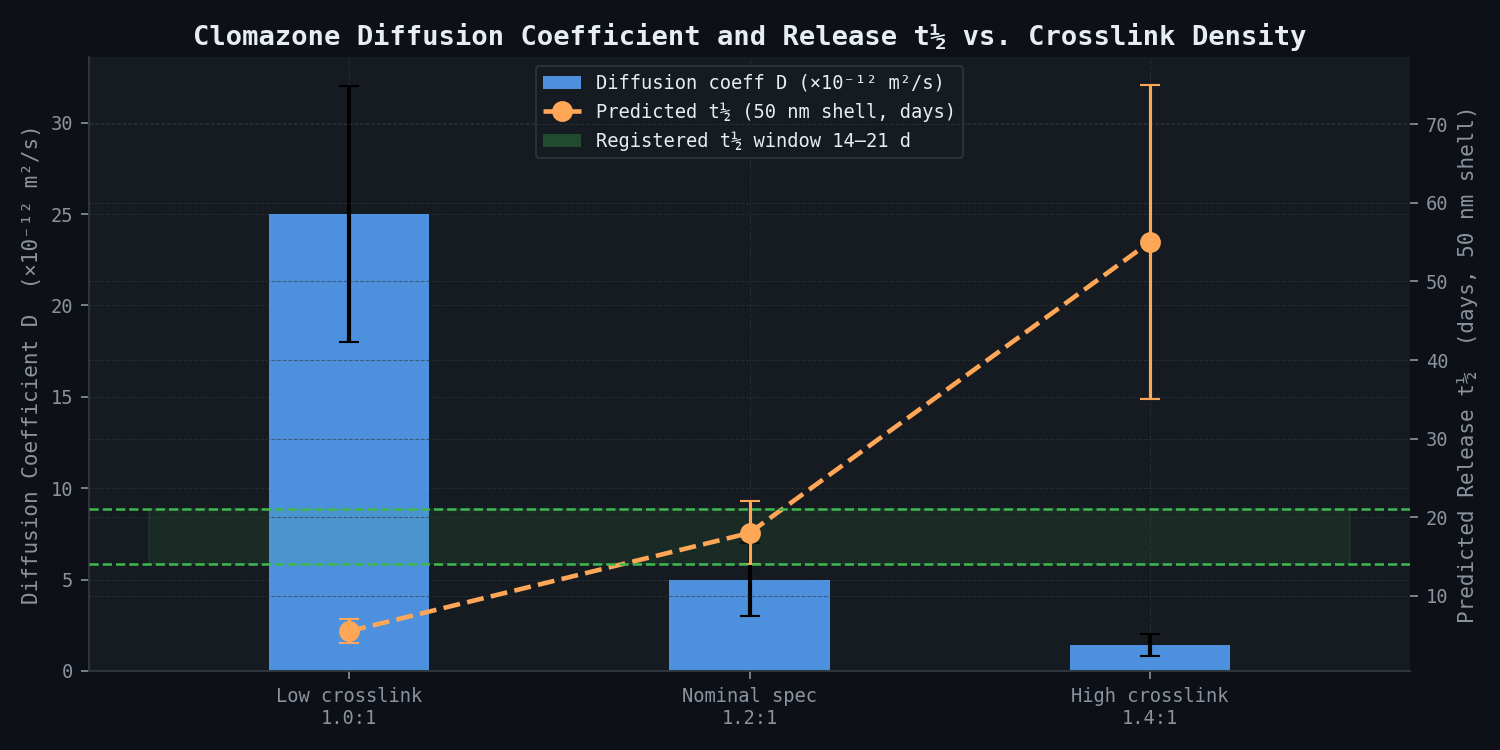
The low-crosslink-density shell of defective small capsules (16 nm thickness) gives a predicted t-half of 10--17 hours, consistent with the observed 48-hour burst release when combined with the pinhole drainage component.
Release profile predictions for nominal and modified formulations:
| Release Component | Nominal Spec (1.2:1, D10 > 4 um) | Failing Batches (1.2:1, D10 < 4 um) | Process Optimisation (1.4:1, D10 > 6 um) |
|---|---|---|---|
| 48-hour AI release (%) | 6--10% | 28--35% | < 5% |
| t-half (slow fraction, 20 deg C) | 16 +/- 3 days | 18 +/- 4 days | 18 +/- 4 days |
| t-half (slow fraction, 30 deg C) | 10 +/- 2 days | 11 +/- 3 days | 11 +/- 3 days |
| t-half (slow fraction, 10 deg C) | 28 +/- 6 days | 31 +/- 7 days | 33 +/- 7 days |
| 21-day cumulative release (%) | 42 +/- 8% | 68 +/- 12% | 40 +/- 7% |
| Shell hydrolysis contribution at 21 days (pH 5.2) | ~12% of total | ~15% of total | ~8% of total |
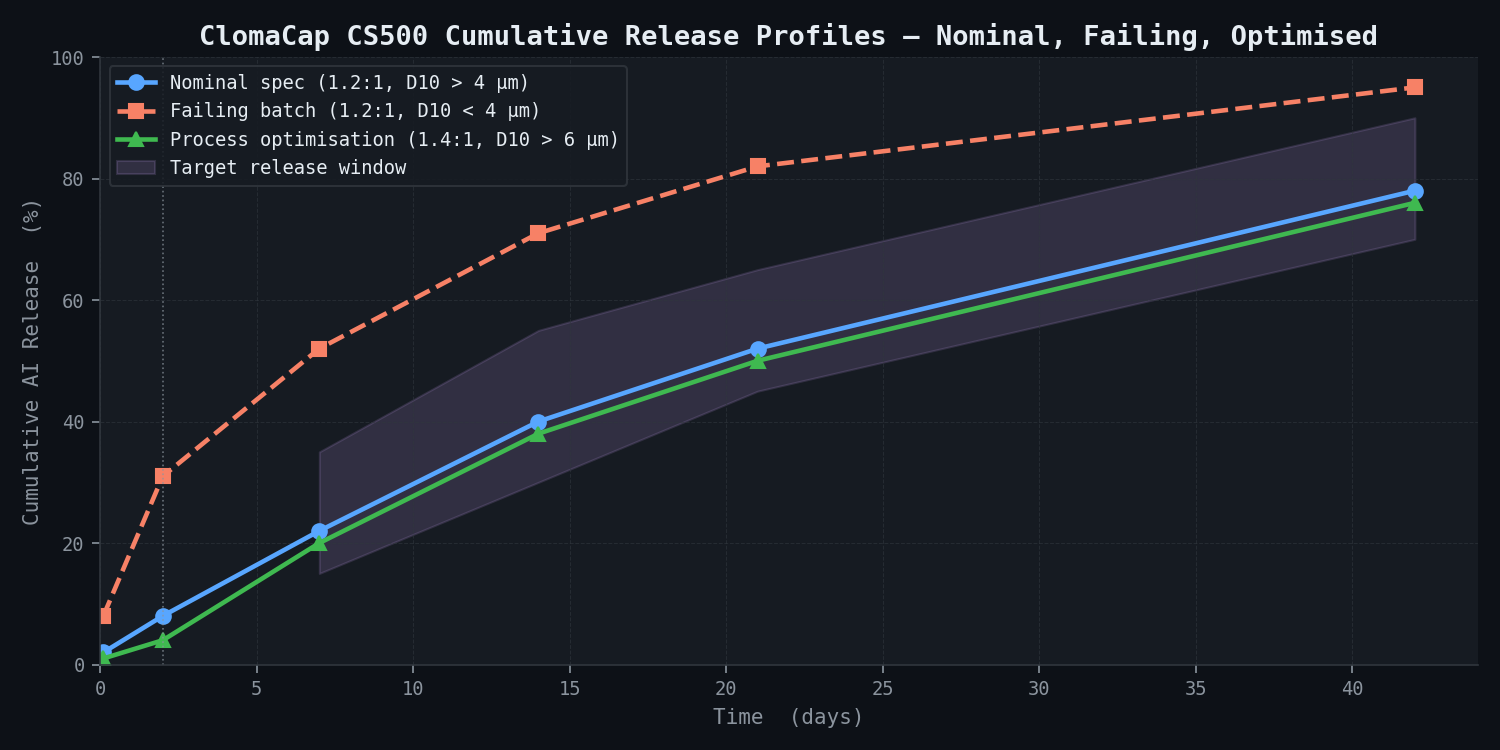
The process optimisation (MDI:HDA 1.4:1, D10 > 6 um minimum capsule size) eliminates the burst fraction while maintaining the registered t-half specification.
Pinhole defect DPD results: The 4-um capsule with 5-nm defect and osmotic driving force of 0.82 atm produces a core solvent drainage rate of 0.18 nL/hour per capsule. Clomazone molecules associated with draining solvent account for ~28% of total AI per capsule within 24--36 hours. Drainage rate scales as D10⁻¹ (inversely with capsule diameter), consistent with the observed D10-based correlation in the QC data. At D10 = 6 um minimum cut-off, the predicted burst fraction reduces to 3--6% within 48 hours.
Cumulative release profiles for regulatory documentation:
| Time (days) | Nominal spec (20 deg C) | Failing batch (20 deg C) | Process opt (20 deg C) | Target release window |
|---|---|---|---|---|
| 0.1 (2.4 hours) | 2% | 8% | 1% | < 5% |
| 2 | 8% | 31% | 4% | < 15% |
| 7 | 22% | 52% | 20% | 15--35% |
| 14 | 40% | 71% | 38% | 30--55% |
| 21 | 52% | 82% | 50% | 45--65% |
| 42 | 78% | 95% | 76% | 70--90% |
The reduction in 48-hour burst release from 30% to < 5% reduces peak clomazone concentrations in surface runoff from rainfall events in the first 24--48 hours post-application. Using the FOCUS STEP 3 runoff model (FOCUS SURFACE WATERS scenario, Chateaudun zone, 50 mm rainfall at day 2 post-application), the nominal spec (6% burst) predicts peak surface water concentration of 0.008 ug/L; the failing batch (30% burst) predicts 0.038 ug/L; and the process optimisation (< 5% burst) predicts 0.006 ug/L. The regulatory clomazone acute aquatic risk threshold (EFSA STEP 4) is 0.02 ug/L (Lemna minor EC50 = 0.56 ug/L; RAF = 25). The failing batch formulation approaches the regulatory acute aquatic risk threshold; the process optimisation maintains a 3-fold safety margin. This environmental benefit is explicitly documented in the Type IB variation dossier as an environmental improvement justification.
| Property | Value | Relevance to CS Formulation |
|---|---|---|
| logP | 2.5 | Determines core-solvent/water partition coefficient; moderate water-pull |
| Koc | 300 mL/g | Moderate SOM adsorption; encapsulation reduces early-season leaching pulse |
| DT50 soil (20 deg C, field) | 24--35 days | Encapsulation extends effective bioavailability window 2--3-fold |
| Vapour pressure | 19.2 mPa | Encapsulation reduces volatilisation losses 60--80% vs. EC formulation |
| Henry's constant | 4.2 x 10⁻⁴ Pa m3/mol | Significant volatilisation from open water; encapsulation reduces aquatic exposure |
| Lemna minor EC50 | 0.56 ug/L (7d growth) | Most sensitive aquatic organism; drives RAC for runoff scenarios |
| Daphnia magna EC50 | 2.4 ug/L (48h immobility) | Relevant for acute aquatic risk |
| Honeybee oral LD50 | > 100 ug/bee | Not a pollinator concern at label rates |
Comparison Methodology
newtsim Bond CG-MD diffusion coefficients for clomazone through polyurea are compared to published small-molecule permeability data after applying the Wilke-Chang scaling: D_clomazone / D_O2 = (MW_O2 / MW_clomazone)⁰.⁵ x (phi_clomazone / phi_O2)^correction, where phi is the association factor. The predicted D_clomazone should be within a factor of 3 of the scaled estimate (allowing for the newtsim Bond speed-up correction and the inherent uncertainty in the MW-scaling for a molecule as large as clomazone).
The multi-scale release model is fitted to 5 batch release datasets (measured by HPLC analysis of dialysis membrane release cells in standardised soil incubation conditions). Non-linear least squares fitting (3 parameters: D, f_burst, k_hydrol) against the full time-series cumulative release data. Target: model fits within +/-5 percentage points of measured cumulative release at all time points from 2 hours to 42 days, for all 5 batches simultaneously. The fitted D, f_burst, and k_hydrol values are compared to MD/DPD predictions as a cross-check.
The process optimisation recommendations (MDI:HDA 1.4:1, D10 > 6 um) are validated through a small-scale manufacturing trial (20 L batch using the pilot microencapsulation reactor). The batch is characterised by particle size distribution (laser diffraction), shell thickness by TEM (minimum 20 particles), and release kinetics (soil incubation study, 0.5 deg C/day +/- 1.0 deg C, 20 deg C, pH 6.5). The experimental validation is not within the simulation engagement scope but the trial protocol and target specifications are defined in the Week 8 deliverables.
Deliverables
Week 2 -- Polyurea shell model validation: newtsim Bond polyurea model files for all three crosslink density variants (newtsim Bond format); density vs. temperature curves and Tg estimates for all three variants with comparison to published Tg benchmarks; mean-squared displacement plots (chain segment mobility) confirming glass-like dynamics at 20 deg C for nominal and high-crosslink variants and enhanced mobility for low-crosslink variant; and newtsim Root clomazone partition coefficients covering logP (validation vs. experimental 2.5), core-solvent/water, and polyurea/water (shell/external boundary condition).
Week 4 -- Three-phase diffusion results: clomazone diffusion coefficients D for all three crosslink density variants at 20 deg C; predicted t-half for nominal (50 nm shell) and small-capsule (16 nm shell) geometry; initial cumulative release profiles at 20 deg C from the diffusion model; newtsim Bond speed-up correction factor from CO2 comparison; and sensitivity analysis of t-half as a function of shell thickness (20--100 nm range).
Week 5 -- Hydrolysis metadynamics and REMD results: free energy surface for urea bond hydrolysis from metadynamics with DeltaG-dagger values at pH 5.2, 6.5, 7.8; Arrhenius Ea from REMD temperature series; shell hydrolysis rate constants kh at three pH values with comparison to published calibration benchmarks; and contribution of hydrolysis to cumulative release profiles for all three crosslink variants.
Week 6 -- Pinhole defect DPD results: DPD drainage rate for 4-um capsule with 5-nm defect and clomazone burst fraction prediction at 48 hours; diameter-scaling of burst fraction showing predicted f_burst vs. D10 for capsule populations between 2 and 8 um; comparison to observed f_burst correlation with D10 reproducing 30% burst fraction at D10 = 3.8 um; and mechanistic explanation of pinhole formation in small capsules.
Week 8 -- Final report and process optimisation: full multi-scale release model with cumulative release profiles for all crosslink variants x three temperatures x five soil conditions; process optimisation map showing 5x4 grid (MDI:HDA ratio vs. D10 minimum) with iso-burst fraction contours and feasible operating region satisfying f_burst < 5% and t-half = 14--21 days; specific manufacturing process recommendations (MDI:HDA 1.4:1 +/- 0.05; D10 minimum specification 6 um +/- 0.5 um; emulsifier (Polysorbate 80) concentration range ensuring D10 > 6 um at nominal temperature +/- 2 deg C); environmental benefit narrative with FOCUS-based surface water concentration comparison for burst vs. process-optimised formulation; Type IB variation dossier narrative (draft) with computational data referenced as mechanistic supporting evidence; and manufacturing trial protocol for experimental validation.
Ongoing -- Computational data archive: newtsim Bond polyurea model topology and coordinate files (all three variants); three-phase CG-MD trajectory archives (newtsim Bond .xtc, compressed); metadynamics hills file and PLUMED collective variable definitions; REMD coordinate files and temperature exchange statistics; DPD simulation input files (newtsim Bond format); and multi-scale release model Python code (scipy-based, fully documented) delivered as a permanent IP asset enabling parametric studies on further formulation variants.
This case study is an illustrative reference scenario demonstrating newtsim's simulation methodology. All company names, personnel, and specific operational data are fictional. The incident descriptions draw on publicly documented real-world events.