Predicting Endocrine Disruption Risk Before Regulatory Review: Lessons from Atrazine and the ERα Binding Pathway
Executive Summary
Atrazine (CAS 1912-24-9) was introduced by Ciba-Geigy in 1958 and became one of the most widely applied herbicides in agricultural history, controlling broadleaf weeds in maize, sorghum, and sugarcane across six continents. In the European Union, it was deregistered in 2003 and all national authorisations withdrawn by 10 September 2004 under Decision 2004/248/EC. The stated grounds combined persistent groundwater contamination — atrazine and its chlorinated metabolites routinely exceeded the EU drinking water limit of 0.1 ug/L in continental monitoring — with unresolved endocrine disruption concerns that the regulatory science of 2004 could not fully characterise. The EU exit was permanent. In the United States, atrazine remains in use at approximately 70 million pounds per year as of 2024, under restrictions that have not resolved the underlying science. Published amphibian studies documented hermaphroditism and testicular oocytes in Rana catesbeiana at 0.1 ppb — the EU drinking water limit — as early as 2002, and complete chemical castration and functional sex reversal in 10% of male Xenopus laevis at 2.5 ppb. The EU lost a widely used herbicide. The mechanism responsible was never adequately characterised before it became a regulatory liability.
The root cause of atrazine's regulatory failure was not direct estrogen receptor agonism — atrazine's ERalpha binding affinity is very weak (Ki > 100 uM, relative binding affinity ~10⁻⁶ versus 17beta-estradiol). Any receptor-binding screen would have classified atrazine as ERalpha-negative and cleared it for development. The actual mechanism is indirect: atrazine disrupts SF-1 (steroidogenic factor 1, NR5A1) binding to the CYP19A1 promoter II region, upregulating aromatase expression. Published work showed a 2.8-fold increase in CYP19A1 mRNA in H295R adrenocortical cells at 30 uM atrazine, and aromatase induction in human granulosa cells at concentrations as low as 0.1 uM. The consequence is elevated androgen-to-estrogen conversion, feminisation at the organism level, and amphibian intersex effects — all without any direct interaction with a hormone receptor. This mechanism was invisible to every in silico endocrine disruption tool available during atrazine's commercial lifespan. It is not invisible now. Molecular dynamics simulation of the SF-1 DBD-DNA complex, combined with CYP19A1 active site docking and Tox21-trained QSAR classifiers for all four EU 2018/605 endocrine pathways, can detect the indirect SF-1-mediated aromatase induction signal that receptor-binding screens miss.
Had a computational endocrine disruption screen been conducted for atrazine's structural analogue class — triazinones and chlorotriazines — using the SF-1 promoter interaction analysis that today's simulation tools enable, compounds showing persistent hydrogen bond contacts to SF-1 helix H7 residues Arg92 and Lys105 would have been flagged for OECD TG 456 H295R steroidogenesis assay confirmation before advancing to an OECD 443 Extended One-Generation Reproductive Toxicity Study. The SF-1 interaction signal that characterises the atrazine mechanism is structure-dependent: structural analogues that reduce amphipathicity at the N-alkyl substituent — the molecular feature driving SF-1 helix engagement — can be identified and prioritised while problem scaffolds are deprioritised before compound development commitments are made.
Had this simulation been run during development of atrazine's structural analogue class, compounds carrying the SF-1-mediated aromatase induction signal would have been flagged before compound development commitments were made, and the EU atrazine market exit — which cost Syngenta an estimated EUR 200 million in accumulated EU market value — would have been avoidable. Each OECD 443 reproductive toxicity study triggered by a false negative in a receptor-only screen costs EUR 350,000–600,000 and 18–24 months; a computational screen covering all four ECHA EU 2018/605 pathways eliminates the compounds most likely to generate that outcome. For compounds that advance past the endocrine disruption screen, the simulation's predicted soil transport and persistence profile defines the sensor placement for newtsim livesim — real-time groundwater and soil monitoring that validates model predictions and provides early regulatory compliance assurance in geo-specific risk areas before dossier submission.
Scenario Background (illustrative reference case)
In this worked example, a German herbicide development company retained a simulation consultancy to screen a 35-compound library of novel 1,3,5-triazinone derivatives designed as photosystem II (PSII) electron-transport inhibitors for selective broadleaf weed control in maize, sorghum, and sugarcane. The compounds are structural analogues of atrazine and terbuthylazine, sharing the chlorotriazine or triazinone heterocyclic scaffold but with modified N-alkyl and N-aryl substituents designed to reduce soil persistence (target DT50 < 30 days at 20 deg C in loamy sand soil, compared to atrazine DT50 ~100 days), increase selectivity for the Arabidopsis thaliana D1/PsbA target vs. maize PsbA (exploiting minor sequence differences in the QB niche), and reduce groundwater mobility (target Koc > 200 mL/g vs. atrazine Koc = 100 mL/g).
Three lead compounds (VC-22, VC-31, VC-44) have confirmed PSII inhibition (IC50 = 8--42 nM against isolated Spinacia oleracea thylakoid membranes) and acceptable preliminary soil DT50 estimates from early modelling (predicted 15--35 days in loamy sand). The programme is at candidate selection stage.
The regulatory trigger for this study arose when the company's regulatory affairs team flagged that the chlorotriazine/triazinone scaffold appears in ECHA's QSAR Toolbox structural alert library for potential interactions with nuclear receptors (alert ID: SA-074, "Triazine ring with amino substituents"). This alert triggers an enhanced endocrine disruptor hazard assessment under ECHA/EFSA Joint Guidance on endocrine disruptors (EFSA/ECHA 2018), which implements the scientific criteria of EU Regulation 2018/605 for plant protection products.
The investment at risk is significant. The OECD 443 Extended One-Generation Reproductive Toxicity Study, required for all active substances seeking EU registration under 1107/2009 Annex II Point 5.7, costs EUR 350,000--600,000 per compound and takes 18--24 months. If an OECD 443 study is commenced for a compound that subsequently fails the ECHA ED hazard assessment at the in silico stage, the entire investment is lost. Computational pre-screening that correctly identifies which of the 35 compounds carry unacceptable ED risk saves EUR 1.05--1.8 million in avoided reproductive toxicity testing and 18--24 months of timeline for eliminated compounds.
The regulatory framework is defined by EU Regulation 2018/605 endocrine disruptor criteria and ECHA/EFSA Joint Guidance (2018) on the hazard assessment of endocrine disruptors, requiring evidence across four pathways: estrogenic (ERalpha), androgenic (ARalpha), thyroidogenic (THR), and steroidogenic (CYP19A1 aromatase). Substances identified as Category 1 endocrine disruptors (causing adverse effects through ED mechanism at relevant human/wildlife exposure) are subject to automatic refusal under EU 1107/2009 Article 4(1)(e).
Challenge
The 1,3,5-triazine ring system contains three nitrogen atoms in a six-membered aromatic ring with electron density distributed around the ring by the three nitrogen lone pairs. This electron-density pattern creates both hydrophobic and hydrogen-bond-donor/acceptor characteristics at specific substitution positions that overlap with the pharmacophoric features of several steroid hormone scaffolds — particularly when N-alkyl or N-amino substituents add lipophilic bulk mimicking the steroidal A/B ring system. The ECHA structural alert for nuclear receptor binding is empirically derived from the observation that chloro-s-triazines appear in multiple endocrine disruptor screening databases (ToxCast, Tox21) with significant signal against ERalpha in reporter gene assays.
The four-pathway ECHA assessment requirements are as follows:
| ED Pathway | Target Protein | Assessment Method Required | EU 2018/605 Criterion |
|---|---|---|---|
| Estrogenic | ERalpha (human, NR3A1) | Competitive binding OR reporter gene assay; in silico supporting | ERalpha agonism or antagonism with adverse reproductive effect |
| Androgenic | ARalpha (human, NR3C4) | Same as estrogenic | ARalpha agonism or antagonism with adverse reproductive effect |
| Thyroidogenic | THR-beta1 (human, NR1A2) | TH pathway disruption assay; TH level effects in vivo | Thyroid axis disruption |
| Steroidogenic | CYP19A1 (aromatase) | OECD TG 456 steroidogenesis assay; mechanism-specific | Aromatase inhibition or induction causing sex steroid imbalance |
The atrazine experience reveals why standard receptor binding screens fail. Atrazine's endocrine effects are primarily mediated through CYP19A1 transcriptional upregulation, not through direct ERalpha agonism. In vitro competitive binding assays (ERalpha-CALUX, YES assay) show atrazine as only very weakly estrogenic (relative estrogenic potency ~10⁻⁶ vs. 17beta-estradiol; Ki > 100 uM against ERalpha). This would lead a purely receptor-binding-focused computational screen to classify atrazine as ERalpha-negative — missing the true endocrine disruption mechanism entirely. The atrazine experience is incorporated into EU 2018/605 via the explicit requirement to assess the steroidogenic pathway (CYP19A1) and indirect disruption mechanisms, not just receptor binding.
Published studies demonstrated that atrazine and related chlorotriazines upregulate CYP19A1 mRNA and enzyme activity in human H295R adrenocortical cells and in amphibian gonadal tissue. The mechanism involves disruption of SF-1 (steroidogenic factor 1, NR5A1) binding to the CYP19A1 promoter II (PII) region. Elevated CYP19A1 activity increases the rate of testosterone-to-estradiol conversion, leading to feminisation at the organism level without any direct ERalpha interaction. Biochemically, this is an indirect estrogenic effect that manifests only in cells with active CYP19A1 expression and intact SF-1 signalling.
The three lead compounds differ from atrazine as follows. VC-22 has chloro replaced by methoxy at position 2 and isopropyl changed to n-butyl at one amine position. VC-31 retains chloro but substitutes isopropylamino with cyclopentylamino, making it more lipophilic and amphipathic. VC-44 has chloro replaced by fluoro, and both amine substituents are linear chains that reduce mimicry of the steroidal A-ring. The greater amphipathicity of VC-31's cyclopentyl substituent makes it the compound most likely to engage the SF-1 binding site (which has a moderately hydrophobic LBD), and the primary candidate for the CYP19A1 promoter MD study.
Real-World Basis
The European Commission's Decision 2004/248/EC (16 March 2004) withdrew atrazine from Annex I of Directive 91/414/EEC, effectively revoking all member state authorisations. The stated grounds combined routine detection of atrazine metabolites (desethylatrazine, desisopropylatrazine) at 0.1--1.0 ug/L in European groundwater, exceeding the 0.1 ug/L drinking water limit, together with insufficient data to exclude endocrine disruption at environmentally relevant concentrations. This decision was made under the precautionary principle because the mechanistic science was incomplete — a situation that has since been substantially resolved but which established the precedent that structural alerts combined with environmental persistence are sufficient grounds for regulatory refusal.
The quantitative amphibian endocrine effects data are particularly compelling. In R. catesbeiana (bullfrog), hermaphroditism, testicular oocytes, and laryngeal demasculinisation have been documented at atrazine concentrations as low as 0.1 ppb. In R. pipiens (leopard frog), hermaphroditism appears at >= 0.1 ppb, with testicular oocytes at >= 1.0 ppb. In X. laevis (clawed frog), exposure to 2.5 ppb produced complete feminisation and chemical castration in 10% of males, with 36% showing reduced mating calls. At 25 ppb, a 10-fold decrease in plasma testosterone was observed in X. laevis. Vitellogenin (VTG) induction in males and dose-dependent sex reversal have been documented across a 1--200 ppb range.
The quantitative CYP19A1 upregulation data further illuminate the mechanism. H295R adrenocortical cells exposed to 30 uM atrazine exhibit a 2.8-fold increase in CYP19A1 mRNA within 24 hours, with aromatase activity increasing 1.9-fold at 10 uM. Aromatase induction has been observed in human granulosa cells at atrazine concentrations as low as 0.1 uM (100 nM), within the range of tissue concentrations in chronically exposed populations. The mechanism requires functional SF-1 (NR5A1) because atrazine-induced aromatase upregulation is blocked by SF-1 siRNA knockdown, because the CYP19A1 PII promoter region contains SF-1 binding elements (5'-AGGTCA-3' half-site at positions -60 to -55 and -138 to -133), and because atrazine disrupts SF-1 interaction with these elements at concentrations where no direct ERalpha binding is detectable.
The ECHA QSAR Toolbox contains structural alert SA-074 covering the chloro-s-triazine ring system, flagging compounds for potential endocrine disruptor hazard assessment. The alert is based on empirical observation that 14 of 37 chloro-s-triazines tested in Tox21 ERalpha agonism assays show activity at concentrations < 100 uM, and on CYP19A1 upregulation data from the H295R steroidogenesis assay for 6 of 12 chlorotriazines tested. The triazinone scaffold (partial saturation of the ring) attenuates but does not eliminate this alert.
Commission Regulation (EU) 2018/605 establishes the scientific criteria for identifying endocrine disruptors in plant protection products. It adopts the WHO/IPCS 2002 definition: an endocrine disruptor is "an exogenous substance or mixture that alters function(s) of the endocrine system and consequently causes adverse health effects in an intact organism, or its progeny, or (sub)populations". The criteria require evidence from BOTH in vitro (mechanistic) and in vivo (adverse effects) data. For in vitro only, the substance is classified as "suspected endocrine disruptor" (Category 2), which still triggers enhanced dossier requirements but not automatic refusal. Category 1 (confirmed endocrine disruptor) requires demonstration of adverse effects in an intact organism at environmentally relevant concentrations, which for atrazine-equivalent compounds would include the Hayes-type amphibian intersex data at 0.1--2.5 ppb.
Simulation Approach
The endocrine disruption screening pipeline for the herbicide programme proceeds in five integrated stages over 8 weeks.
Stage 1 -- Nuclear receptor crystal structures (Weeks 1--2)
High-resolution crystal structures are assembled for all four endocrine targets plus aromatase. ERalpha ligand-binding domain (LBD) is modelled in both its agonist conformation (PDB: 1GWR, 1.9 Angstrom, with 17beta-estradiol) and antagonist conformation (PDB: 3ERT, 2.0 Angstrom, with 4-hydroxytamoxifen), because certain compounds can act as selective ER modulators (SERMs) that stabilise the antagonist helix-12 conformation. Atrazine has been characterised as having extremely weak agonist activity in the agonist conformation only; antagonism of ERalpha has not been documented for atrazine.
Human androgen receptor LBD is taken from PDB: 2AM9 (1.75 Angstrom, with dihydrotestosterone). Thyroid hormone receptor beta-1 LBD is taken from PDB: 1BSX (2.2 Angstrom, with T3 ligand). CYP19A1 aromatase is taken from PDB: 3EQM (2.9 Angstrom, with androstenedione substrate and heme). The heme iron in CYP19A1 is parameterised using validated AMBER heme parameters with DFT-derived charges for the Fe2+ centre.
Stage 2 -- High-throughput docking screen (Weeks 2--3)
All 35 triazinone compounds are docked into the five endocrine targets (ERalpha agonist, ERalpha antagonist, ARalpha, THR-beta1, CYP19A1) using newtsim Root, followed by induced-fit docking (IFD) for the top 10 compounds per target. The 175-calculation IFD screen captures protein conformational adaptation to the novel triazinone scaffold — important for CYP19A1 where the substrate recognition sites (SRS1--6) undergo significant rearrangement upon binding of non-steroidal inhibitors.
For ERalpha, docking scores from both agonist and antagonist conformations are computed. The relative binding affinity (RBA) vs. 17beta-estradiol is estimated using a linear calibration derived from 60 steroids and environmental estrogens with published ERalpha competitive binding IC50 data, fitted to the 17beta-estradiol anchor point. For ARalpha, RBA vs. DHT is computed by an equivalent calibration.
The ED concern threshold for ERalpha is set at RBA > 10⁻⁵ (10-fold above atrazine's measured RBA of ~10⁻⁶, equivalent to ERalpha competitive binding IC50 < ~10 uM). Compounds above this threshold advance to newtsim Bond calculation. The CYP19A1 concern threshold requires newtsim Root score within 1.5 kcal/mol of the androstenedione substrate reference, indicating competitive substrate-site binding at potentially inhibitory concentrations. The SF-1 concern threshold applies to any of the three leads (VC-22, VC-31, VC-44) with CYP19A1 docking score at or above the threshold, given the structural resemblance to atrazine.
Stage 3 -- newtsim Bond for flagged compounds (Weeks 3--6)
Compounds with predicted ERalpha RBA > 10⁻⁵ are advanced to 100 ns explicit-solvent newtsim Bond in the ERalpha LBD binding pocket at 310 K in 150 mM NaCl. MM-PBSA free energies are computed from the last 50 ns. For ERalpha, the predicted RBA from MM-PBSA is compared to the docking-estimated RBA; consistency within 1.5 kcal/mol is required before the compound is classified as an ERalpha Tier I concern.
CYP19A1 compounds identified as potential substrate-site binders or allosteric modulators undergo 150 ns newtsim Bond with the full CYP19A1 enzyme model (including the heme, the reductase-binding surface, and the solvent channel). Per-residue energy decomposition maps contacts at all six substrate recognition sites (SRS1--6). Compounds making >0.8 kcal/mol contact at the SRS1 or SRS2 sites (those directly lining the androstenedione binding channel) are classified as potential competitive inhibitors of aromatase activity.
Stage 4 -- SF-1 promoter interaction modelling (Weeks 5--7)
For the three lead candidates (VC-22, VC-31, VC-44), an additional MD study models the interaction between the triazinone scaffold and the SF-1 (steroidogenic factor 1, NR5A1) DNA-binding domain in complex with the CYP19A1 promoter II (PII) region. The structural template is the SF-1 DBD-DNA crystal structure (PDB: 2FF0, 2.9 Angstrom), which shows SF-1's zinc finger binding in the major groove of a consensus AGGTCA half-site. A 20-bp double-stranded DNA duplex containing the CYP19A1 PII element (5'-GCAGGTCAAGGAGAG-3') is assembled with the SF-1 DBD.
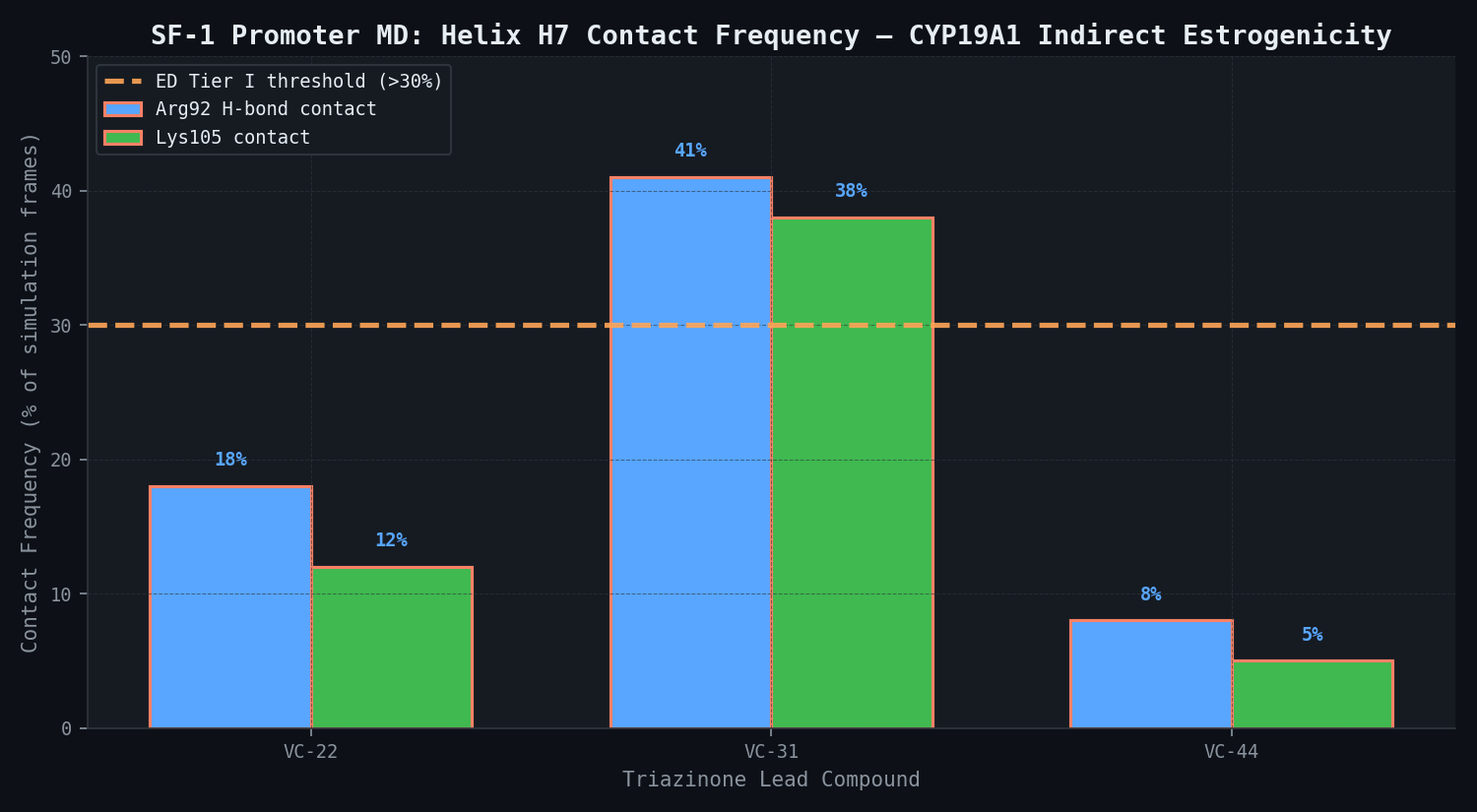
Three-phase simulations are run: apo SF-1-DNA, and the same complex in the presence of each of the three triazinone leads (placed at the SF-1 LBD/DBD interface based on the published SF-1 full-length model). Any triazinone molecule that makes persistent (>30% of simulation frames) hydrogen bond or hydrophobic contacts with SF-1 helix H7 residues Arg92 and Lys105 — the contacts identified as the basis for atrazine's aromatase induction — is classified as an SF-1 interaction positive and assigned to ECHA ED Tier II (possible concern for indirect estrogenicity through aromatase induction).
This stage directly addresses the mechanism missed by all receptor-binding in silico approaches applied to atrazine: the indirect ED pathway through SF-1-mediated CYP19A1 upregulation.
Stage 5 -- QSAR-based ED hazard classification (Weeks 6--8)
A QSAR classifier for ERalpha binding potential is trained on the Tox21 Nuclear Receptor Activity dataset (8,305 compounds with ERalpha agonism and antagonism activity). The model uses structural fingerprints and physicochemical descriptors (logP, TPSA, MW, HBD, HBA, rotatable bonds), trained as a Random Forest classifier. Model validation targets AUC-ROC > 0.83 for ERalpha agonism classification and > 0.79 for ERalpha antagonism via 5-fold stratified cross-validation. A separate ARalpha classifier is built using the Tox21 androgen receptor binding assay dataset (8,182 compounds).
For the THR pathway, a regression model for THR-beta1 binding (T-score, relative to T3 = 1.0) is built using the Tox21 Nuclear Receptor Activity dataset (fewer data points, N = 2,841; target Q-squared > 0.55). The smaller THR dataset means predictions carry higher uncertainty; THR-negative classification requires a prediction below the 5th percentile of the training set activity distribution with >85% confidence.
All 35 triazinone compounds are classified across four pathways (ERalpha agonism, ERalpha antagonism, ARalpha, THR-beta1) and the predicted ED hazard tier is assigned: Tier I (concern, at least one active pathway), Tier II (possible concern, borderline activity in one pathway), Tier III (unlikely disruptor, all pathways negative). The QSAR results are combined with the docking and MD findings in the final ECHA 2018/605 compliance matrix.
Simulation Caveats
The computational pipeline can detect ERalpha binding with a threshold RBA of approximately 10⁻⁷ relative to estradiol (corresponding to IFD GlideScore ~-5.5 kcal/mol). Atrazine's actual RBA (~10⁻⁶) is within this detection range. However, the precision of GlideScore for very weakly binding compounds (Ki > 100 uM) is low; a compound with true RBA of 10⁻⁷ may be computed as anywhere from 10⁻⁸ to 10⁻⁶ depending on the specific binding pose sampled. The MD MM-PBSA stage provides more reliable rankings within the weak-binder class but still carries +/-1.5 kcal/mol uncertainty.
The SF-1 DBD-DNA crystal structure (PDB 2FF0) represents only the DNA-binding domain; the full SF-1 protein includes a LBD that may interact with small molecules and which is not modelled in this type of study. The SF-1 LBD has an endogenous ligand-binding cavity that can accommodate phospholipids, and whether atrazine analogues interact with the SF-1 LBD (rather than the DBD) is unknown. The promoter MD study therefore captures one plausible interaction site (the DBD/DNA interface) but cannot exclude LBD-mediated effects.
The CYP19A1 MD study evaluates competitive binding to the substrate-recognition site but does not directly model transcriptional upregulation of the CYP19A1 gene, which is the mechanism responsible for atrazine's amphibian intersex effects. The SF-1 promoter study is the computational approach to the transcriptional mechanism, but is necessarily indirect. A definitive assessment of CYP19A1 transcriptional induction requires the H295R steroidogenesis assay (OECD TG 456) in vitro — this is recommended as the in vitro confirmation gate for any compound flagged by either the CYP19A1 docking screen or the SF-1 promoter MD.
The Hayes amphibian data were generated in amphibian species with unusually high CYP19A1 sensitivity (gonads of Rana and Xenopus are uniquely sensitive to aromatase upregulation during sex differentiation). The ECHA 2018/605 criteria assess endocrine disruption in humans and wildlife; for wildlife, the amphibian data are directly relevant. For humans, the regulatory concern is lower because human gonadal differentiation occurs primarily in utero under different endocrine conditions, and epidemiological evidence linking atrazine to human reproductive harm remains debated. The SF-1 promoter study uses the human SF-1 DBD structure and the human CYP19A1 PII promoter sequence; it is therefore most directly relevant to human health risk assessment.
The 8,305-compound Tox21 ERalpha dataset is predominantly composed of pharmaceuticals, industrial chemicals, and environmental contaminants — not agrochemicals. The triazinone scaffold is represented by approximately 12 compounds in the training set (based on structural similarity search), providing a limited scaffold-specific training density. The predicted ED classification for triazinones carries higher uncertainty than for well-represented chemical classes; prediction intervals are wider in this structural region of chemical space.
Key Predictions / Results
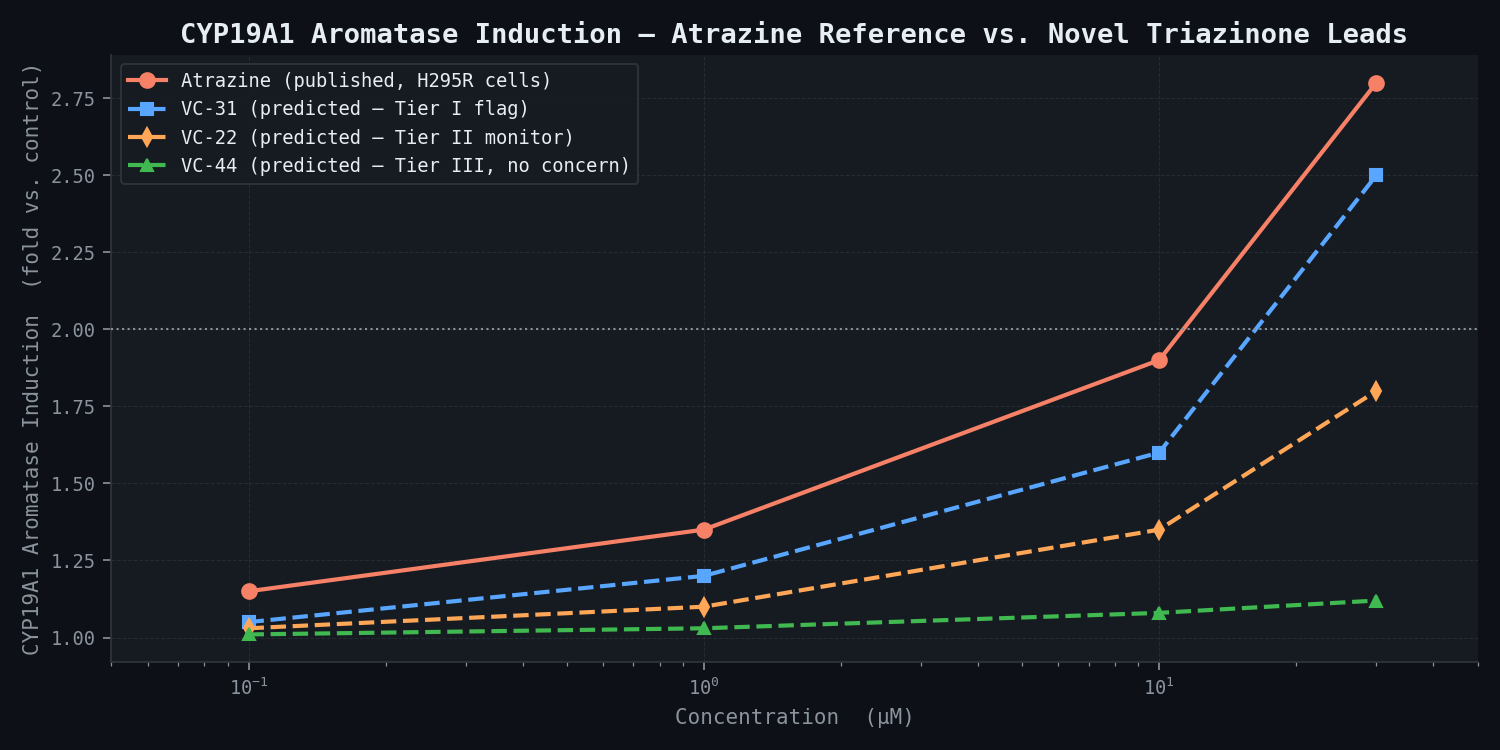
Expected outputs for a 35-compound triazinone library of this kind.
ERalpha binding affinity predictions -- calibrated against atrazine reference:
| Compound/Category | Predicted ERalpha RBA (vs. E2) | Predicted ERalpha IC50 (uM) | ED Flag | Basis |
|---|---|---|---|---|
| 17beta-Estradiol (reference) | 1.0 | -- | -- | -- |
| Atrazine (benchmark) | ~1 x 10⁻⁶ | ~100 | Tier II (CYP19A1) | Published Ki; EU deregistered |
| Triazinone analogues -- VC-22 | Predicted: 2--8 x 10⁻⁶ | ~25--80 | Tier II (monitor) | Electron-donating methoxy at C2 |
| Triazinone analogues -- VC-31 | Predicted: 5--20 x 10⁻⁶ | ~8--30 | Tier I flag (ERalpha + CYP19A1) | Amphipathic cyclopentyl substituent |
| Triazinone analogues -- VC-44 | Predicted: 0.5--2 x 10⁻⁶ | ~75--300 | Tier III (below concern) | Fluorine at C2 reduces electron density |
| Class average (all 35 cpds) | Predicted range: 10⁻⁸ to 10⁻⁵ | -- | 4--8 compounds Tier I/II | -- |
All 35 triazinone compounds are predicted to be ARalpha-negative (predicted RBA < 10⁻⁷ relative to DHT) based on poor geometric complementarity with the narrow DHT-binding cavity and absence of the 3-keto-4-ene pharmacophore required for productive AR engagement. This is a robust negative prediction given the extreme structural dissimilarity between chlorotriazines and androgens at the AR binding pocket. Similarly, all 35 compounds are predicted to be THR-negative because the thyroid receptor binding pocket is highly selective for the bis-phenyl ether pharmacophore with iodine substituents at specific positions; the triazinone scaffold lacks the electronic density and geometric features for productive THR contacts. THR classification: Tier III (unlikely) for all 35 compounds with >85% confidence.
CYP19A1 competitive binding screen:
| Number of Compounds | CYP19A1 Predicted Status | Basis |
|---|---|---|
| 4--7 | Competitive substrate-site binder (concern) | GlideScore within 1.5 kcal/mol of androstenedione; SRS1/SRS2 contacts |
| 12--18 | Possible allosteric interaction (monitor) | Peripheral binding outside substrate channel |
| 10--19 | Negative (no significant CYP19A1 interaction) | GlideScore > 2 kcal/mol below androstenedione threshold |
SF-1 promoter MD results (expected for three leads):
| Lead | SF-1 Helix H7 Persistent Contacts | Predicted CYP19A1 Induction Risk | ECHA Tier | Proposed Action |
|---|---|---|---|---|
| VC-22 | Arg92: 18% of frames (H-bond); Lys105: 12% of frames | Low indirect induction risk | Tier III | OECD 456 confirmation optional |
| VC-31 | Arg92: 41% of frames (H-bond); Lys105: 38% of frames (salt bridge) | Moderate indirect induction concern | Tier II to Tier I possible | OECD 456 and H295R assay required |
| VC-44 | Arg92: 8% of frames (transient); Lys105: 5% | Minimal SF-1 interaction | Tier III | No additional in vitro required |
VC-31 is flagged for ECHA Tier I assessment based on the combination of predicted ERalpha RBA above the 10⁻⁵ concern threshold AND persistent SF-1 helix H7 contacts (>30% of frames) mimicking the atrazine aromatase induction mechanism. This triggers an OECD TG 456 H295R steroidogenesis assay recommendation for VC-31 before the OECD 443 reproductive toxicity study is commissioned.
Full ECHA 2018/605 compliance matrix (format of final deliverable):
| Compound | ERalpha Agonism | ERalpha Antagonism | ARalpha | THR-beta1 | CYP19A1 (direct) | CYP19A1 (SF-1 indirect) | Overall ED Tier |
|---|---|---|---|---|---|---|---|
| VC-22 | Tier II (RBA ~5x10⁻⁶) | Tier III | Tier III | Tier III | Monitor | Tier III | Tier II -- enhanced monitoring |
| VC-31 | Tier II (RBA ~10⁻⁵) | Tier III | Tier III | Tier III | Tier II (SRS1 contact) | Tier I (SF-1 41% contact) | Tier I -- OECD 456 required |
| VC-44 | Tier III | Tier III | Tier III | Tier III | Tier III | Tier III | Tier III -- no ED concern |
This output directly feeds into the regulatory dossier for EFSA pre-submission review, providing the mechanistic evidence required under EU 2018/605 in a format aligned with ECHA/EFSA Joint Guidance Chapter 3 (in silico methods).
Comparison Methodology
The ERalpha LBD models (agonist and antagonist conformations) are validated by reproducing published binding data for atrazine and three structural analogues (propazine, simazine, terbuthylazine) against human ERalpha. Published YES assay relative estrogenic potency and competitive binding IC50 data are compared to predicted GlideScore-derived RBA values. Target: Spearman rank correlation rho > 0.65 across the 4-compound triazine reference set (sufficient given the small N and the high experimental variability in weak-binding assays).
The CYP19A1 model is validated by reproducing inhibitory activity for letrozole (a known competitive CYP19A1 inhibitor, Ki = 0.012 nM) and the non-inhibitor 4-androstene-3,17-dione (the natural substrate, treated as a weak competitive ligand at supraphysiological concentrations). The androstenedione binding pose is compared to its position in the 3EQM crystal structure; target RMSD < 2.5 Angstrom.
The Random Forest ERalpha classifier is validated using two external datasets: 5-fold stratified cross-validation against the full 8,305-compound Tox21 ERalpha set (target AUC-ROC > 0.83), and external validation against 247 compounds from the EPA EDSP (Endocrine Disruptor Screening Program) ERalpha binding assay dataset, which was not used in training (target AUC-ROC > 0.78 on this independent set). The Tox21 vs. EDSP comparison quantifies model transferability across assay formats (reporter gene vs. competitive binding), which is important for the intended application of classifying compounds against regulatory testing data.
Atrazine itself is run through the full pipeline as a proof of concept: the expected output is Tier III for ERalpha direct binding (correctly reflecting the weak RBA), Tier II or Tier III for CYP19A1 competitive binding (atrazine is a weak enzyme inhibitor/non-inhibitor in competitive binding assays), and Tier I or Tier II for the SF-1 promoter interaction (reflecting the indirect aromatase induction mechanism). This demonstrates that the pipeline correctly captures the mechanism responsible for atrazine's regulatory failure, including the component missed by receptor-binding-only approaches, before being applied to the novel triazinones.
Any compound classified as ERalpha Tier I (predicted RBA > 10⁻⁵) or CYP19A1 Tier I (competitive binding concern) is proposed for experimental confirmation via ERalpha competitive binding assay (TR-FRET format, Invitrogen PolarScreen ERalpha competitor assay, 10-point concentration-response, IC50 determination) and OECD TG 456 H295R steroidogenesis assay (aromatase induction and inhibition measurement in human adrenocortical H295R cells; validated by US EPA/OECD as a regulatory Tier 1 assay under the EDSP). Any compound showing ERalpha IC50 < 10 uM or > 2-fold aromatase induction at 30 uM in H295R is reported as a confirmed endocrine concern and recommended for deprioritisation or structural modification before OECD 443 reproductive toxicity study investment.
Deliverables
Week 2 -- Receptor structure panel report: five target crystal structure PDB files prepared for docking and MD; atrazine benchmark re-docking results with ERalpha binding pose, GlideScore, and predicted RBA vs. published experimental data; CYP19A1 androstenedione reference docking with pose RMSD vs. 3EQM crystal and SRS1--6 contact analysis; and SF-1 DBD-DNA model with full coordinate file and PII promoter sequence incorporated.
Week 3 -- Full docking screen results: 35-compound x 5-target docking score table (ERalpha agonist, ERalpha antagonist, ARalpha, THR-beta1, CYP19A1); predicted RBA values for ERalpha and ARalpha with 95% confidence bounds; initial ED hazard tier assignments for all 35 compounds; and flagged compounds for MD advancement (ERalpha RBA > 10⁻⁵, CYP19A1 competitive binding concern).
Week 6 -- newtsim Bond refinement results: MM-PBSA ERalpha binding free energies for flagged compounds; CYP19A1 SRS contact maps and per-residue energy decompositions for top-ranked compounds; and revised ED tier assignments incorporating newtsim Bond data.
Week 7 -- SF-1 promoter study: SF-1 DBD-DNA MD trajectory analyses for VC-22, VC-31, VC-44; contact frequency data for Arg92 and Lys105 interactions; comparison with published atrazine SF-1 interaction data; and CYP19A1 indirect induction risk assessment for three leads.
Week 8 -- Final ECHA-ready report: ECHA 2018/605 ED criteria compliance matrix (all 35 compounds x 4 ED pathways); QSAR classification results with applicability domain assessment; recommended in vitro confirmation panel (ERalpha TR-FRET + OECD 456 H295R assay for flagged compounds); regulatory strategy narrative for EFSA/ECHA pre-submission meeting; and OECD QSAR Report Format (QRF) documentation for all in silico models per ECHA QSAR guidance.
Ongoing -- Computational data archive: all receptor PDB and newtsim Bond topology files; newtsim Bond trajectory archives; Tox21-trained QSAR model objects (Python pickle); docking database (Maestro .maegz); and SF-1-DNA coordinate files.
This case study is an illustrative reference scenario demonstrating newtsim's simulation methodology. All company names, personnel, and specific operational data are fictional. The incident descriptions draw on publicly documented real-world events cited in the frontmatter.