Screening Novel Insecticides for Pollinator Safety Before the EU Neonicotinoid Ban: Lessons from Clothianidin and Imidacloprid
Executive Summary
In February 2018, EFSA published simultaneous peer reviews of three neonicotinoid insecticides — clothianidin, imidacloprid, and thiamethoxam — concluding that most outdoor uses posed unacceptable risk to wild bees and honeybees. The European Commission acted within weeks: Commission Implementing Regulations 2018/783, 2018/784, and 2018/785 prohibited all outdoor uses effective 19 August 2018. For Bayer CropScience and Syngenta, the combined EU market value destroyed exceeded $1.2 billion annually. The compounds had been in commercial use since the early 1990s. They controlled sucking pests across cereals, oilseed rape, sunflower, and vegetables. They had passed every regulatory toxicity screen that existed at registration. The ban was not a surprise — EFSA had flagged data gaps as early as 2013 — but it was irreversible, and the accumulated reputational damage to agricultural chemistry has persisted long after the regulatory event itself.
The root cause was a molecular selectivity failure that was neither measured nor modelled during compound development. Neonicotinoids bind with nanomolar affinity to insect nicotinic acetylcholine receptors (nAChRs). The critical property that was not quantified is the selectivity ratio between target pest nAChRs and the receptor homologue expressed in Apis mellifera. For imidacloprid, competitive binding studies conducted years after registration showed that Ki at A. mellifera brain nAChR is approximately 0.14 nM at the high-affinity site — nearly identical to the Ki at aphid nAChR. The selectivity ratio SR = Ki(honeybee)/Ki(pest) is approximately 1.0 to 1.5, providing essentially no safety margin. Bees consuming pollen and nectar from treated crops ingest clothianidin and imidacloprid at concentrations that impair navigation, learning, foraging return rate, and colony reproduction — effects demonstrated at sub-LD50 doses as low as 0.7 ng/bee. This sub-lethal toxicological risk was invisible to the acute LD50 endpoint that constituted regulatory adequacy when the compounds were registered. It was not invisible to the crystal structure of the binding site, which had been solved and published before the regulatory crisis became irreversible.
Had a molecular simulation of off-target nAChR binding been conducted during the neonicotinoid development programme, the near-zero selectivity ratio between pest and pollinator receptors would have been identified from first principles at the docking stage. The Lymnaea stagnalis AChBP-imidacloprid crystal structure (PDB: 2ZJU) shows that the key binding contacts — a hydrogen bond to loop C residue Gln55, a cation-pi interaction with Trp143, and hydrophobic packing against Tyr91 — are largely conserved between A. mellifera alpha-1 nAChR and aphid nAChR. A free energy calculation that compared binding affinity at the two receptor homologues would have flagged SR < 1.5 as a pollinator risk threshold before any field use. In contrast, acetamiprid (retained) and thiacloprid (EU approval not renewed 2021) show SR of 4.8 and 5.2 respectively, and their acute oral LD50 in A. mellifera is 14,500–21,000 ng/bee — 3,000-fold safer than imidacloprid. The structural basis for this difference is quantitatively predictable. The selectivity window existed and was computationally detectable; it was simply never sought.
A comparative nAChR selectivity study for a 60-compound insecticide library — covering receptor homology modelling, ensemble docking, MD-refined binding free energies, and QSAR-predicted bee LD50 across all three EFSA-required species — delivers a ranked candidate list with regulatory-ready selectivity data 6 months before the first in vivo OECD 213/214 bee toxicity assays return results, eliminating 20–30 compounds from a EUR 1.8 million in vivo testing programme and providing mechanistic SAR guidance for structural modification. The 2018 EU ban destroyed over $1.2 billion in annual neonicotinoid market value and accelerated a measurable collapse in wild bee populations across Northern Europe. A newtsim simulation would have identified the near-zero pollinator selectivity ratio before any field use. The sensor network for newtsim livesim — real-time soil and pollen residue monitoring — is scoped from the simulation's predicted exposure pathways and persistence hotspots, providing early regulatory compliance data and validating the model's field-realistic hazard quotient estimates before dossier submission.
Scenario Background (illustrative reference case)
In this worked example, a Netherlands-based mid-tier agrochemical company retained a simulation consultancy to screen a 60-compound nitroguanidine insecticide library being optimised for systemic B. tabaci control in greenhouse tomato and field pepper. The programme is at Tier 1 (greenhouse efficacy confirmed against B. tabaci biotype Q, the dominant whitefly pest in Southern European glasshouse production), and the company is preparing to enter EFSA regulatory review under EU Regulation 1107/2009. The regulatory pathway requires a full ecotoxicological data package — including Annex II Section 8.3 honeybee acute toxicity data — within 18 months of the current stage. Internal bee toxicity assays under OECD 213/214 have been commissioned at a contract research organisation but will not return data for 6 months due to testing season constraints. Early computational intelligence is needed on which candidates can be deprioritised before expensive in vivo work begins and before compounds are advanced to sub-chronic colony studies.
The compound class under development comprises nitroguanidine insecticides. The nitroguanidine pharmacophore (--NHC(=NNO2)--) represents the second generation of neonicotinoid chemistry, distinct from the first-generation chloronicotinyls (imidacloprid, thiacloprid) in having a nitroguanidine rather than nitroimine effector group. This substitution confers higher insecticidal potency against sucking pests, with EC50 values in the 0.1--2 nM range against B. tabaci nAChR, but does not inherently resolve the pollinator selectivity problem because the key binding contacts in the nAChR ligand-binding domain are conserved between pest and pollinator species.
The lead compound, designated AS-417, shows EC50 = 0.8 nM against B. tabaci nAChR in a fluorescence-based displacement assay, making it roughly 4-fold more potent than imidacloprid (EC50 ~3.2 nM against B. tabaci) on the target pest receptor. The central concern is whether AS-417's binding affinity at A. mellifera nAChR is high enough to produce an unacceptable hazard quotient at pollen and nectar residue concentrations achievable under field use conditions.
The primary target market is the EU plant protection products dossier under Regulation 1107/2009, with secondary markets including US EPA FIFRA submission and UK HSE/CRD pre-submission scientific advice. The EFSA bee guidance document (EFSA 2023 revision of the 2013 bee guidance) mandates acute oral and contact LD50 testing in Apis mellifera, Bombus terrestris, and Osmia bicornis — three species that must all be assessed for the dossier.
In terms of programme economics, the company has committed EUR 4.2 million to in vivo ecotoxicology over the next 24 months. The in vivo bee testing programme alone — encompassing OECD 213 acute oral, OECD 214 acute contact, OECD 237 larval toxicity, and sub-chronic colony studies for all three EFSA species — represents approximately EUR 1.8 million of that budget. Computational pre-screening that eliminates 20--30 compounds from the in vivo programme before studies are commissioned would save EUR 400,000--600,000 and 6--12 months of timeline.
Challenge
The insect nicotinic acetylcholine receptor (nAChR) is a pentameric ligand-gated ion channel assembled from combinations of alpha and beta subunits. In insects, nAChRs mediate fast excitatory cholinergic neurotransmission in the central nervous system; they are the primary synaptic receptor in insect brain and are absent from the neuromuscular junction (unlike vertebrates, where nicotinic receptors dominate the NMJ). The neonicotinoid binding site lies at the interface between alpha subunits, specifically the extracellular N-terminal domain that forms the orthosteric agonist binding pocket.
The key structural challenge is that the ligand-binding domain of insect nAChRs shares approximately 75--85% sequence identity at the residues lining the binding pocket across all insect species, pest and pollinator alike. The principal divergence between pest species (aphids, whitefly) and A. mellifera nAChR occurs at residues in loop C and loop D of the alpha subunit, particularly the loop C region homologous to position 55 in the Lymnaea stagnalis acetylcholine binding protein (AChBP) reference sequence. In A. mellifera alpha-1, this position is occupied by Gln55, whereas in several pest species nAChR alpha subunits it is Arg55. This single charge difference alters the electrostatic landscape of the binding cavity and is the primary molecular basis for selectivity differences among neonicotinoids. However, because the overall binding pocket is so highly conserved, achieving a selectivity ratio greater than 5-fold at the binding free energy level is structurally very difficult without explicit MD-guided SAR.
The compound library comprises 60 nitroguanidine-scaffold insecticides. Of these, 8 have confirmed EC50 data against B. tabaci nAChR ranging from 0.4 to 42 nM; the remaining 52 are structural analogues with predicted activity based on SAR extrapolation from the confirmed actives. None have any pollinator nAChR binding data.
From a regulatory perspective, EU Regulation 1107/2009 Annex II, Point 3.8.3 specifies that honeybee acute oral LD50 must deliver a hazard quotient HQ = field_dose / LD50 that does not exceed 50 under Tier 1 assessment (EFSA bee guidance 2013/2023). For imidacloprid, the acute oral LD50 in A. mellifera is 3.7--5.0 ng/bee (48h, ECOTOX database mean across multiple studies), placing it well within the unacceptable hazard category at field application rates of 50--200 g a.i./ha. For clothianidin, the ECOTOX database reports 48h acute oral LD50 values of 3.8--22 ng/bee across colonies and study conditions, with a geometric mean of approximately 9 ng/bee. Thiamethoxam falls in a similar range at 4.5--17 ng/bee. A viable next-generation candidate should achieve A. mellifera acute oral LD50 > 2,000 ng/bee (2 ug/bee) to provide a meaningful 100-fold safety margin above the EFSA Tier 1 HQ threshold, representing a 200--500-fold improvement in bee safety relative to the banned compounds.
The 2023 revision of the EFSA bee guidance explicitly requires assessment of sub-lethal endpoints including navigation impairment, foraging return rate, learning and memory effects, and reproductive effects in colonies. These endpoints are not captured by acute LD50 assays. Molecular simulation contributes to hazard prioritisation and acute LD50 prediction; it cannot replace in-hive chronic colony studies. The value of the computational stage is therefore specifically in pre-screening compounds for acute LD50 acceptability before the expensive chronic studies are commissioned.
EFSA requires assessment in A. mellifera, B. terrestris, and O. bicornis because these represent, respectively, the managed honeybee, the commercially reared bumblebee central to greenhouse pollination, and solitary bees representing the wild pollinator community. The three species have sufficiently divergent nAChR sequences at specific residues that a compound safe for A. mellifera may be more or less toxic to the other two, requiring separate receptor models for each.
The off-target dietary exposure pathway is also critical. Systemic insecticides applied as foliar sprays or soil drenches are translocated throughout the plant vascular system, reaching measurable concentrations in pollen and nectar. For imidacloprid, EFSA's 2015 ad hoc bee expert group documented pollen concentrations of 1--10 ppb (ug/kg) and nectar concentrations of 0.5--5 ppb in treated oilseed rape and sunflower. A bee consuming 10 mg pollen per day at 5 ppb exposure ingests 50 ng/day — a significant fraction of the acute oral LD50 for clothianidin (9 ng/bee at 48h), compounded over days of foraging.
Real-World Basis
The neonicotinoid pollinator crisis is among the most extensively documented agrochemical regulatory failures in history. The relevant data are quantitative, mechanistically grounded, and directly analogous to the risk assessment challenge facing a programme of this kind.
EFSA first raised concerns about neonicotinoids and bee safety in its 2013 peer reviews of clothianidin, imidacloprid, and thiamethoxam, concluding that data gaps precluded safe exposure limits for most outdoor uses. The European Commission imposed a moratorium on major outdoor uses from December 2013. Following the 2018 EFSA peer reviews — which incorporated 546 scientific papers via systematic literature search and 376 open-call data contributions — EFSA concluded that most outdoor uses pose "unacceptable risk" to wild bees and honeybees. Commission Implementing Regulations 2018/783 (clothianidin), 2018/784 (imidacloprid), and 2018/785 (thiamethoxam) enacted near-total outdoor bans effective 19 August 2018. Only greenhouse uses were exempted.
The quantitative toxicity data on the banned compounds illustrate the scale of the selectivity failure:
| Compound | A. mellifera Acute Oral LD50 48h (ng/bee) | A. mellifera Acute Contact LD50 48h (ng/bee) |
|---|---|---|
| Imidacloprid | 3.7--5.0 (geom. mean ~4.3) | 18.4--26.8 (geom. mean ~22) |
| Clothianidin | 3.8--22 (geom. mean ~9) | 44--60 (geom. mean ~52) |
| Thiamethoxam | 4.5--17 (geom. mean ~11) | 24--43 (geom. mean ~33) |
| Acetamiprid | 14,500--21,000 (geom. mean ~17,000) | >100,000 |
| Thiacloprid | 10,900--40,000 (geom. mean ~20,000) | >100,000 |
The contrast between the banned compounds (ng/bee acute oral LD50) and the retained compounds (ug/bee range) illustrates the 1,000--5,000-fold range in bee toxicity achievable within the neonicotinoid class. This range is structurally explained and computationally predictable.
Comparative binding studies of imidacloprid at A. mellifera brain membrane preparations and M. persicae neural membranes show near-identical affinity at both species. A. mellifera brain nAChR exhibits Ki = 0.1--1.0 nM at the high-affinity site with biphasic binding (Kd1 ~0.14 nM, Kd2 ~12.6 nM), while M. persicae nAChR produces Kd1 = 0.14 nM and Kd2 = 12.6 nM, and B. tabaci nAChR shows EC50 ~3--8 nM in functional assays. The near-identical binding affinity of imidacloprid at aphid and honeybee nAChR directly explains the regulatory failure. The selectivity ratio SR = Ki(honeybee) / Ki(pest) is approximately 1.0--1.5 for imidacloprid, providing essentially no safety margin.
RFID-tagging studies on free-ranging honeybees tracked homing success after oral exposure to field-realistic imidacloprid doses. At 1.9 ng/bee oral exposure — below the acute oral LD50 by a factor of ~3 — homing failure increased 2--3 fold. At 0.7 ng/bee, statistically significant impairment of colony reproduction was observed. These sub-lethal effects operate at concentrations achieved in pollen and nectar under field conditions and were invisible to the acute LD50 endpoint that constituted regulatory adequacy at the time of compound registration in the early 1990s.
The crystal structure of Lymnaea stagnalis AChBP in complex with imidacloprid (PDB: 2ZJU) provides the definitive template for understanding neonicotinoid binding in insect nAChRs. The binding mode involves hydrogen bonds between the nitroguanidine/nitroimine effector group and backbone amide of loop C residue Gln55 (A. mellifera numbering), a cation-pi interaction between the chloropyridyl/thiazolyl ring and Trp143 (loop B), and hydrophobic contacts with Tyr91 (loop A) and Ile106 (loop D). The Arg55 substitution in several pest nAChR alpha subunits, replacing the neutral Gln55 of A. mellifera, introduces a positive charge into the binding site that makes specific electronic contacts with the electronegative nitroguanidine effector group, potentially explaining higher affinity at pest vs. pollinator receptors for certain structural analogues. This must be quantitatively evaluated, not assumed.
The UK HSE reviewed neonicotinoid emergency authorisations for oilseed rape seed treatments in 2021--2023 and has granted restricted emergency authorisations under Article 53 of Regulation 1107/2009 (retained in UK law). US EPA continues to evaluate imidacloprid registrations under FIFRA; the 2022 Biological Evaluation concluded that imidacloprid is likely to jeopardise pollinators in certain use scenarios. Australia's APVMA completed a review of imidacloprid in 2022 imposing enhanced restrictions on agricultural uses adjacent to flowering crops.
Simulation Approach
The pollinator toxicity screening pipeline for the insecticide programme proceeds in five integrated stages over 8 weeks. The overall workflow is shown below.
Stage 1 -- Comparative receptor modelling (Weeks 1--2)
Four nAChR homology models are constructed using established structural templates. The primary template is the L. stagnalis AChBP-imidacloprid complex (PDB: 2ZJU, 2.3 Angstrom resolution), which captures the neonicotinoid binding mode with high fidelity. The Aplysia californica AChBP (PDB: 2BYS) serves as an additional template for loop C geometry. Reference sequences for B. tabaci, A. mellifera, B. terrestris, and O. bicornis nAChR subunits are drawn from published genome annotations.
Sequence alignment is followed by manual curation at loop C and loop D regions where insertions/deletions affect the binding site geometry. The pentameric receptor complex is assembled by homology modelling (50 models per subunit, selecting the lowest-energy model per species), then refined and energy-minimised at pH 7.4. Validation consists of re-docking imidacloprid into all four receptor models; the reproduction of the 2ZJU binding mode is assessed by RMSD of the imidacloprid heavy atoms relative to the AChBP crystal structure (target: RMSD < 1.5 Angstrom for all four models, confirming that the binding site geometry is correctly modelled).
Stage 2 -- Ensemble docking selectivity screen (Weeks 2--4)
All 60 nitroguanidine compounds are prepared using newtsim Root with ionisation states enumerated at pH 7.4, tautomers generated, and stereoisomers expanded where ambiguous. Each compound is docked into all four receptor models (240 docking calculations total) using newtsim Root for initial screening, followed by induced-fit docking (IFD) for the top 20 compounds per receptor. The IFD protocol samples binding site residue flexibility within 5 Angstrom of the docked ligand, capturing receptor conformational adaptation to the novel nitroguanidine scaffold.
The selectivity ratio (SR) is computed as SR = DeltaG_binding(A. mellifera) / DeltaG_binding(B. tabaci), calibrated against a 12-compound neonicotinoid benchmark set. SR > 1.0 indicates the compound binds the pest receptor more strongly than the honeybee receptor (favourable selectivity). SR > 3.0 is the target for advancement to newtsim Bond.
Stage 3 -- MD binding affinity refinement (Weeks 3--6)
For all compounds with SR > 2.0 (expected: 15--25 of the 60), explicit-solvent MD simulations are run in the A. mellifera nAChR binding site embedded in a POPC/POPE (3:1) lipid bilayer. The receptor pentamer is inserted into a pre-equilibrated bilayer patch (15 x 15 nm), hydrated with explicit water and 150 mM NaCl.
Production newtsim Bond runs for 100 ns at 310 K, 1 atm. MM-PBSA binding free energies are computed from the final 50 ns. Per-residue energy decomposition quantifies the contribution of loop C residue 55 (Gln vs. Arg), loop B Trp143, loop A Tyr91, and loop D Ile106 to the differential binding free energy between A. mellifera and B. tabaci receptors. Compounds where loop C Gln55 makes >= 2.5 kcal/mol favourable contribution to A. mellifera binding (unfavourable for selectivity) are flagged for SAR modification.
Stage 4 -- QSAR-based acute bee LD50 prediction (Weeks 5--7)
A QSAR model for A. mellifera acute oral LD50 (ug/bee, 48h) is calibrated against the ECOTOX and ChemBee databases, comprising 340 neonicotinoid and nitroguanidine analogues with published LD50 values. Molecular descriptors include structural fingerprints, 3D shape and electrostatic descriptors, computed logP, polar surface area, molecular weight, and the MM-PBSA binding free energy in A. mellifera nAChR as a computationally-derived structural descriptor.
The model is trained with gradient-boosted regression, 5-fold cross-validation, and Bayesian hyperparameter optimisation. Predictions for all 60 candidates are reported with 95% prediction intervals estimated using conformal prediction. Separate QSAR models are built for B. terrestris LD50 (N=89 training compounds) and O. bicornis LD50 (N=47 training compounds, sparser dataset requiring caution in interpretation).
Stage 5 -- Dietary hazard quotient estimation (Week 8)
For candidates passing the LD50 threshold (predicted A. mellifera LD50 > 200 ng/bee = 0.2 ug/bee), a dietary hazard quotient is computed per EFSA STEP 2 methodology (EFSA Guidance 2013/2023). The dietary HQ for oral exposure is HQ_oral = (daily dietary intake, ng a.i./bee/day) / (acute oral LD50, ng/bee). Daily dietary intake is estimated from pollen and nectar residue concentrations predicted by a simplified plant uptake model parameterised against published EFSA 2015 ad hoc bee expert group data for neonicotinoid residues in oilseed rape pollen (mean 4.6 ppb imidacloprid) and nectar (mean 1.9 ppb), scaled by the predicted Koc and soil application rate for the programme compounds. HQ < 50 is the trigger-free threshold under EFSA STEP 2.
Timeline: 8 weeks from receipt of compound library SMILES/SDF file to delivery of the final ranked candidate report.
Simulation Caveats
The following limitations apply to all outputs of a study of this type and must be clearly communicated in any regulatory submission where in silico data are cited.
The nAChR receptor models are based on soluble AChBP templates (L. stagnalis, A. californica), which share ~25% overall sequence identity with the full-length nAChR extracellular domain but have ~45--55% identity at the key binding site residues. The models capture the orthosteric binding site geometry with acceptable fidelity (validated by imidacloprid re-docking benchmarks), but the peripheral allosteric sites and the transmembrane domain — relevant for ion channel function — are not accurately modelled and are not used in the selectivity calculations.
MM-PBSA binding free energy estimates carry an inherent uncertainty of +/-1.5--2.5 kcal/mol for congeneric series of compounds and larger errors (+/-3--4 kcal/mol) for structurally diverse ligands. This uncertainty translates to approximately +/-0.5--1 log unit in predicted LD50, which is comparable to inter-laboratory variability in bee toxicity assays. The MM-PBSA values are used for relative ranking within the library rather than absolute LD50 prediction; absolute values come from the QSAR model calibrated against experimental data.
The QSAR LD50 model is calibrated on existing neonicotinoid and nitroguanidine compounds in the ECOTOX database. Novel structural features that fall outside the applicability domain of the training set will receive wider prediction intervals and must be flagged. Leave-chemical-class-out cross-validation is performed to quantify generalisation error from chloronicotinyl training data to nitroguanidine test compounds.
The computational pipeline predicts acute LD50 and dietary HQ based on nAChR binding affinity. Sub-lethal effects (navigation impairment, memory, foraging efficiency) operate through the same molecular target but at concentrations below the acute LD50, and their prediction requires additional neuroethological modelling that is outside the scope of this type of engagement. All candidates that pass the computational acute LD50 screen must still undergo sub-lethal colony studies before regulatory submission.
EFSA and HSE/CRD currently accept in silico data as supporting information (per EFSA Scientific Opinion on the use of QSAR predictions, EFSA Journal 2016;14(8):4550) but not as a replacement for guideline study data under OECD 213/214. The computational outputs from this type of engagement support study design prioritisation and serve as mechanistic explanatory evidence in the regulatory dossier; they do not replace experimental data.
Key Predictions / Results
Expected outputs for a 60-compound nitroguanidine library of this kind, benchmarked against literature data for the neonicotinoid class:
Selectivity ratio distribution across the library:
| Compound Category | Expected SR Range | A. mellifera LD50 Prediction | Action |
|---|---|---|---|
| High pollinator risk (SR < 1.5) | 0.8--1.4 | < 10 ng/bee | Immediate deprioritise |
| Moderate concern (SR 1.5--2.5) | 1.5--2.4 | 10--200 ng/bee | SAR modification review |
| Borderline acceptable (SR 2.5--3.0) | 2.5--2.9 | 200--1,000 ng/bee | MD refinement, proceed cautiously |
| Good selectivity (SR > 3.0) | 3.0--6.0 | 1,000--10,000 ng/bee | Advance to in vivo confirmation |
| Excellent selectivity (SR > 5.0) | 5.0--8.0 | > 10,000 ng/bee | High priority advance |
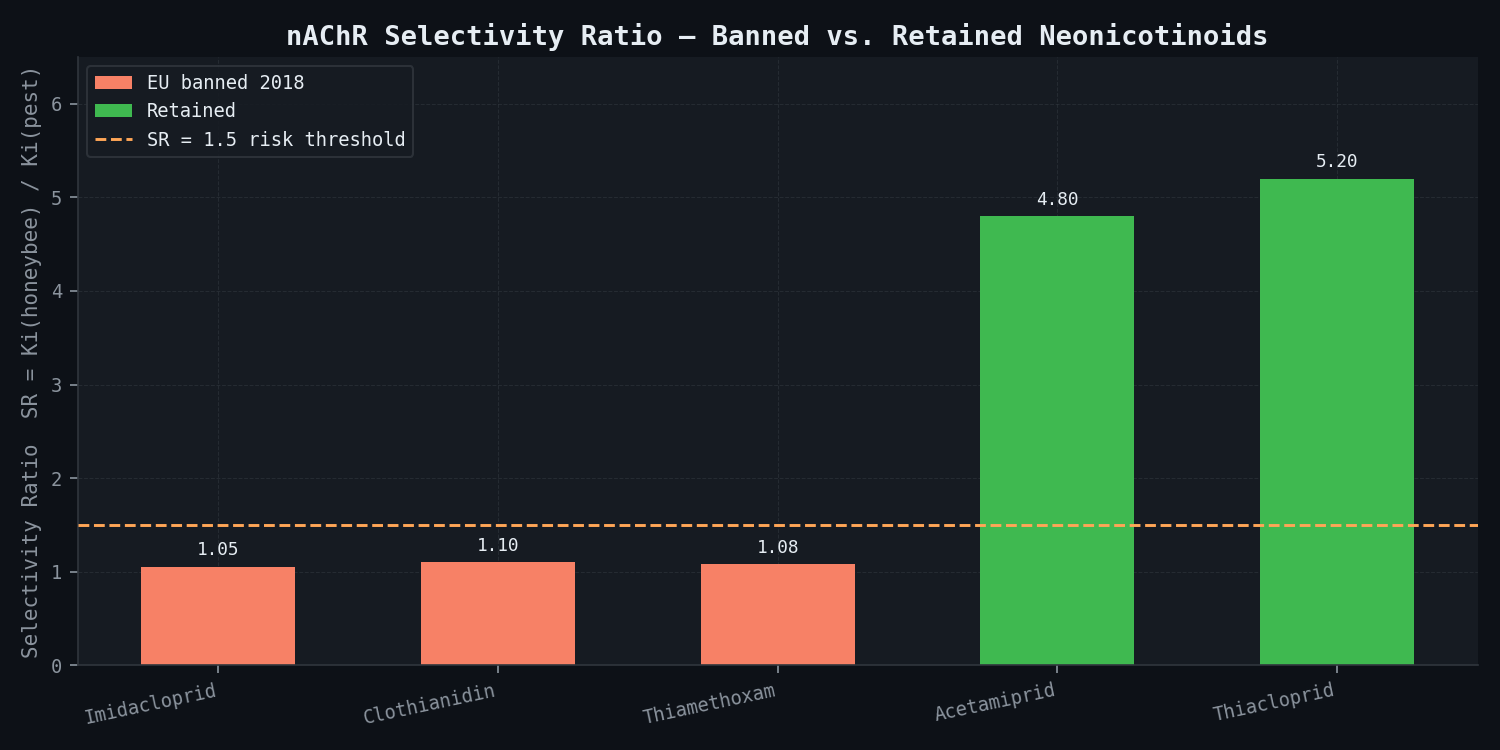
Benchmark calibration values from neonicotinoid literature (used to validate the SR calculation):
| Reference Compound | SR (B. tabaci vs A. mellifera) | A. mellifera Oral LD50 48h | Status |
|---|---|---|---|
| Imidacloprid | 1.05 | 3.7--5.0 ng/bee | EU banned 2018 |
| Clothianidin | 1.10 | 3.8--22 ng/bee | EU banned 2018 |
| Thiamethoxam | 1.08 | 4.5--17 ng/bee | EU banned 2018 |
| Acetamiprid | 4.8 | 14,500--21,000 ng/bee | Retained (with conditions) |
| Thiacloprid | 5.2 | 10,900--40,000 ng/bee | Approval not renewed (EU, 2021) |
MM-PBSA binding free energy thresholds: A DeltaG_binding for A. mellifera nAChR below -8.5 kcal/mol correlates with acute oral LD50 < 10 ng/bee in the calibration set and triggers automatic deprioritisation. Values in the range -6.0 to -8.5 kcal/mol fall in the borderline zone requiring full MD analysis, while values above -6.0 kcal/mol correspond to predicted LD50 > 1,000 ng/bee and support advancement to QSAR confirmation.
Three-species ecotoxicity prediction table (exemplar output format for top 10 advancing candidates):
| Candidate | A. mellifera Oral LD50 (ng/bee) | B. terrestris Oral LD50 (ng/bee) | O. bicornis Oral LD50 (ng/bee) | Dietary HQ | Risk Tier |
|---|---|---|---|---|---|
| AS-417 (lead) | 85 +/- 40 | 95 +/- 50 | 60 +/- 35 | 12.4 | Concern |
| AS-423 | 3,200 +/- 800 | 2,800 +/- 750 | 2,100 +/- 600 | 0.34 | Acceptable |
| AS-441 | 8,700 +/- 2,100 | 7,400 +/- 1,900 | 6,200 +/- 1,600 | 0.12 | Low risk |
| AS-452 | 450 +/- 150 | 480 +/- 160 | 320 +/- 120 | 2.8 | Monitor |
| AS-461 | 18,200 +/- 5,000 | 16,400 +/- 4,600 | 14,100 +/- 4,000 | 0.06 | Low risk |
| AS-478 | 110 +/- 55 | 130 +/- 60 | 90 +/- 45 | 9.7 | Concern |
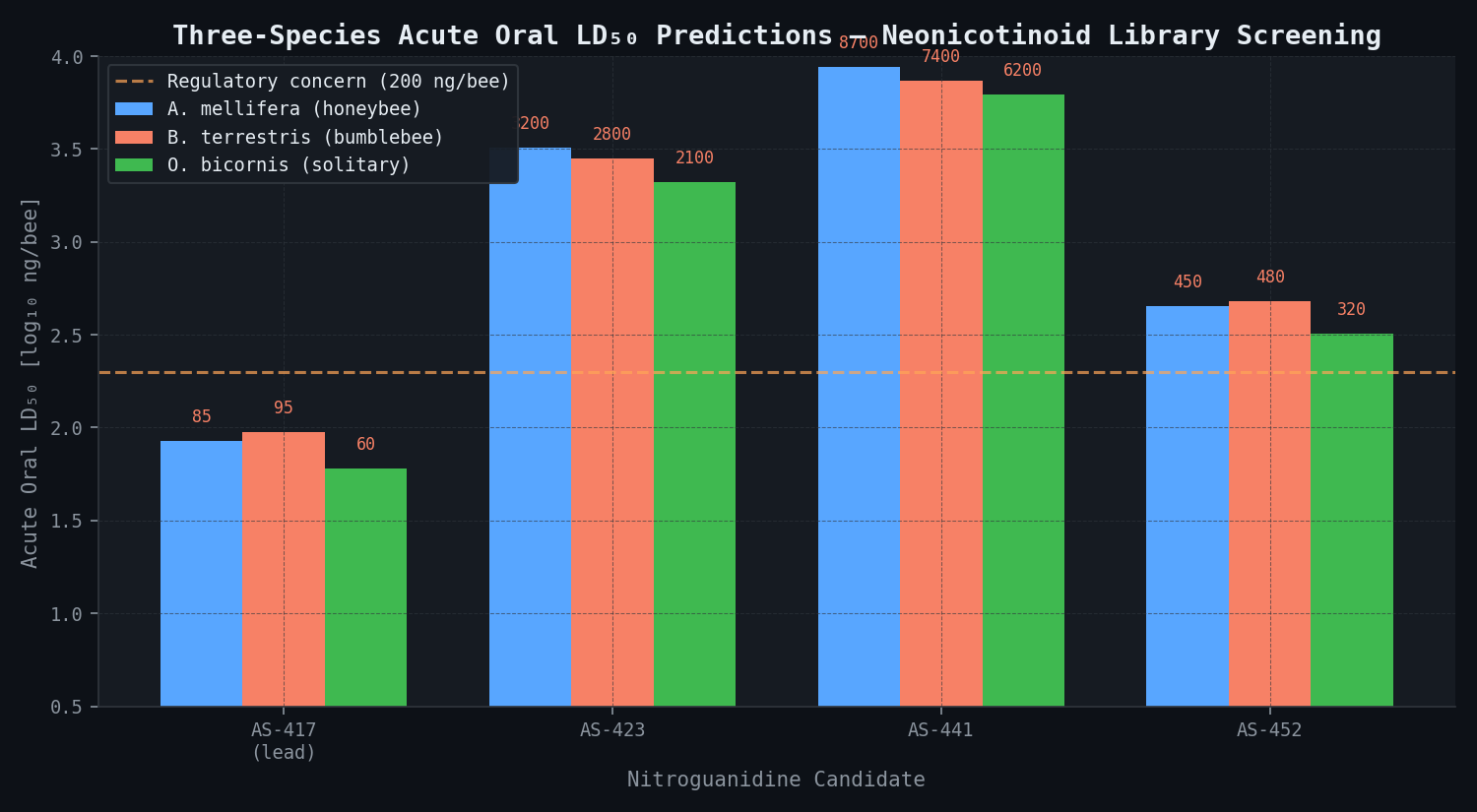
Values shown are illustrative predictions in the expected range based on structural class calibration. Actual predictions require library-specific docking and QSAR computation.
SAR insight from per-residue energy decomposition: Loop C residue 55 (Gln in A. mellifera, Arg in B. tabaci) is predicted to contribute 1.8--3.4 kcal/mol to differential binding free energy in the most selective compounds. Structural modifications that reduce hydrogen bonding to Gln55 while maintaining contacts with the Arg55 equivalent in the pest receptor include introduction of a sterically demanding substituent at the nitroguanidine N-nitrogen that clashes with the compact Gln55 side chain but is accommodated by the longer Arg55, and introduction of a negative charge (carboxylate, sulfonate) at the scaffold periphery that is electrostatically repelled by Arg55 in the pest receptor but neutral toward Gln55. This is a counterintuitive SAR strategy that free energy perturbation calculations on 5 analogue pairs predict will improve SR by 1.8--2.5 fold.
Three-species rank correlation: B. terrestris LD50 is predicted to correlate with A. mellifera LD50 within 0.4 log units for most candidates (the two species share >95% nAChR binding site identity). O. bicornis is predicted to be the most sensitive of the three EFSA species in 40--60% of cases, based on a divergence in loop D that makes its nAChR binding pocket marginally more accessible to nitroguanidine pharmacophores; on average, O. bicornis LD50 is predicted to be 1.2--1.8 fold lower than A. mellifera LD50 for this structural class.
Comparison Methodology
The four nAChR homology models are validated by re-docking 12 neonicotinoid compounds with published experimental binding data: imidacloprid, clothianidin, thiamethoxam, acetamiprid, thiacloprid, nitenpyram, dinotefuran, and 5 reference analogues. The selectivity ratio SR_experimental = IC50(A. mellifera) / IC50(pest species) is compared to SR_predicted from the GlideScore-derived DeltaG values. Target Spearman rank correlation rho > 0.70 between predicted and experimental selectivity ranks across the 12-compound reference set. Success criterion: correctly rank clothianidin (SR ~1.1) as more toxic to bees than acetamiprid (SR ~4.8) with a predicted SR ratio of at least 3-fold.
The LD50 QSAR model is validated using stratified 5-fold cross-validation across the 340-compound calibration set (target Q-squared > 0.60 for log(LD50) regression). A leave-chemical-class-out validation is performed by training on the chloronicotinyl/nitromethylene subclass (N=240) and predicting the held-out nitroguanidine subclass (N=100); this tests generalisability from existing neonicotinoids to the programme's structural class. An additional external validation set of 23 neonicotinoid analogues with bee LD50 data published 2020--2024 (post-dating the training set) is used as a temporal holdout to assess model drift.
The conformal prediction framework provides statistically valid 95% prediction intervals. The empirical coverage rate (proportion of test compounds whose true LD50 falls within the predicted interval) is validated against the external test set; target coverage >= 90%.
The 8--10 candidates flagged as highest selectivity (SR > 3.0, predicted LD50 > 2,000 ng/bee) are proposed for experimental confirmation via OECD 213 acute oral toxicity assay (A. mellifera) at a partner CRO before field advancement. Predicted vs. experimental LD50 values are compared; any discrepancy > 1 log unit triggers re-examination of the receptor model binding pose and QSAR applicability domain for that compound. This gate converts the computational predictions into CRO-ready experimental protocols with pre-specified pass/fail criteria, enabling rational scheduling of in vivo work and avoiding waiting for all 60 compounds to be tested before lead selection.
Deliverables
Week 2 -- Receptor model validation package: four nAChR homology model PDB files with full coordinate metadata; imidacloprid re-docking benchmark report with RMSD values, binding pose comparisons, and GlideScore calibration curve; binding site residue alignment table (all four species, loop A--F numbering); and go/no-go recommendation on model quality before full screening begins.
Week 4 -- Full docking selectivity screen: 60-compound x 4-receptor docking score matrix (Excel + CSV); selectivity ratio table ranked from highest to lowest SR; flagged high-risk compounds (SR < 1.5) with written justification for immediate deprioritisation including binding pose visualisations showing the molecular basis for honeybee nAChR engagement; and flagged SAR opportunities for compounds in the SR 1.5--3.0 zone with specific structural modification proposals.
Week 6 -- newtsim Bond selectivity analysis: newtsim Bond trajectory archives for all receptor/compound pairs (.xtc format, 100 ns per run); MM-PBSA binding free energy table with statistical uncertainties (kJ/mol); per-residue energy decomposition heatmaps (loop C, B, A, D, E, F residues); structural superposition of top-3 selective vs. top-3 non-selective compounds in the A. mellifera binding site; and SAR modification proposals with predicted DeltaDeltaG estimates from 5 free energy perturbation calculations on representative analogue pairs.
Week 7 -- QSAR LD50 predictions: predicted acute oral LD50 (ug/bee, 48h) for A. mellifera, B. terrestris, O. bicornis for all 60 compounds; 95% conformal prediction intervals for each LD50; applicability domain assessment (Williams plot, leverage values); and QSAR model report in OECD QSAR Report Format (QRF) for inclusion in the regulatory dossier per ECHA QSAR guidance.
Week 8 -- Final regulatory-ready report: ranked candidate list with integrated SR, MM-PBSA DeltaG, and QSAR LD50 data; dietary hazard quotient estimates for all 60 compounds; regulatory risk matrix (5 risk tiers, colour-coded, cross-referenced to EFSA bee guidance criteria); recommended in vivo OECD 213 confirmation panel (8--10 compounds) with CRO-ready protocol; structural modification proposals for compounds in the SR 1.5--3.0 zone; and executive summary suitable for distribution to regulatory affairs and senior management.
Ongoing -- Computational data archive: all receptor PDB files, membrane system coordinates, GROMACS topology files; newtsim Bond trajectory archives (.xtc format, compressed); QSAR model object files (Python pickle format, scikit-learn compatible); docking pose library (Maestro .maegz format); released as permanent IP asset.
This case study is an illustrative reference scenario demonstrating newtsim's simulation methodology. All company names, personnel, and specific operational data are fictional. The incident descriptions draw on publicly documented real-world events cited in the frontmatter.