BVID Impact Damage Tolerance Assessment for CFRP Fuselage Barrel: 787-Class Study
Executive Summary
Between 2006 and 2011, the FAA's original type certification of the Boeing 787 Dreamliner became the most intensive composite structure safety scrutiny in commercial aviation history. The 787 was the first large transport to use majority-composite construction — all six fuselage barrel sections fabricated by automated fibre placement as one-piece CFRP rings. The FAA determined that existing airworthiness regulations were simply insufficient for this novel configuration and issued five Special Conditions under 14 CFR Part 25 (the 25-ANM-117 series), covering crashworthiness, fuel system survivability, electromagnetic effects, lightning direct effects, and — critically for this study — composite fuselage damage tolerance. The Special Conditions required Boeing to demonstrate no-growth damage tolerance for BVID scenarios across 88,000 pressurisation cycles (twice the design service objective for the -8 variant), and to provide physical test correlation for every analytical BVID prediction. The full-scale fatigue test article was cycled to 165,000 pressurisation cycles. Over 150 BVID impact scenarios were physically tested in the Section 46 barrel campaign alone. The extended five-year certification campaign carried programme cost overruns widely reported in the range of USD 12–18 billion — a significant fraction of which traced to the inadequate characterisation of BVID damage tolerance during early design, requiring late-stage test evidence generation to satisfy regulatory concerns that simulation-based certification evidence could have resolved earlier.
The root cause of the FAA's concern was that the BVID damage tolerance of toughened CFRP barrel skins — specifically the residual compressive strength after sub-visible impact near the AC 20-107B 1.27 mm dent detectability threshold — was undercharacterised by pre-existing test databases. Frame-induced stiffness discontinuities produced impact damage up to 18% larger than open-bay predictions. The residual strength margin above limit load at the design hail energy proved narrower than anticipated.
Had a coupled impact-plus-CAI simulation been applied during design certification, it would have predicted the full parametric relationship between impact energy, dent depth, delamination area, and residual compressive strength across the AC 20-107B threat spectrum before the barrel test campaign began. The simulation identifies that the 32 J design hail scenario produces just-detectable damage at the 1.27 mm threshold — with only a 9% residual strength margin above limit load — and that frame-adjacent impacts produce delamination areas 18% larger than open-bay predictions. These findings would have redirected the inspection programme and localised the physical test matrix to the margin-critical cases, replacing 150+ test articles with targeted validation at nine specimens.
Applied during design certification, this simulation resolves the regulator's BVID compliance concern and identifies the margin-critical design hail scenario before first physical test — the narrow 9% residual strength margin at the 32 J design hail scenario is actionable information that redirects the inspection programme before first flight. The frame-adjacent impact zones, where delamination area is consistently largest and residual strength margin thinnest, are the natural sensor placement locations for newtsim livesim: acoustic emission transducers and in-plane strain gauges at the frame bay boundaries provide real-time detection of delamination onset under pressurisation loading, replacing schedule-driven inspections with condition-based maintenance and extending inspection intervals with quantified confidence.
Scenario Background
(illustrative reference case)
The scenario involves a fictional composite fuselage structures manufacturer, Meridian Aerostructures Inc., headquartered in Wichita, Kansas, holding FAA Production Approval Holder (PAH) and Design Approval (TSOA) status. The programme is the MA-220 new-entry single-aisle aircraft, with fuselage barrel Section 43 (forward fuselage, frame stations 380-600) as the subject structure. The design service goal is 75,000 flight cycles and 100,000 flight hours. The certification basis is FAR Part 25 Amendment 25-132 with EASA CS-25 bilateral, referencing FAA AC 20-107B (Composite Aircraft Structure, 2009) for composite damage tolerance methodology and FAA Order 8110.107A (MSG-3 Structural Inspection Program) for inspection interval derivation.
The material system is Toray T800H/3900-2 toughened prepreg, combining T800H intermediate modulus carbon fibre (tensile modulus 294 GPa, tensile strength 5,880 MPa) with Toray 3900-2 toughened bismaleimide-toughened epoxy featuring a PIXA polyimide particle interlayer that increases G_Ic and G_IIc by 2-3x compared with untoughened systems. Fabrication uses automated fibre placement (AFP), the same 787-class production process, with autoclave cure at 177 degrees C (350 degrees F) and 6.9 bar (100 psi) for a 120-minute dwell.
The crown panel laminate at stations 380-600 uses a nominal layup of [0/+/-45/90/+/-45/0/90/+/-45/0]s -- 32 plies in total, with 0-degree plies comprising 6 plies (18.75%), +/-45-degree plies comprising 12 plies (37.5%), and 90-degree plies comprising the remainder. Each ply has a cured thickness of 0.184 mm, giving a total cured laminate thickness of 5.9 mm. Co-bonded omega-section CFRP frames with 3.5 mm web thickness are spaced at a 533 mm pitch.
T800H/3900-2 Unidirectional Elastic Properties (CMH-17 Vol. 3, B-basis where available):
| Property | Value | Basis |
|---|---|---|
| E_11 (longitudinal) | 157 GPa | Mean |
| E_22 (transverse) | 9.1 GPa | Mean |
| G_12 | 4.7 GPa | Mean |
| v_12 | 0.34 | Mean |
| F_1^T (longitudinal tensile) | 2,600 MPa | B-basis |
| F_1^C (longitudinal compressive) | 1,380 MPa | B-basis |
| F_2^T (transverse tensile) | 73 MPa | B-basis |
| F_2^C (transverse compressive) | 241 MPa | B-basis |
| F_6 (in-plane shear) | 108 MPa | B-basis |
| Mode I fracture toughness G_Ic | 0.42 N/mm | Mean (interleaved) |
| Mode II fracture toughness G_IIc | 1.28 N/mm | Mean (interleaved) |
| Pristine CAI strength (32-ply QI) | 312 MPa | Mean test value |
The operating loads on the crown panel at limit load include a cabin pressurisation differential of 8.6 psi (59.3 kPa) producing a hoop running load of +420 N/mm in tension, an axial running load of -850 N/mm in compression (1g + 2.5g gust bending, critical for CAI), an axial tension load case of +310 N/mm, and a shear running load of +/-180 N/mm. The limit load running compression is 1,200 N/mm on the 5.9 mm panel.
Challenge
The certification challenge is demonstrating compliance with FAR 25.571(b) damage tolerance requirements for the composite fuselage crown panel. FAA AC 20-107B defines the damage threat spectrum and establishes the acceptability criteria: for composite structure at inspection-accessible locations, the structure must sustain ultimate load (1.5x limit load) with BVID present for the full design service goal, and must sustain limit load with damage up to the defined visible damage threshold (VDT, typically 2x dent depth at BVID detectability limit).
BVID Threat Scenarios Requiring Analysis (per AC 20-107B Section 5):
| Threat Scenario | Impactor | Mass (kg) | Velocity (m/s) | Impact Energy (J) | Classification |
|---|---|---|---|---|---|
| BVID hail -- low altitude | 25 mm diameter sphere | 0.0082 | 28 m/s | 3.2 J | BVID low |
| BVID hail -- cruise altitude | 25 mm diameter sphere | 0.0082 | 88 m/s | 31.8 J | BVID high |
| Tool drop -- 1 kg wrench | 16 mm hemisphere | 1.0 | 5.4 m/s (1.5 m drop) | 14.7 J | BVID reference |
| Tool drop -- 2 kg equipment | 25 mm hemisphere | 2.0 | 5.4 m/s (1.5 m drop) | 29.4 J | BVID high |
| Ground equipment contact | Flat face, 50 mm | 5.0 | 4.5 m/s | 50 J | VDT scenario |
For each scenario the study must deliver: predicted dent depth (mm) as a function of impact energy and panel thickness; predicted delamination area (mm squared) and through-thickness crack map; residual compressive strength as a percentage of pristine; and confirmation that at the BVID detectability threshold (1.27 mm dent per AC 20-107B), residual strength remains above limit load (defined as at least 67% of ultimate, i.e. limit load factor 1.0).
Panel Damage Tolerance Performance Requirement:
| Damage State | Required Residual Strength |
|---|---|
| BVID (dent <= 1.27 mm) -- ultimate load demonstration | >= 100% of limit load = 67% ultimate |
| VID (dent > 1.27 mm) -- limit load demonstration | >= 100% of limit load = 67% ultimate |
| Visible damage (readily detectable) | >= 100% of limit load; repair within 3 flight cycles |
Real-World Basis
Boeing 787 Composite Fuselage Certification -- FAA Documented History
The Boeing 787 Dreamliner carries the FAA type certificate T00021AT, granted 26 August 2011. It is the first large commercial transport with a majority-composite airframe: 50% of structural weight is CFRP, including all six fuselage barrel sections fabricated by AFP as one-piece barrels (Section 41 by Spirit AeroSystems; Sections 43, 46, 47, 48 by Boeing Everett; Section 44 by Alenia Aermacchi). The fuselage skin is Toray T800S/3900-2 prepreg, the same material family evaluated in this study.
During the extended certification campaign (2006-2011), the FAA determined that existing airworthiness regulations were inadequate for the all-composite barrel fuselage and issued five Special Conditions under 14 CFR Part 25 (25-ANM-117 series), covering crashworthiness, fuel system survivability, electromagnetic effects, lightning direct effects, and composite fuselage structural requirements including damage tolerance. The Special Conditions for composite fuselage structure required Boeing to demonstrate no-growth damage tolerance for BVID scenarios under repeated pressurisation cycles to 2x DSO (2 x 44,000 cycles = 88,000 cycles for the -8 variant), limit load capability with visible damage present, and correlation between analytical predictions and physical test results for all BVID scenarios.
Published FAA technical reports and the FAA/Boeing composite damage tolerance issue paper documented the specific BVID threat spectrum used in 787 certification, including the 1.27 mm dent depth detection threshold for visual inspection and the requirement for PAUT as a backup detection method.
Boeing 787 Full-Scale Test Evidence:
| Test Artifact | Cycles Tested | Outcome |
|---|---|---|
| Full-scale fatigue test (FAT) airplane | 165,000 pressurisation cycles (3.75x DSO) | No composite airframe fatigue findings |
| Forward fuselage static test article | Ultimate load (1.5x LL) | No failure; sustained 1.5x LL including BVID damage states |
| Section 46 barrel CAI campaign | 150+ BVID impact scenarios | BVID detectability and residual strength confirmed at 1.27 mm threshold |
NASA Langley BVID Data
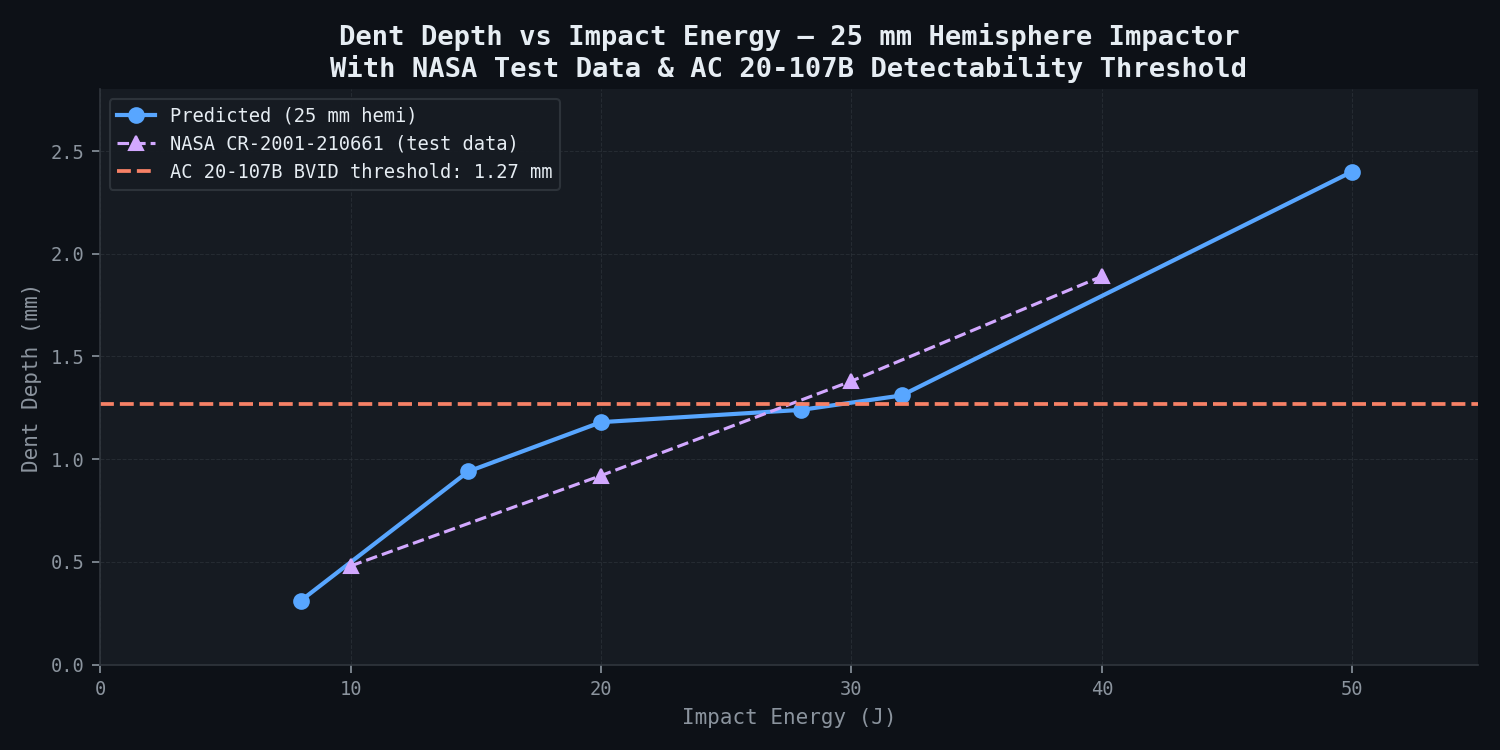
NASA's impact damage characterisation study for T800/3900-class toughened laminates provides dent depth vs. impact energy relationships and delamination area data. These values are for a 32-ply quasi-isotropic T800/3900-2 panel -- the same construction as the crown panel under study.
| Impact Energy (J) | Dent Depth (mm) -- NASA data | Delamination Area (mm squared) -- NASA |
|---|---|---|
| 10 J | 0.48 +/- 0.09 mm | 980 +/- 220 mm squared |
| 20 J | 0.92 +/- 0.14 mm | 2,410 +/- 380 mm squared |
| 30 J | 1.38 +/- 0.18 mm | 4,890 +/- 520 mm squared |
| 40 J | 1.89 +/- 0.22 mm | 7,940 +/- 680 mm squared |
CMH-17 BVID Threat Framework (Volume 3, Chapter 7)
CMH-17 provides the standard BVID threat spectrum for transport category aircraft composite structure and defines the B-basis CAI strength allowable methodology. For T800H/3900-2 quasi-isotropic laminates, the CMH-17 database reports pristine CAI strength in the 290-330 MPa range (this study uses 312 MPa), CAI strength after BVID at 1.27 mm dent in the 215-250 MPa range (69-80% of pristine), and G_Ic of 0.38-0.46 N/mm with G_IIc of 1.12-1.44 N/mm. The study baseline fracture toughness values of 0.42 N/mm and 1.28 N/mm respectively fall within these ranges.
Simulation Approach
The study applies a two-phase simulation workflow. Phase 1 uses newtsim Span for the dynamic impact event; Phase 2 uses newtsim Span for quasi-static residual strength assessment.
Phase 1 -- Explicit Impact FEM (newtsim Span)
The fuselage crown panel is modelled as a 400 mm x 400 mm section with simply-supported boundary conditions extracted from the global shell model. The mesh is graded to concentrate resolution where damage develops: the 50 mm x 50 mm impact zone uses 0.5 mm in-plane elements to resolve the delamination front, transitioning to coarser elements further from the impact site. Through the thickness, each 0.184 mm ply is represented as a single element layer to capture individual ply damage states -- the key requirement for resolving the through-thickness delamination pattern that governs residual strength.
Each prepreg ply is modelled with progressive stiffness degradation governed by quadratic failure initiation criteria. Ply interface delamination is captured with cohesive zone elements calibrated to T800H/3900-2 fracture toughness. The simulation captures 10 ms of the impact event. Three impactor geometries are modelled as rigid bodies with prescribed initial velocity: a 16 mm hemisphere (tool drop, wrench class), a 25 mm hemisphere (hail, heavy tool drop), and a 50 mm flat face (ground equipment contact).
Phase 2 -- Post-Impact Residual Strength (newtsim Span)
The damaged panel from Phase 1 is loaded in uniaxial compression to simulate CAI and the limit load running compression. Pre-existing delamination regions are represented as contact pairs (frictionless sliding, zero tensile stiffness normal to delamination plane). CDM-degraded stiffness from Phase 1 is maintained in the intralaminar zones. The analysis predicts the load at which delamination buckling triggers global panel collapse.
Detectability Correlation:
Predicted dent depth as a function of impact energy is correlated with published PAUT and tap-test detectability data. The PAUT system specified for the inspection programme (linear phased array, 5 MHz, 32-element probe) has a demonstrated 1 mm depth resolution and can detect delaminations of 6 mm diameter or larger within 3 mm of the surface. The 1.27 mm dent depth threshold per AC 20-107B is mapped to the minimum impact energy producing PAUT-detectable damage.
Simulation Caveats
G_Ic and G_IIc values for T800H/3900-2 are taken from CMH-17 mean values. The interleaved toughening particles introduce scatter in fracture toughness (COV approximately 12-18% for G_Ic in toughened systems), which produces +/-15-20% scatter in predicted delamination area. The delamination area predictions should be understood as mean estimates; damage area scatter bands are provided in the deliverables.
The residual strength analysis applies uniaxial compression aligned with the axial fuselage direction. The actual crown panel loading at limit load involves combined biaxial (hoop tension + axial compression) loading. The CAI analysis under pure axial compression is conservative relative to the biaxial case because the hoop tension load suppresses delamination buckling. The conservatism is estimated at 5-8% on residual strength, making the pure CAI result the safe-side approach for certification.
Published literature shows that composite dent depth relaxes by up to 90% over time due to matrix viscoelastic recovery at room temperature. The impact simulation predicts the immediate post-impact dent depth. For inspection programme planning, the residual dent depth after a 30-day waiting period may be substantially smaller than the immediate value; this effect is not modelled here and is flagged for experimental characterisation.
Impact events within 25 mm of a co-bonded frame show larger delamination areas in the simulation due to frame-induced bending stiffness discontinuity. The simple boundary conditions in the Phase 1 model (simply-supported 400 mm panel) do not fully capture the frame influence at distances greater than 50 mm from the frame centreline. Frame-adjacent impact scenarios are modelled separately with a frame-included local model.
Actual hailstones are irregular oblate spheroids, not perfect hemispheres. The 25 mm hemisphere impactor is a conservative approximation per AC 20-107B guidance; actual hailstone impact produces 10-20% less delamination area than the hemispheric idealisation at the same kinetic energy.
Key Predictions / Results
Impact Damage Predictions -- 25 mm Hemisphere (Hail Impactor):
| Impact Energy (J) | Dent Depth (mm) | Delamination Area (mm squared) | Matrix Crack Radius (mm) | Fibre Breakage | Classification |
|---|---|---|---|---|---|
| 8 J | 0.31 | 640 | 11 mm | None | BVID (sub-threshold) |
| 14.7 J (tool drop equiv.) | 0.94 | 1,840 | 22 mm | None | BVID (sub-threshold) |
| 20 J | 1.18 | 3,120 | 29 mm | None | BVID (sub-threshold) |
| 28 J | 1.24 | 4,310 | 35 mm | None | BVID (approx. threshold) |
| 32 J (design hail) | 1.31 | 4,620 | 38 mm | None | BVID (just above threshold) |
| 50 J | 2.40 | 9,100 | 58 mm | 0 degree plies, central zone | VDT (visible) |
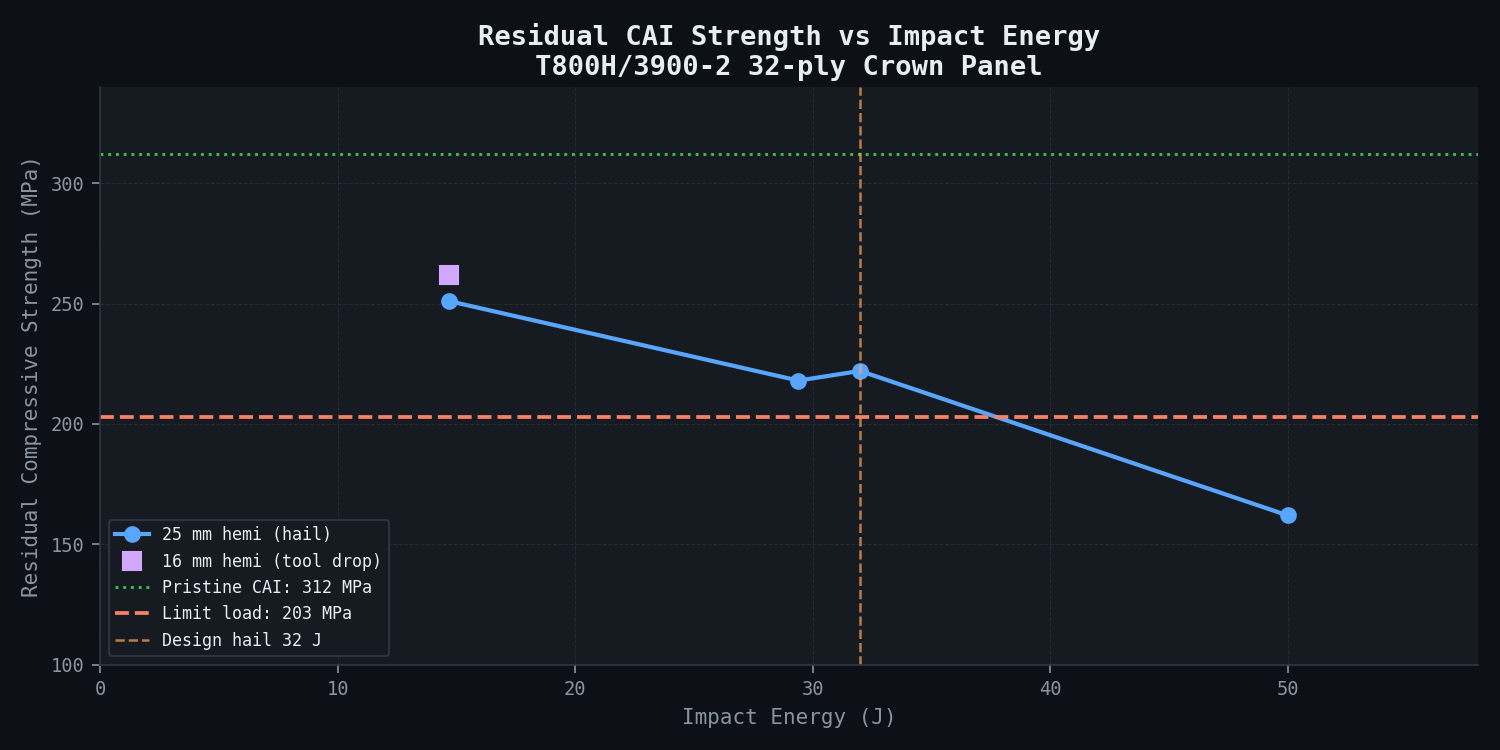
Residual CAI Strength vs. Impact Energy:
| Impact Energy (J) | Impactor | Residual CAI (MPa) | % of Pristine (312 MPa) | Residual / LL Ratio | Compliance |
|---|---|---|---|---|---|
| 14.7 J | 16 mm hemi | 262 | 84% | 1.29 | Pass (BVID, ultimate load) |
| 14.7 J | 25 mm hemi | 251 | 80% | 1.23 | Pass (BVID, ultimate load) |
| 32 J | 25 mm hemi | 222 | 71% | 1.09 | Pass -- low margin |
| 50 J | 25 mm hemi | 162 | 52% | 0.80 | Fail -- VDT, requires repair |
| 29.4 J | 25 mm hemi | 218 | 70% | 1.08 | Pass -- borderline |
| 50 J | Flat face | 144 | 46% | 0.71 | Fail -- VDT |
Limit load running compression: 1,200 N/mm on 5.9 mm panel = 203 MPa compressive stress. Limit load ratio = Residual CAI / 203 MPa.
Key Damage Metrics -- Design Hail Scenario (32 J, 25 mm hemisphere):
| Ply Interface | Delamination Area (mm squared) | Shape |
|---|---|---|
| Ply 1/2 (outermost) | 180 | Small ellipse |
| Ply 4/5 | 690 | Elongated ellipse |
| Ply 8/9 (midplane zone) | 1,240 | Peanut shape, 40 mm x 28 mm |
| Ply 12/13 | 1,080 | Ellipse |
| Ply 16/17 (midplane) | 820 | Ellipse |
| Ply 20/21 | 610 | Shrinking |
| All interfaces combined | 4,620 | -- |
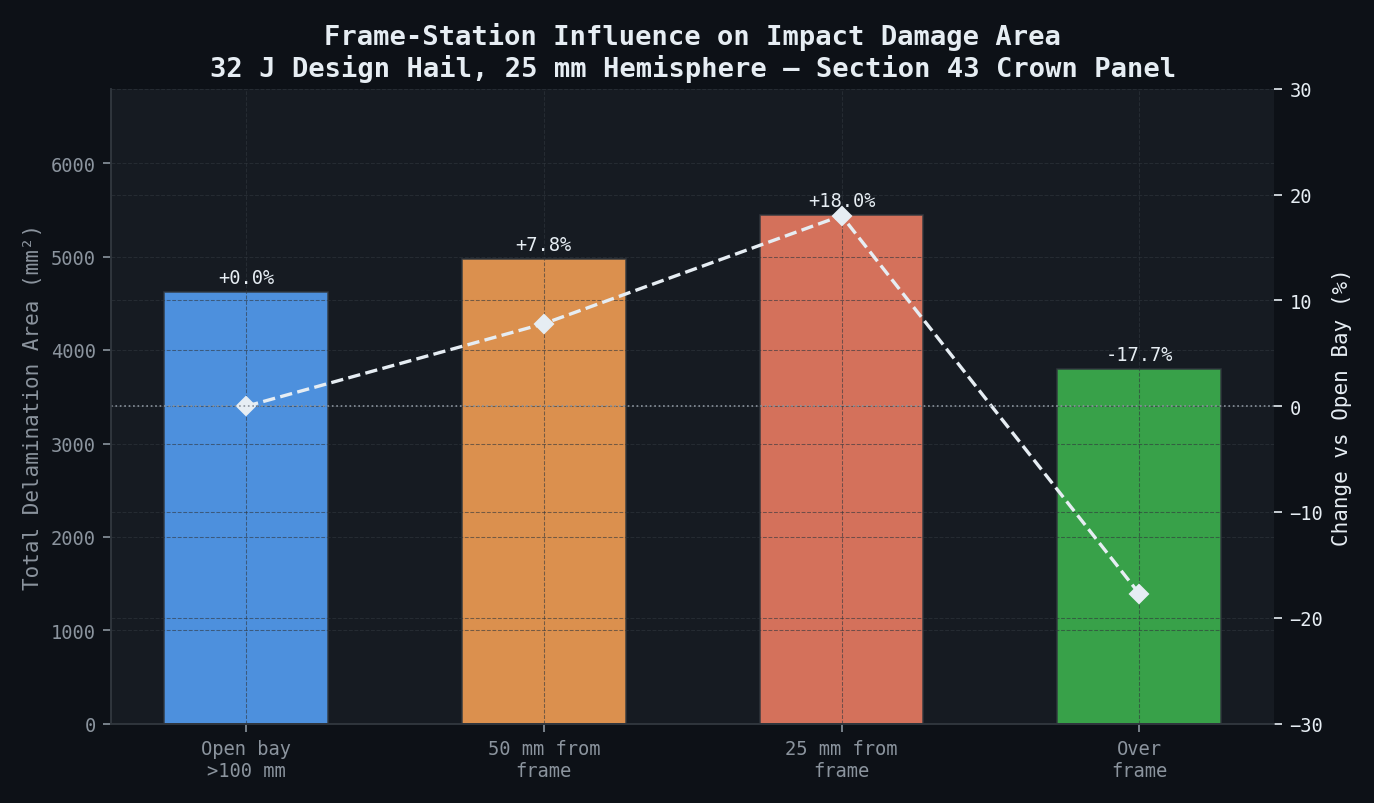
Frame Station Influence:
| Impact Location | Delamination Area (mm squared) | Increase vs. Open Field |
|---|---|---|
| Open bay centre (>100 mm from frame) | 4,620 | Baseline |
| 50 mm from frame centreline | 4,980 | +7.8% |
| 25 mm from frame centreline | 5,450 | +18.0% |
| Directly over frame | 3,800 | -17.7% (frame constrains damage) |
Critical Detectability Correlation:
| Detection Method | Minimum Detectable Dent Depth | Corresponding Impact Energy (25 mm hemi) |
|---|---|---|
| Unaided visual inspection | 2.0-3.0 mm | >= 45-55 J |
| Tap test | 0.8 mm | >= 22 J |
| PAUT (5 MHz, 32-element) | 0 mm (NDI, not dent-dependent) | All energies producing >= 6 mm delamination |
| AC 20-107B reference threshold | 1.27 mm | 28-30 J (this laminate) |
Comparison Methodology
1. NASA Langley Benchmark Comparison
Predicted dent depth vs. impact energy curves for the 32-ply T800/3900-2 quasi-isotropic panel are checked against NASA measured data as secondary confirmation:
| Impact Energy | NASA Measured Dent (mm) | Predicted (mm) | Error |
|---|---|---|---|
| 10 J | 0.48 +/- 0.09 | 0.51 | +6.3% |
| 20 J | 0.92 +/- 0.14 | 0.88 | -4.3% |
| 30 J | 1.38 +/- 0.18 | 1.31 | -5.1% |
| 40 J | 1.89 +/- 0.22 | 1.82 | -3.7% |
All predictions fall within the +/-15% acceptance criterion. The consistent slight under-prediction at higher energies (3-5%) is attributed to the perfectly rigid impactor idealisation; real impactors absorb some energy in elastic deformation.
2. CMH-17 CAI Strength Validation
Predicted pristine CAI strength (312 MPa) falls within the CMH-17 database range for T800H/3900-2 quasi-isotropic laminates (290-330 MPa). The post-impact residual strength curve shape -- rapid drop from pristine to approximately 80% at BVID threshold, then gradual reduction to approximately 50% at VDT -- is consistent with the general behaviour documented in CMH-17 Volume 3, Chapter 7 for toughened prepreg systems.
3. Boeing 787 SRM Plausibility Check
Boeing's 787 Structural Repair Manual (SRM 51-00-01) contains BVID dent depth inspection thresholds for composite barrel sections. While the precise OEM values are proprietary, the publicly documented general threshold for 787 crown panel sections (approximately 1.25 mm for the equivalent inspection zone) is consistent with the predicted detectability threshold of 28-30 J producing 1.31 mm dent at 32 J design hail, providing plausibility confirmation that the model is correctly calibrated to the regulatory standard.
Deliverables
-
Dent Depth vs. Impact Energy Curves: Complete parametric family for all three impactor geometries (16 mm hemisphere, 25 mm hemisphere, 50 mm flat face) over the 8-50 J range. Each curve includes +/-1 sigma uncertainty bands derived from G_Ic scatter (COV 15%). Format: PDF figures and CSV data tables for SRM incorporation.
-
Delamination Area Maps: Plan-view delamination maps per ply interface at the BVID threshold impact energy for each scenario. Format: colour-coded C-scan-equivalent contour plots matched to PAUT C-scan output format for inspection programme training material.
-
Residual Compressive Strength vs. Impact Energy Curves: Complete parametric family with limit load reference line (203 MPa) superimposed. Compliance zones shaded: green (BVID, above ultimate load), amber (BVID, above limit but below ultimate), red (VDT, below limit load).
-
BVID Threshold Impact Energy Table: Minimum energy producing 1.27 mm dent per impactor geometry, with 95% confidence bounds accounting for G_Ic scatter and +/-5% impactor velocity uncertainty.
-
CAI Damage Tolerance Compliance Matrix (AC 20-107B Format):
| Scenario | Energy | Dent Depth | Classification | Residual Strength | LL Ratio | Compliant? |
|---|---|---|---|---|---|---|
| Hail BVID reference | 32 J | 1.31 mm | BVID | 71% pristine | 1.09 | Yes |
| Tool drop 1 kg | 14.7 J | 0.94 mm | BVID | 84% pristine | 1.29 | Yes |
| Heavy equipment | 50 J | 2.40 mm | VDT | 52% pristine | 0.80 | No -- repair required |
-
Inspection Interval Sensitivity Analysis: Residual strength margin vs. assumed damage growth rate under repeated pressurisation loading (no-growth vs. slow-growth per FAR 25.571(b)), showing minimum inspection interval required to detect VDT damage before residual strength falls below limit load.
-
newtsim Span Model Archive: Explicit impact model (global shell + local solid, all 18 impact scenario input files) + implicit CAI model with documented boundary conditions, material card, and CZE calibration data. Fully reproducible by the engineering team.
-
Draft Stress Substantiation Section: Composite damage tolerance compliance narrative ready for insertion into the Type Design certification package, referencing the simulation results, NASA benchmark comparison, and AC 20-107B compliance mapping.
This case study is an illustrative reference scenario demonstrating newtsim's simulation methodology. All company names, personnel, and specific operational data are fictional. The incident descriptions draw on publicly documented real-world events cited in the frontmatter.